The Radical Left, war and self-defense

The Radical Left, war and self-defense

Cedric Domenjoud

by Cedric Domenjoud | Apr 25, 2026

This article examines war and the stance on war taken by European radical left and anti-authoritarian circles (RLAA), as well as by some decolonial and indigenist movements (DI). The author subscribes to an anti-authoritarian and internationalist perspective that prioritizes popular self-defense and struggles for self-determination over the often-detached theoretical assumptions of a middle class radicalized by capitalist violence, yet one that typically lacks any empirical understanding of war and its implications.

Introductory note: Behind the acronym RLAA, which I have chosen to employ, lies a complex and multifaceted reality, comprising numerous movements whose political radicalism varies greatly. It ranges from the left wing of institutional social-democratic and socialist parties to the far left, and even beyond the traditional political spectrum modeled on political representation within conventional parliamentary assemblies. It therefore includes anti-parliamentary and anarchist movements that situate their thinking and action outside of party politics and issues of representation. It should also be noted that this analysis focuses primarily on European movements, excluding those in the Balkans, the Caucasus, and more generally the former USSR, unless otherwise specified in the text.

The Cold Wars of the Radical Left

Since the late 19th century, heated debates have divided the European RLAA whenever a war breaks out within 1,200 km of its home territory. This was particularly true during World War I and World War II, but much less so during the Balkan and Chechen wars of the 1990s. It would appear that the RLAA no longer viewed those wars as anti-colonial struggles, and that the collapse of the USSR a few months earlier had suddenly deprived the peoples fighting for self-determination of the support of the internationalist left. Furthermore, it would appear that the RLAA’s ideological framework failed to keep pace with the times, leaving it unable to grasp the religious and sectarian dimensions mobilized since the mid-1980s by armed groups fighting against white and Western colonial domination. In particular, the RLAA does not seem to have been able to analyze the emergence of Islamist radicalism as the combined result of the failure of socialism and the success of counterinsurgency on a global scale. Consequently, we have seen the RLAA gradually sink into political confusion and campism, supporting here and there ultra-reactionary and authoritarian states and movements under the pretext of anti-imperialism. It should be noted that imperialism is generally viewed by the RLAA—entangled in the binary analytical framework inherited from the Cold War—as unilateral and embodied exclusively by the United States and its “lackeys” (Israel, NATO members, etc.). This development occurred in parallel with the emergence of decolonial movements—intellectual rather than militant—led by a radical left with immigrant roots and influenced by both U.S. academic circles and postcolonial humanitarianism, which I refer to as “NGO-ism.” In France, these groups add to their analytical framework the specific ideological contradictions faced by the descendants of colonized Algerians—caught between nostalgia and fascination for the Algerian independentist National Liberation Front (FLN) from the era when Algiers was still the “Mecca of Revolutionaries” (1960–1970)—and entangled in the identity conflicts characteristic of postcolonial immigration. Their ideology lies at the intersection of interventionist leftism and what some people may call "Islamic socialism".

Before delving further into the issue of war, it is worth noting that over the past three decades, the RLAA has undergone a significant transformation. Even beyond the issue of war, it has become notably divided on decolonial issues, on issues of race and gender, as well as on the appropriate stance to adopt toward religion in general and Islam in particular. Without reducing anyone to their political affiliation, we can nevertheless identify the major current trends as follows:

- The radical left, which emerged from the traditional socialist and communist parties, as well as from the New Left and the Revolutionary Left, has largely become more liberal and now forms a more cohesive bloc within the establishment left—which is traditionally interventionist, secular, and aligned with campism;

- Antifascist circles—generally the heirs of the workerist and Maoist left—have split between a more institutional tendency close to the interventionist left on the one hand, and decolonial and indigenist networks on the other, both of which have a fairly limited interest in gender issues—and particularly LGBT issues—and a vision of internationalism that is notably campist. While the former tendency may adopt secular positions, the latter, on the contrary, displays a certain animosity toward secularism, perceived solely as a smokescreen for Islamophobia;

- A significant portion of anarchist circles has chosen to abandon criticism of religion and adopt a form of neutrality toward political Islam, while throwing themselves wholeheartedly into controversies surrounding race and gender identities, as well as issues related to speciesism, psychophobia, and ableism. When it comes to international and decolonial issues, these circles are often out of touch or fundamentally insurrectionist, meaning that they support—and romanticize—any popular uprising without necessarily understanding the stakes involved ; The other faction of the Anarchists, now a minority, has partially embraced issues related to gender, but has remained conservative on matters of race and religion, and more broadly on decolonial issues, where its positions are most often campist and ideologically pacifist, as they are rooted in a bygone revolutionary past, when their movements—and the society in which they thrived—were almost exclusively white;

- Finally, a last fringe of the extra-parliamentary radical left, which I would describe as autonomous and internationalist, emerging from a fusion of anarchism, libertarian communism, situationism and maoist spontaneism, seems to be the only one to truly reject campism and all kinds of colonialism, embracing issues of race and gender, while including (as much as possible) non-European non-marxist left-wing or anarchist activists in its movements;

Let us first review some of the most significant armed conflicts of the past half-century before delving into a theoretical examination of war in general, and community self-defense in particular.

Lebanon and Syria, 1980s

Context: Following the outbreak of the Lebanese civil war between Christian conservatives and the Palestinian-aligned Lebanese left in 1975, the Syrian army entered Lebanon the following year to support the Christian Phalangists and limit the presence of Palestinian fighters from the PLO. The Syrian dictator Hafez al-Assad made no secret of his support for the imperialist concept of “Greater Syria,” which would unite Syria, Lebanon, and Palestine. The Syrian occupation of Lebanon lasted from 1976 to 2005.

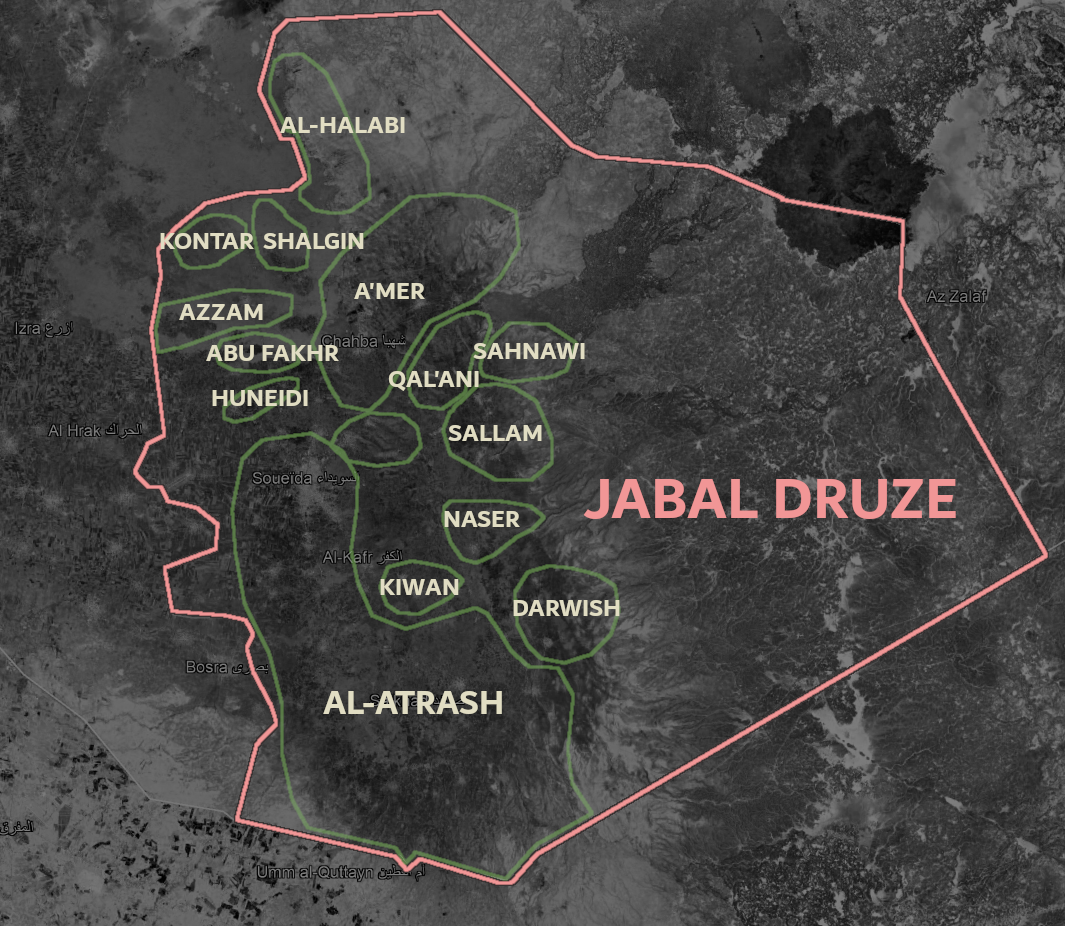
It is important to note that the Islamist movements Islamic Jihad, Hezbollah, and Hamas emerged between 1982 and 1988 following the end of the armed resistance of the Palestine Liberation Organization (PLO), which had by then been politically weakened and expelled from the Levant. Prior to this period, the struggle against Israeli colonialism—the bridgehead of Western imperialism in the Levant—was almost exclusively embodied by the radical left-wing movements united within the PLO and behind Yasser Arafat, which had themselves been supported by the USSR since 1970. For the European RLAA, the framework for understanding the situation was much simpler at the time, as it was shaped by the binary US versus USSR narrative and promoted worldwide by thousands of revolutionary armed groups supported by or affiliated, directly or indirectly, with socialist Russia. The latter, moreover, was already well-established militarily in Syria, where since the 1960s it had been a privileged partner of the regime embodied by the Arab Socialist Ba’ath Party under Salah Jadid and later Hafez al-Assad. Yet it was the regime of Hafez al-Assad—which must be regarded as a fully-fledged model of Arab National Socialism, and thus of fascism—that ultimately destroyed the PLO before allowing the Islamic Republic of Iran to divert the resistance against Israel from its original goal: the decolonization of Palestine. Let us recall that the two objectives of Hezbollah—which is nothing more than an offshoot of the Iran’s Islamic Revolutionary Guard Corps—are “resistance against Israeli occupation in Lebanon and the establishment of an Islamic state.” This is therefore a far cry from the PLO’s program. The alliance between Syria and Iran, set in stone as early as 1982 to defeat their shared enemies in Lebanon and Iraq, has since served as the cornerstone of a system of political terror that gave rise to the first - Shia - Islamist suicide bombings in modern history and, exactly thirty years later, would enable Assad’s son to crush the progressive Syrian popular uprising of 2011. This alliance is perfectly embodied by the partnership between Hezbollah and the Syrian Social Nationalist Party, a far-right Syrian militia that views Palestine as the “occupied south of Greater Syria” and whose 16-year-old member, Sana’a Mehaidli, is considered the first woman to have carried out a suicide bombing (in 1985). Despite this, the RLAA—joined by the Decolonialists and Indigenists (DI) starting in the 2010s—has never ceased to view the Assad regime and the Iranian Islamist militias—among which Hamas must be included, as it would not exist without Syria and Iran—as “the axis of resistance” to Western imperialism. This demonstrates that the RLAA and the DI have never understood that this so-called “axis of resistance” politically neutralized the PLO after orchestrating the massacre of Palestinian refugees in the Tel al-Zaatar camp (1976) and the assassination of revolutionary activists close to the PLO, such as the Druze socialist Kamal Jumblatt (1977), before allowing Israel to continually justify the genocide of the Palestinians under the guise of the “war on terror.” The struggle for the self-determination of the Palestinian people—an eminently leftist cause—has in fact been indefinitely compromised by Syrian-Iranian fascism and terror.

Chechnya, 1990s

Context: At the dawn of the 1990s, the Russian Empire refused to be completely dismantled by denying the right to self-determination to the peoples of the Caucasus. In 1991, Chechen independence leader Dzhokhar Dudaev was elected the first president of the Chechen Republic of Ichkeria, which he immediately declared independent, prompting a military response from the Kremlin. After the failure of an initial airdrop operation in 1991, Russian President Boris Yeltsin launched a full-scale war in 1994.

Still reeling from the collapse of the USSR, the RLAA had not mobilized to take up the cause of the Chechen separatists. Yet the latter—particularly due to their anti-imperialist nature—had many traits in common with the Irish separatists of the Irish Republican Army (IRA) or the Basque separatists of the Euskadi Ta Askatasuna (ETA), for whom the RLAA had shown far greater revolutionary enthusiasm over the past two decades. In the first two years of the Chechen war, there was indeed fertile ground for an international anti-imperialist mobilization, especially given how the Russian economic system of the time embodied capitalist plunder in its most aggressive and deregulated form. The slightest opportunity to inflict a defeat on it should have been seized by leftist forces, especially given that one of Russia’s main pipelines—cynically named “Friendship” (Druzhba)—was already crossing the region to supply Europe with oil. Unfortunately, as early as 1995, international indifference—with the exception of human rights NGOs, which cannot be considered political organizations—turned a blind eye to the rapid spread of Wahhabi ideology, which, under the leadership of the nine Chechen salafist Akhmadov brothers and the Saudi jihadist Ibn al-Khattab, very quickly crushed the Chechen independence movement. As mentioned above, the RLAA flatly refused then—and still refuses thirty years later—to view Russia as an empire with expansionist (colonialist) ambitions. Furthermore, it also refuses to see Russia as part of globalized capitalism, even though Russian president Boris Yeltsin had aggressively liberalized the Russian economy as early as the year following the dissolution of the USSR, and his successor Vladimir Putin has fully aligned his policies with the imperialist logic of the market economy, starting from the moment he took power in 1999.

It is worth noting, incidentally, that the elimination of progressive forces from within the Chechen independence movement through the importation of Salafist militants—which must be viewed for what it is: a far-right movement—already bore a strong resemblance to the counterinsurgency tactics that would be replicated many times over in various regions of the globe in the decades that followed. Created and/or exploited by colonial powers, this ideological and religious radicalization offers nothing but advantages to empires seeking a free hand to crush a region over which they wish to gain or maintain control. It effectively allows counterinsurgency to be disguised as counterterrorism, thereby gaining legitimacy: it is no longer a matter of crushing a popular uprising, but of eliminating “dangerous lunatics” allied with “barbaric zealots.”

During the second Russian offensive against the people of Chechnya in 1999—this time orchestrated by Putin to legitimize his seizure of power under the guise of the very same “war on terror”—once again, the RLAA did not appear to be radically opposed to Russian imperialism. As noted above, I do not include in this critic the RLAA of countries directly affected by Putin’s totalitarianism, including the Russian left itself. Unfortunately, the Russian RLAA’s support for the Chechen rebels—which only emerged in the 2000s, by which time most of their remnants had become religiously radicalized—was not necessarily much more relevant from an anti-authoritarian perspective: some of Russia’s anti-fascists, for example—in a dynamic that was, unfortunately, more confused than truly political—expressed their support for the Chechen guerrillas by posing in photos with their fingers raised toward the sky, as the mujahideen usually do. It is worth noting that this can be seen as a foretaste of what would become commonplace twenty years later with the support of a significant portion of the RLAA for reactionary and Islamist movements in the Levant. We will return to this later. In any case, criticism of Russian authoritarian rule still did not seem to have taken root in the European left’s consciousness, while decolonial thought was still finding its feet on this side of the Atlantic.

That was thirty years ago. One might think that a lot has happened since then, and that it took time to understand what a society under Putin’s rule might look like. So let’s fast-forward a bit to see if something changed.

Ukraine, 2014

Context: In November 2013, a mass popular movement emerged in Ukraine to oppose the corruption of Viktor Yanukovych’s pro-Russian government, as well as his decision to postpone the association agreement between Ukraine and the European Union in favor of a trade agreement with Russia. The occupation of Independence Square in Kyiv (Euromaidan) by protesters continued until February 22, 2014, and ended in a violent confrontation in which 120 people were killed. Yanukovych was forced to resign, while Russia, which had been backing the formation of armed separatist groups in the east of the country, launched a military intervention in the wake of what Putin had called a "coup d’état".

When, in 2014, Russia decided to annex Crimea and then part of the Donbas—a clear act of aggression—we didn’t see many impassioned texts from the European RLAA denouncing its distinctly colonial nature. We do not recall, for example, that anti-authoritarian and now also decolonial activists—the concept of decolonialism having finally crossed the ocean alongside Critical Race Theory and identity politics—took up the cause of the Tatars, Ukrainians, Belarusians, Armenians, Jews, and Karaites—even though these groups constitute minorities whose forced assimilation into the Russian ethnic majority was by no means a foregone conclusion. It is also clear that most of those who have been voicing strong opinions on the war in Ukraine since 2022 are not even aware of this ethnocultural diversity or of the potential for it to serve as fertile ground for indigenous struggles for self-determination. At most, some within the RLAA movements were dazzled by the Maïdan uprising that preceded the invasion of Crimea by Putin’s little green men, as it ticked all the boxes of the insurrectionary and revolutionary imagination while serving as a genuine laboratory for mass popular self-organization. Alas, very quickly, the patriotic takeover of the insurrectionary movement on the one hand and Russia’s declaration of war on the other put an end to the RLAA’s spell. A few well-orchestrated media campaigns were enough to give credence to Putin’s propaganda regarding the supposed fascisation of Ukrainian society: thanks to the Russian propaganda media Russia Today—among others—the “Tsar of All Russia” was portrayed almost as a left-wing, anti-fascist, and anti-imperialist leader, while the entire Ukrainian people were equated with the nationalists of the Pravyï Sektor and Svoboda parties or the Azov paramilitary unit, which together, however, represent little more than 30,000 members and 892 elected officials out of the 43,122 that Ukraine had in 2020—or 2.07% of the votes cast in regional elections. That is to say, ten to fifteen times fewer than the far-right parties in Europe. The European RLAA, as confused and disoriented as ever, thus once again succumbed to the pathological campism that has defined it since the Cold War. Since his grand entrance on the red carpet at the Saint Andrew’s Hall in the Kremlin in 1999, Putin has always enjoyed the indulgence of both the left and the right. Not that opposition from the European radical left is a decisive factor in curbing the expansionism of empires, but there was nevertheless a time when it was better able to identify—and support—popular liberation struggles and anti-imperialist guerrilla movements. So to speak: at least in the past, the left’s campism benefited popular left-wing or progressive and liberating movements rather than right-wing oppressive tyrants.

Syria, 2015

Context: In power since 1970, the Assad clan had ruled the country with an iron fist for 40 years when the Syrian people, weary of the permanent state of emergency and the lack of freedom, rose up in February 2011. The uprising unfolded in three phases: the first (February–March) primarily called for the lifting of the state of emergency, the release of prisoners, and political reforms (demands for justice); the second (March–June) saw massive demands for the regime’s downfall and a democratic transition; the third (following the Jisr ash-Shugur massacre on June 12), which led to the creation of the Free Syrian Army and the formation of islamist armed groups, definitively transformed the democratic revolution into a civil war. 

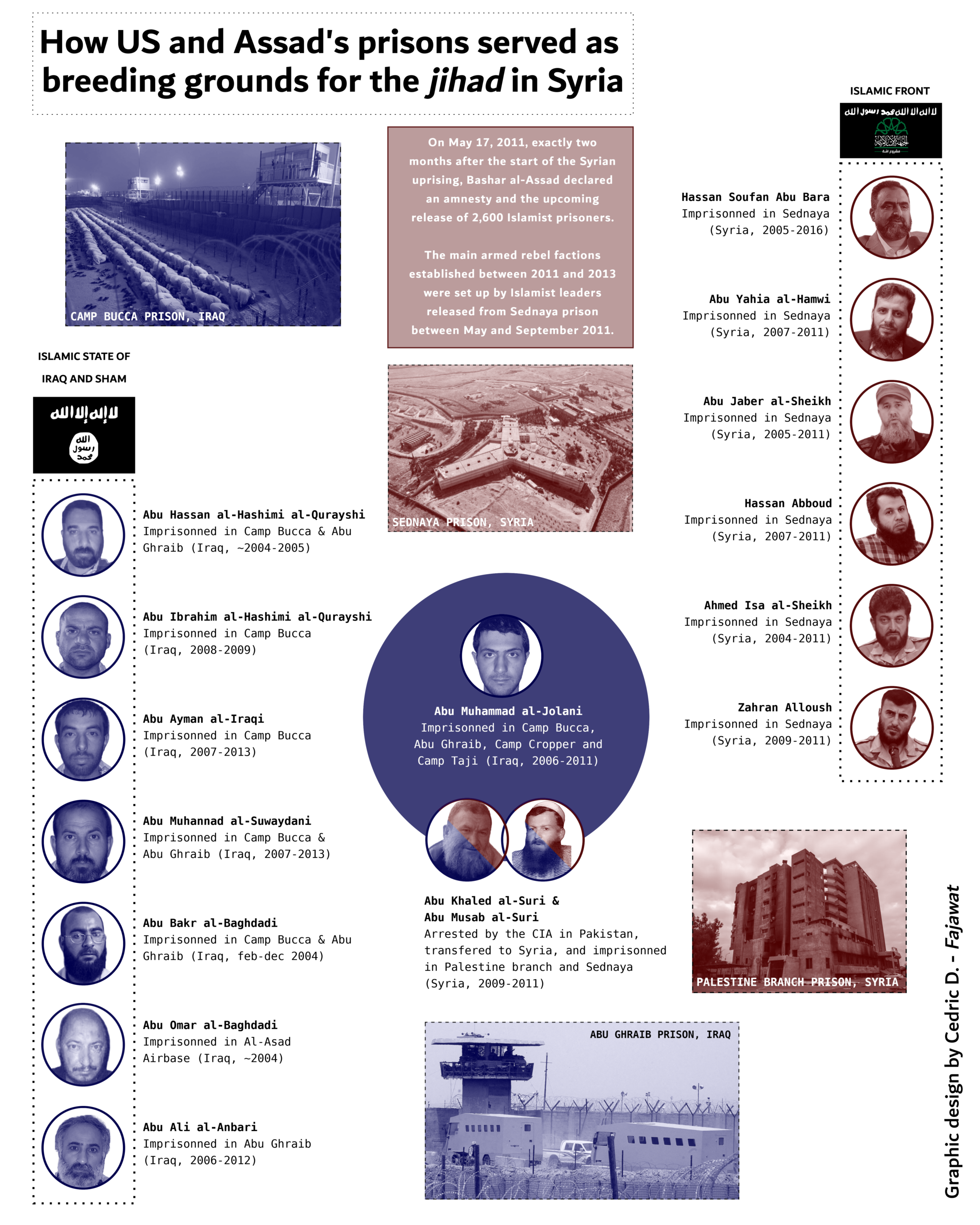
When the Syrian National Socialist regime received military support from Iran and Hezbollah (2011) and then from Russia (2015) to crush the Syrian people’s resistance, the RLAA and the DI either said nothing or applauded this alliance against “Western imperialism,” which was accused of being solely responsible for the Islamization of the rebellion and the rapid expansion of the Islamic State. Once again, this binary assessment chose to ignore or deny what all analysts had clearly understood as early as May 2011, when Assad released thousands of Islamists from his prisons: that the major powers (Syria, USA, UK, Jordan, Qatar, Turkey, Saudi Arabia, Israel…) had all funded, trained and/or manipulated the Salafists, participating in crushing the Syrian progressive resistance—including that of the Palestinian Yarmouk camp in Damascus—from within. The proof is that we saw Russia and the United States divide up the Syrian skies under the pretext of “fighting terrorism” as early as 2015, then Russia and Israel agreed to have the Russian military police participate in the “disarmament” of southern Syria in 2018, and finally, Russia and Turkey coordinated to establish a cordon sanitaire around the Islamists in the Idlib enclave after 2020. And finally, 2015 was the year in which the Kurdish Democratic Union Party (PYD) of northeastern Syria declared the region’s autonomy while creating a US-backed armed force—the Syrian Democratic Forces (SDF)—under the pretext of “fighting terrorism.” We then witnessed a subtle American soft power maneuver concealed behind a hard power operation: the Kurdish socialist movement renounced its role as the embodiment of Syrian revolutionary aspirations against the Assad regime in order to redirect its military resources against the product of American imperialism in Afghanistan and Iraq—Al-Qaeda and its avatar, the Islamic State. This compromise is particularly sad given that the very first act of the Syrian uprising against Assad in 2011 took place in the Kurdish stronghold of Hasakeh. It should be noted that that this refusal to become further embroiled in the civil war and the acceptance of a compromise with Western imperialism was motivated primarily by the need for all communities in northeastern Syria to survive in the face of a genocidal enemy that was then nearly unstoppable.

The RLAA has largely failed to grasp the stakes of the Syrian civil war and has generally contented itself with viewing the 2011 uprising as a plot by Western imperialism against the “axis of resistance,” while remaining divided on the issue of the Kurdish autonomist movement. This did not prevent certain left-wing campists—in their utter confusion—from supporting both the socialist PYD and islamist Hezbollah, while justifying Russian airstrikes in Syria under the pretext of fighting "western-backed islamic fascism" (sic). Unlike the RLAA, the far right has never been mistaken in identifying its friends and allies: the regimes of Putin and Bashar al-Assad are among them. Moreover, neither of them has ever made a secret of the fact that they support the European far right, particularly the French one. We are familiar with the ties between Putin and the National Front fascist party, but we know much less about the ties established by the same party with the Assad regime since the mid-1990s. At the time, the man who would become the National Front’s secret financier, Frédéric Châtillon, had in fact begun to forge lasting ties with Syrian Defense Minister Mustafa Tlass, known in particular for orchestrating the massacre of 20,000 to 40,000 people in Hama in 1982. This mass crime, committed under the pretext of quelling the long-standing and violent Muslim Brotherhood insurgency, constitutes a profound trauma in the Syrian collective consciousness and largely explains the massive popular support among the city’s residents for the Islamist rebels who seized power in Damascus in 2024. It is worth noting in passing that Mustafa Tlass, who is ideologically aligned with the Syrian Social Nationalist Party mentioned above, regards Jordan as “Southern Syria.” Given that nearly half of Jordan’s population is of Palestinian origin, this speaks volumes about the colonialist mindset that pervades the Assad clan’s supporters. It should also be noted that the Groupe Union Défense (GUD)—one of the most violent French fascist splinter groups—founded by the same Frédéric Châtillon mentioned just above, has never ceased—out of pure anti-Semitism—to claim support for the Palestinian cause, while denying to Palestinians any political freedom outside of Palestine. Just like Assad and Hezbollah.

In any case, by continually denying the counterinsurgency violence of the Syrian regime, as well as that of the Russian and Iranian regimes, the Radical Left and the DI—here I do not include most anarchists and anti-authoritarians—have thus objectively placed themselves on the same side as the far right they claim to fight.

Ukraine, 2022

When Putin finally relaunched the invasion of Ukraine in March 2022—which, let us recall, was not the start of the war, since it had begun eight years earlier—it suddenly became more difficult for the RLAA to deny the colonial and authoritarian nature of Russia’s actions. It is also telling that this military aggression mobilized more than 12,000 Chechen mercenaries loyal to Putin’s lackey Ramzan Kadyrov—within the Ahkmat units—while Ukraine, for its part, is recruiting numerous foreign volunteers—and mercenaries—motivated by their desire to settle scores with Russian imperialism. Among the latter, there are also a number of Chechens, serving notably in the Sheikh Mansour, Dzhokhar Dudayev, and Khamzat Gelayev units, including fighters from Ajnad al-Kavkaz, a battalion of Chechen jihadists known for its involvement in numerous war crimes in Syria. On both sides, there are also Syrian Arabs as well as Arab and Black Africans—some serving as volunteers or mercenaries, others as forced recruits (particularly on the Russian side). What this “internationalism” reveals is precisely the imperialist continuum that leads colonial wars to systematically remobilize the ghosts and survivors of previous conflicts: one need only distinguish which side is mobilizing yesterday’s victims and which is mobilizing the former perpetrators to estimate, with little risk of error, which is the victim and which is the aggressor. It should be noted, however, that this rule is not mathematical, for one thing, and that the victims and colonized are not necessarily good people, for another. In any case, it shows a great deal of bad faith to claim that in Ukraine, Russia is not in the position of aggressor, as it was in Chechnya and Syria. Islamist extremism, for its part, is merely one of the consequences of these interventions, not the cause; this is something many people in the West still struggle to understand. It should also be noted that one of the very first jihadist uprisings—the Afghan mujahideen affiliated with the Hezb-i-Islami party—was the result of the colonial war waged by Russia in Afghanistan between 1979 and 1989, before its American counterpart enabled it to spread throughout the rest of the world: Jihadists have always been both the product and the useful idiots of imperialism. It is also worth pointing out that, following the collapse of socialism, jihadism is the political and religious movement that has benefited most from globalization.

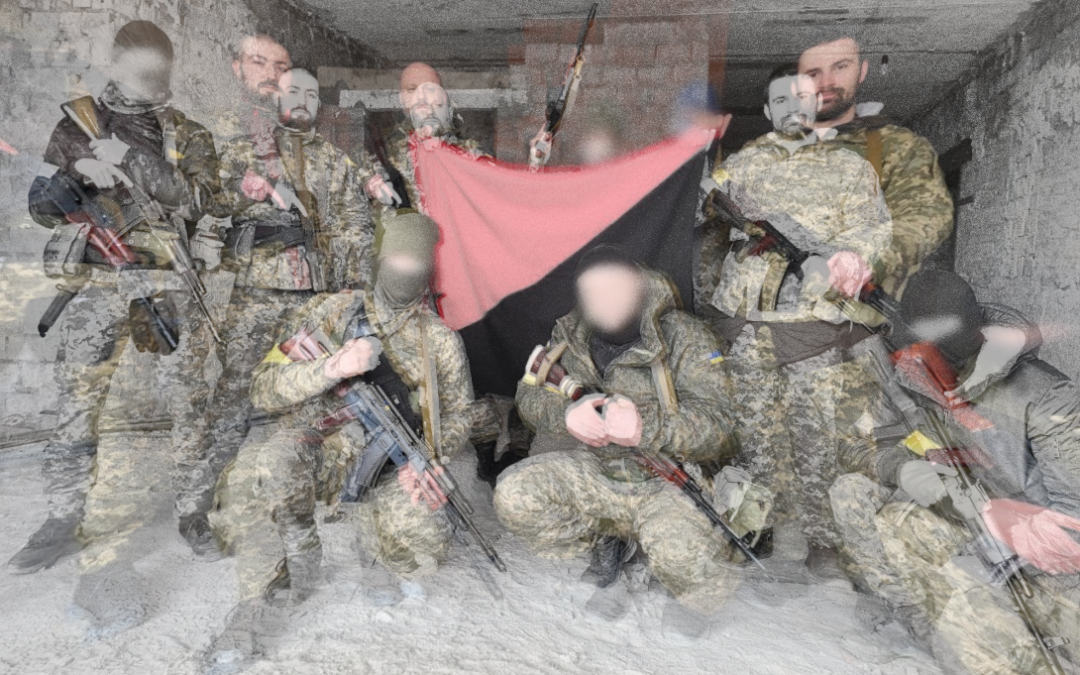
My focus here is on the fact that the war in Ukraine has drawn thousands of foreign fighters from regions affected by Russian imperialism. Beyond that, it has sparked widespread mobilization among those who oppose colonialism and stand in solidarity with colonized peoples. Thus, it mobilized both domestic and foreign RLAA networks more than any other conflict in the past three decades. Indeed, many left-wing political activists are being recruited into the Ukrainian army, volunteering, or are helping to assist and support both civilians and combatants on the front lines. The indigenous RLAA organization we hear most about is Solidarity Collectives (SolCol), a Kyiv-based initiative that has been coordinating solidarity efforts at the local and international levels since the start of the conflict. Their decision to fully participate in Ukraine’s community-based self-defense—given their reality and their genuine lack of choice as indigenous people directly threatened by Russian occupation and colonization—is politically courageous in a context where war abolishes all political freedom and suspends democratic rights. Furthermore, their choice to maintain a critical stance toward the established order and not to limit themselves to humanitarian action out of a concern for neutrality stems from a collective strength made possible by the effective support they have received from their Ukrainian, Belarusian, and Russian comrades exiled in Europe. This unwavering solidarity stands in contrast to the repeated attacks from several factions of the RLAA in Europe, which, in addition to producing wordy texts to cast discredit on SolCol's actions, have gone so far as to ban the collective from supposedly internationalist gatherings and events. The collective is thus prevented from explaining its position and from even having the opportunity to convince others of the righteousness of its actions. What is striking about this resort to the practice of “calling out” for political reasons is that it follows the same logic as counterterrorism, nullifying conflict and debate by ostracizing individuals or collectives and labeling them as internal enemies or aggressors from whom the community must be protected. But protected from what? From its own empathy? What this reveals is the inability of a large part of the contemporary RLAA to confront political contradictions and to engage in a conflict that might force it out of its comfort zone. It should be noted, by the way, that Ukrainian men of fighting age are prohibited from leaving Ukrainian territory, so SolCol’s sidelining from European political forums applies particularly to women, who already suffer from being colonized among the colonized. All this for what? Because SolCol does not judge or condemn its comrades sent to the front as traitors to their cause, and worse, provides them with equipment that slightly increases their chances of survival. The RLAA would prefer that all Ukrainian men hide in the forests of Transcarpathia while women bring them provisions at nightfall and their loved ones are crushed under bombs at home. What a lovely imagery of the maquis. In any case, the RLAA seems to have absolutely no idea what it means when your home region is struck by 600 suicide drones a day. Suffice it to say that in this situation, you don’t exactly have the luxury of writing texts questioning SolCol’s alleged complicity with NATO. I’ll stop my cynicism there.

There is no need to multiply the examples to assert that the European RLAA circles systematically miss the mark when it comes to supporting indigenous communities fighting for their independence or autonomy, or simply for their survival, especially if their struggle does not strictly adhere to the codes of 20th-century Marxist or post-Marxist guerrilla warfare—let alone anti-authoritarianism. Worse still, this left has consistently offered Putin the same kind of excuses that have allowed authoritarian and reactionary leaders such as Ali Khamenei, Hugo Chávez, Bashar al-Assad, Hassan Nasrallah, Ismail Haniyeh, or more recently Ibrahim Traoré—as well as other despots before them—to pass themselves off as champions of anti-imperialism under the pretext that they openly declare themselves enemies of the United States and Zionism. It should be noted here that this syllogistic thinking—the enemies of my enemies are my friends—is one aspect of what is known as campism. This line of reasoning is neither left-wing nor right-wing; it is either red-brown or simply politically confused.

War: A Definition

I promised to discuss war and community self-defense after providing an overview of the war zones that generally interest the European RLAA, so here we are.

As the saying goes, “war is the continuation of politics by other means.” This definition could not be more accurate, for it captures the complete inability of nation-states to resolve social conflicts through mediation and public consultation. War is the armed violence that emerges when dialogue has been rendered impossible. It therefore goes beyond conflict itself; rather, it is the negation or abolition of conflict by those who know no other way to communicate than through violence. It should be noted that this rarely begins with the targeted killing of a political leader, but rather with the opening of fire on civilians or military personnel who hold no decision-making authority. And this declaration of war is often accompanied by a sudden, even unexpected, movement of troops across a demarcation line separating two territories in conflict or against a population refusing to be oppressed. Thus, an occupation by force. If the military operation targets a foreign territory, it is a war. If it targets an indigenous population, it is either a massacre or counterinsurgency, with the massacre potentially accompanying counterinsurgency. If the targeted population resists with arms, it is self-defense or resistance. And if this resistance becomes organized over time and militarizes, it turns into a civil war. Finally, if the rebel groups thus formed depend on human or material support from a foreign state, they become proxies or mercenaries, and their struggle loses its legitimacy. If, on the other hand, they receive support from foreign non-military volunteers, it remains an act of international solidarity, even if the motivations and analyses of these foreign fighters are confused or mistaken.

If the question now is to distinguish between an act of aggression and a defensive response, there is certainly no need for lengthy deliberation to determine whether or not a state’s regular army has intervened on its own initiative on the territory of another state or against an indigenous community on its own territory. This is then a war of aggression. If, on the other hand, this army intervened to protect a community that is seriously threatened by armed groups or by the regular army of its country of residence and at its request—and thus not on its own initiative—then it is difficult to speak of aggression, but we can speak of interference. Finally, if the regular army of a state defends its territory against the intervention of another state’s army—and without invading the territory of that state in question—then this constitutes a response that can be considered legitimate. The question is not about who is right or wrong, or about distinguishing the good from the bad, because no war is just; rather, it is simply a matter of establishing who is the aggressor and who is the victim. And it is certainly not a matter of determining whether the victim provoked the aggressor, as that would lend credence to the aggressor’s rhetoric. Finally, armed intervention cannot be justified merely on the grounds of having been “provoked” if that “provocation” does not take the form of a prior act of violent armed aggression. The Ukrainian case helps illustrate this point: the Maidan uprising against Ukraine’s pro-Russian elites, or even the desire for separatism among ethnic Russians in eastern Ukraine, are in no way legitimate grounds for justifying Russian military intervention in Ukraine. If these communities had been the targets of ethnic violence directed against them by other communities in Ukraine or by the Ukrainian state, the question would be framed differently. But that is not the case.

In any case, from RLAA’s perspective— which has a pacifist and anti-militarist ethos—it is always necessary to condemn war regardless of its motivations. On the other hand, it seems entirely inappropriate to pass judgment on the acts of self-defense by populations directly impacted by these wars, particularly if the territory where they live has been the target of external aggression. One may despise Nations and Borders, but that does not change the fact that the peoples they enclose are bound to their territory by ties of interdependence that transcend the mere question of the nation-state.

Participation in the war effort or community self-defense?

Once we have agreed on this fairly basic definition of war, we can address the issues of community self-defense and self-determination, as well as pacifism. The examples from Ukraine and Syria detailed above will help illustrate my point. Both peoples are united by the similar fate they have endured: first, because they rose up in the early 2010s against the corruption and totalitarianism of the political system that had governed their daily lives for decades; and second, because the social conflict was quashed by the launch of military operations in which they were the primary targets. Suddenly, Ukrainians and Syrians woke up one morning to bombardment followed by the armed invasion of civilian residential areas. Finally, both people were killed through the use of Russian military forces, with Russia intervening exclusively to defend its geostrategic and economic interests. At this stage, the analysis is simple from the perspective of the targeted populations: their community is being targeted, their world risks being wiped off the map, and everything that makes up their lives can be destroyed overnight, just because one or another Empire benefits from it. This is an “imminent danger of death,” and the very notions of choice or consent are immediately nullified by the use of force.

It is at this very moment that the theoretical positions of the RLAA—from which we must exclude part of the anarchists and libertarian communists—become extremely problematic, because they are generally unable of taking into account the lack of choice and the state of necessity faced by the communities concerned, which alone then guide popular self-defense. Whatever one may think of war or weapons is relegated to the shelf of relics, which one can retrieve and polish as much as wished once the war is over. All well-meaning concepts of pacifism cease to have any place the very moment conflict has been abolished and replaced by a state of war. Since the outbreak of war in Ukraine, an army of campist and pacifist ideologues—often from the white middle class of Western Europe—has thus declared war on the indigenous people of Ukraine who have taken up arms against the Russian occupier, accusing them of being militarists and accomplices of imperialism, or even fascism. Beyond the outrageous nature of this criticism, which serves to harass and intimidate communities already affected by violence, terror, and grief, we see here one of the hallmarks of ethical relativism that plague Western European societies. By embracing this guilt-inducing rhetoric, the RLAA displays a narcissistic perversity that matches its lack of empathy and its detachment from colonial reality. For the RLAA, and especially some self-proclamed anarchists, only desertion and sabotage are legitimate means of action, confining its analysis to an intellectual straitjacket made up of mythological interpretations and historical fantasies, in which it would suffice for masses of Ukrainians to desert or sabotage the military machine for the war to end. Not only is this belief absurd, because it would result in Russia’s total occupation and ethnic cleansing of Ukrainian territory—as was the case in Chechnya and as is the case in Crimea and the Donbas—but also, and above all, it denies the fact that it is first and foremost up to the Russian people to desert and sabotage their state’s military machine. Why, then, are these attacks targeting Ukrainian resistance fighters if not to prop up Putin’s imperialism and dictatorship? If it weren’t so tragic, one might find it ironic that left-wing activists find themselves again on the same side as the European far right.

Is it truly pacifism that drives the critics of Ukraine’s “anarchists at war”—who, as we recall, are accused of “participating in the war effort”—or rather their refusal to support armed resistance and community self-defense if these do not strictly fit within the fantasized frameworks of revolutionary guerrilla warfare? Would they have harassed the fighters of the Durutti Column and the POUM in the same way during the Spanish Civil War against the Spanish fascists in 1936? Are they attacking the Kurdish socialist movement engaged on multiple fronts against Turkish fascists and Syrian, Iraqi, and Iranian Islamists? One might counter that the comparison does not hold, that the contexts are different, or that the Spanish Republicans and the Kurdish socialists did not join the regular army of a state, but defended projects of popular autonomy. Nevertheless, strictly speaking, both groups took up arms to defend their lands and homes, which were threatened with occupation, and were forced to make compromises in order to survive. The former participated in the Spanish government and thus made compromises with the USSR, while the latter received military support from the United States and Europe, while maintaining neutrality toward Assad’s army. People can think whatever they want about the Spanish social revolution of 1936 or the revolutionary project in Rojava, just as they can think whatever they want about SolCol’s political positions; the fact remains that all of them were or are equally threatened with extinction by the spread of fascism. In this case, it is no longer a question of being for or against war, but of fighting or dying as a human community on the one hand, and as a political collective on the other. This point is extremely important, because it pinpoints the fundamental problem that divides the RLAA even beyond the cleavages between violence and non-violence or between freedom and authority: the divide between individualism/libertarianism and communism/collectivism. The individualist stance defends only the deserter, while the collectivist position also defends the fighter. The second view considers individual action to be dependent on its impact on the collective, whereas the first is essentially libertarian: it takes into account only the preservation of a Self disconnected from others and views collective action merely as the sum of selfish decisions. Abstention/desertion may work against an opponent who seeks to defeat you at the ballot box, but not against an enemy whose victory means your crushing defeat or physical elimination by force. Abstention/desertion is an option in the realm of choice and democracy, not in the realm of coercion, tyranny, and war. Let’s take an example more familiar to these pseudo-pacifists of the European RLAA: demonstrations. As long as the police do not attack the demonstration, you can defend the non-violent stance of your choice, but as soon as it uses force against the radical activists on the front lines, what is the most appropriate or expected reaction from the latter? Flight or collective defense? It is certain that the near-unanimity of those who launch heated rhetoric against SolCol's so-called "militarism" also praises popular self-defense during demonstrations. Consequently, this clearly demonstrates that the pacifist and non-violent stance—which favors submission or flight over resistance—is a privilege of those who actually do not experience violence.

This text does not aim to over-legitimize or delegitimize either indigenous struggle, but to point out the contradictions and inconsistencies in the discourse of those within the RLAA and the DI who believe they can judge and condemn one side or the other from the couch of their community center located in the heart of Meloni’s Italy, Macron’s France, or Merz’s Germany. Before engaging in any theoretical considerations, one must first be able to analyze the power dynamics at play, as well as which parties to the conflict—and here I am referring to peoples, not states—are in the position of aggressors or victims. And if one has never experienced war, it is undoubtedly better to remain silent and express solidarity with the victimized and colonized populations, rather than waste time writing pamphlets to undermine them. You have the choice to remain silent; the indigenous people have no choice but to find the means of defense and survival available to them. At last, you can easily choose to support only deserters or resistance fighters—or even both - if you’re 1,200 kilometers away, but you cannot choose whether or not to be caught up in the war when you’re at ground zero.
About the author: Cédric Domenjoud is an independent researcher and activist based in Europe. His research areas focus on exile, political violence, colonialism, and community self-defense, particularly in Western Europe, the former USSR, and the Levant. He is investigating the survival and self-defense of Syrian communities and developing a documentary film about Suwayda, as part of the Fajawat Initiative.
From Camp Bucca to Mount Qasioun: how the US coalition paved the way for Al-Sharaa

From Camp Bucca to Mount Qasioun: how the US coalition paved the way for Al-Sharaa

Cedric Domenjoud

by Cedric Domenjoud | Mar 20, 2026

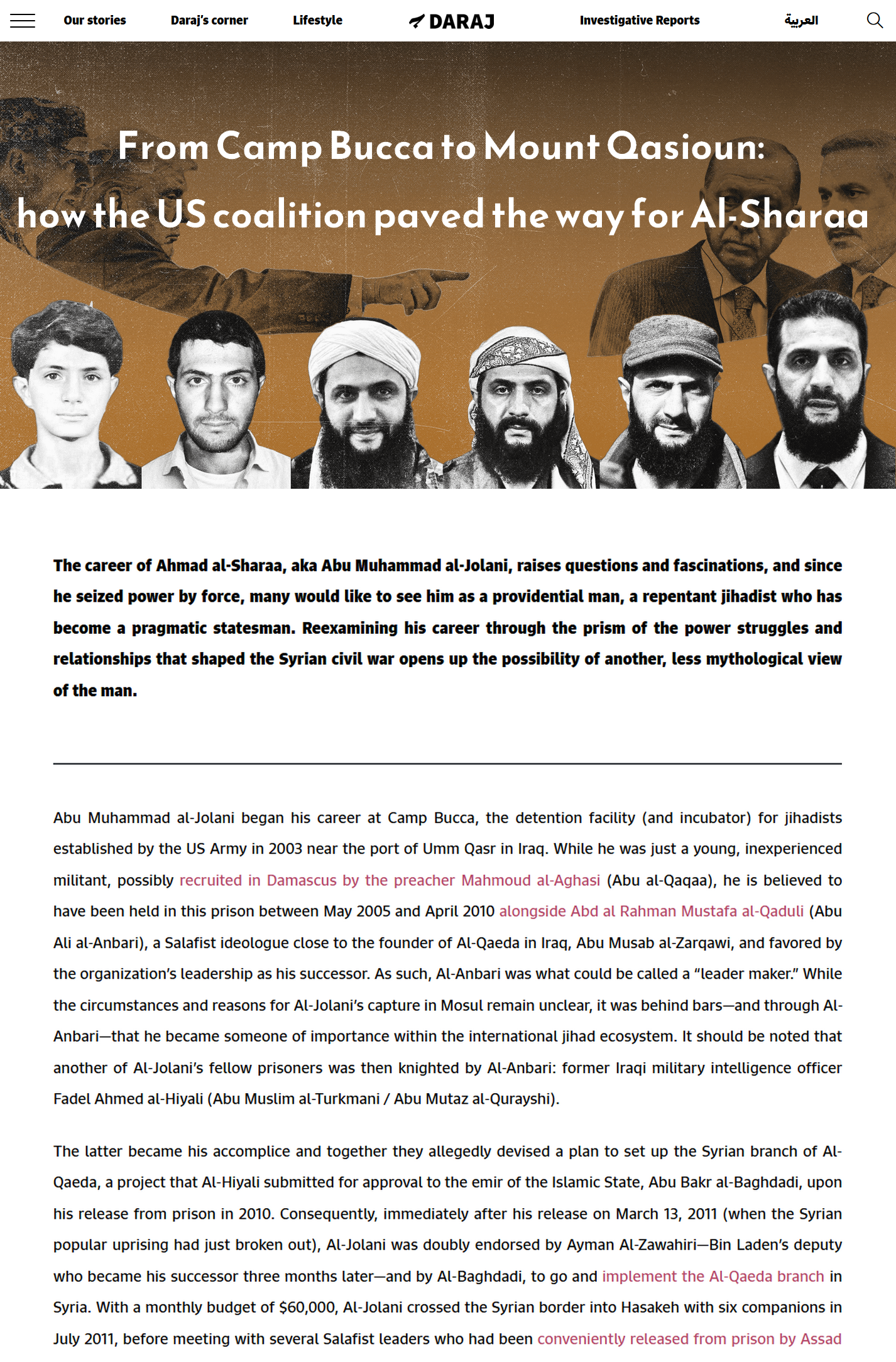
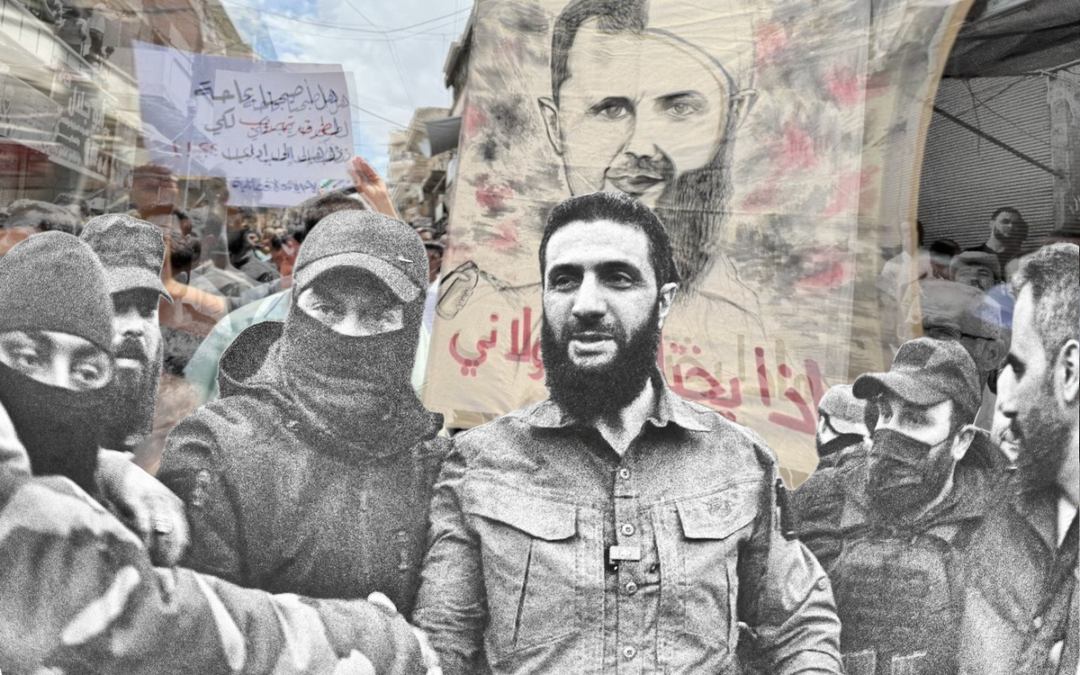
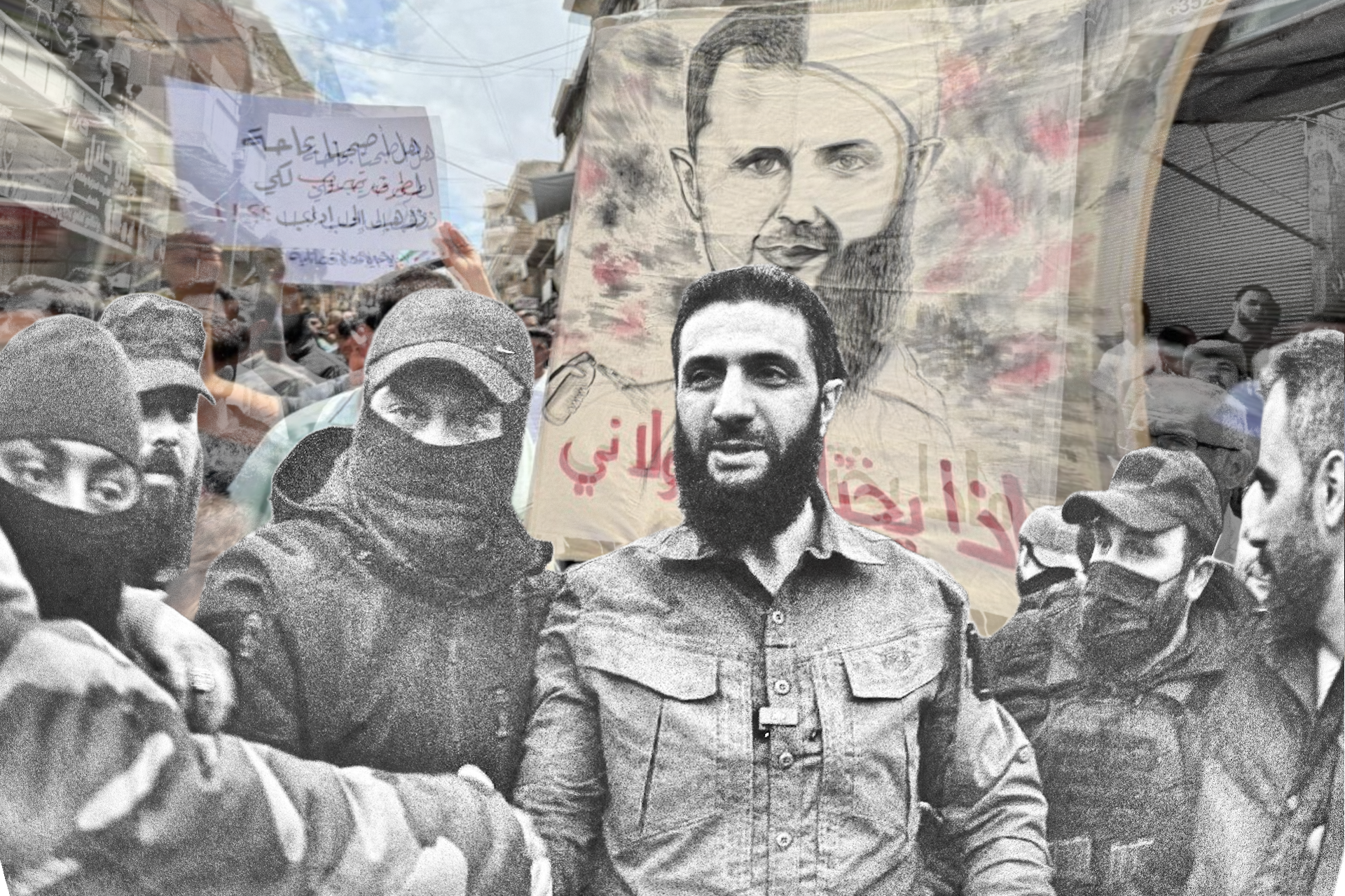
The career of Ahmad al-Sharaa, aka Abu Muhammad al-Jolani, raises questions and fascinations, and since he seized power by force, many would like to see him as a providential man, a repentant jihadist who has become a pragmatic statesman. Reexamining his career through the prism of the power struggles and relationships that shaped the Syrian civil war opens up the possibility of another, less mythological view of the man.

Jabhat al-Nusra, a product of US detention camps

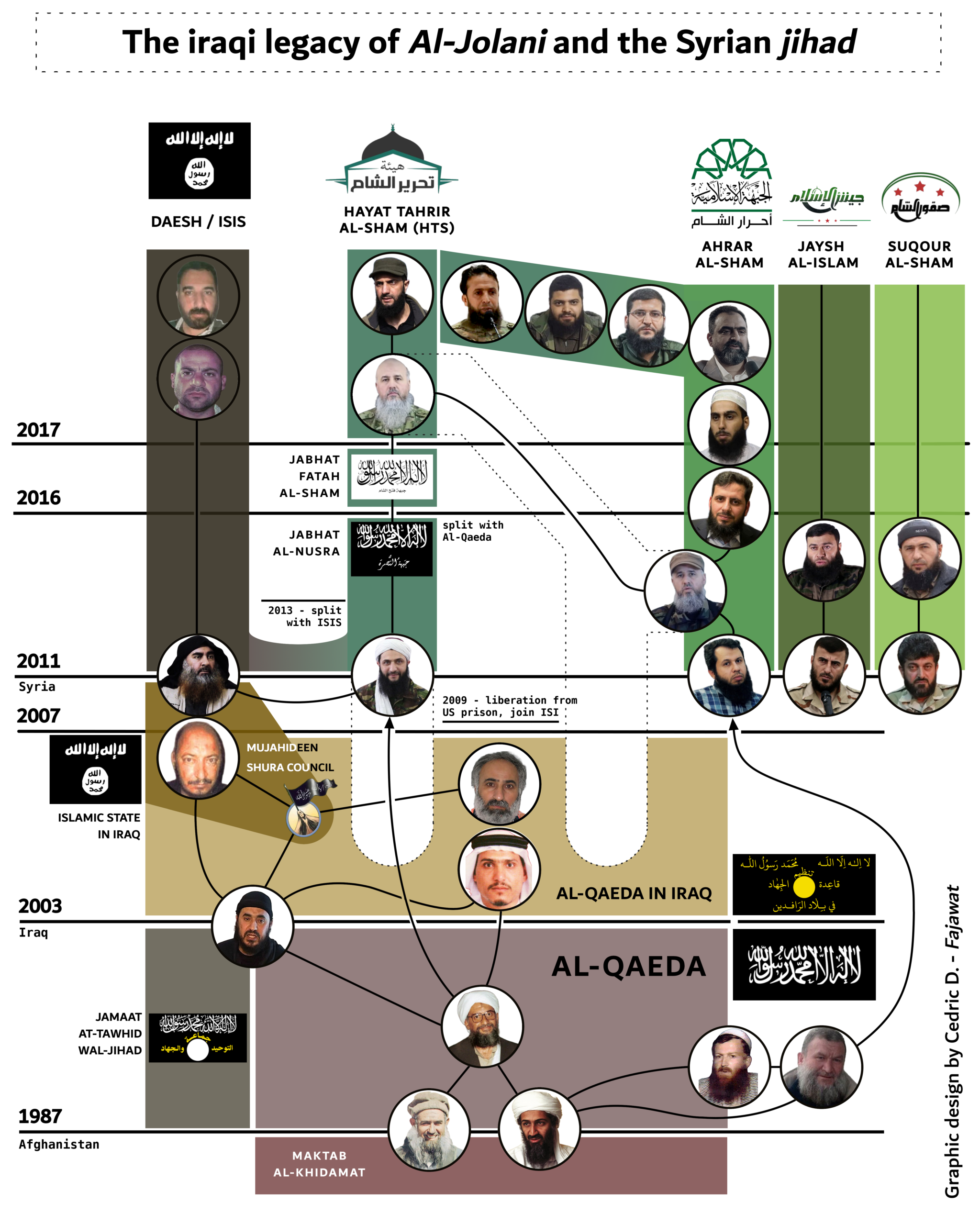
Abu Muhammad al-Jolani began his career at Camp Bucca, the detention facility (and incubator) for jihadists established by the US Army in 2003 near the port of Umm Qasr in Iraq. While he was just a young, inexperienced militant, possibly recruited in Damascus by the preacher Mahmoud al-Aghasi (Abu al-Qaqaa), he is believed to have been held in this prison between May 2005 and April 2010 alongside Abd al Rahman Mustafa al-Qaduli (Abu Ali al-Anbari), a Salafist ideologue close to the founder of Al-Qaeda in Iraq, Abu Musab al-Zarqawi, and favored by the organization's leadership as his successor. As such, Al-Anbari was what could be called a “leader maker.” While the circumstances and reasons for Al-Jolani's capture in Mosul remain unclear, it was behind bars—and through Al-Anbari—that he became someone of importance within the international jihad ecosystem. It should be noted that another of Al-Jolani's fellow prisoners was then knighted by Al-Anbari: former Iraqi military intelligence officer Fadel Ahmed al-Hiyali (Abu Muslim al-Turkmani / Abu Mutaz al-Qurayshi).

The latter became his accomplice and together they allegedly devised a plan to set up the Syrian branch of Al-Qaeda, a project that Al-Hiyali submitted for approval to the emir of the Islamic State, Abu Bakr al-Baghdadi, upon his release from prison in 2010. Consequently, immediately after his release on March 13, 2011 (when the Syrian popular uprising had just broken out), Al-Jolani was doubly endorsed by Ayman Al-Zawahiri—Bin Laden's deputy who became his successor three months later—and by Al-Baghdadi, to go and implement the Al-Qaeda branch in Syria. With a monthly budget of $60,000, Al-Jolani crossed the Syrian border into Hasakeh with six companions in July 2011, before meeting with several Salafist leaders who had been conveniently released from prison by Assad in the preceding weeks. Finally, after making its debut with a few bomb attacks on Syrian intelligence buildings in Damascus during the winter, the Syrian branch of Al-Qaeda was finally born on January 23, 2012, under the name Jabhat Nusrat Ahl al-Sham, or Al-Nusra Front. This is what you might call an operational project.

Assad and the Islamization of the Syrian rebellion

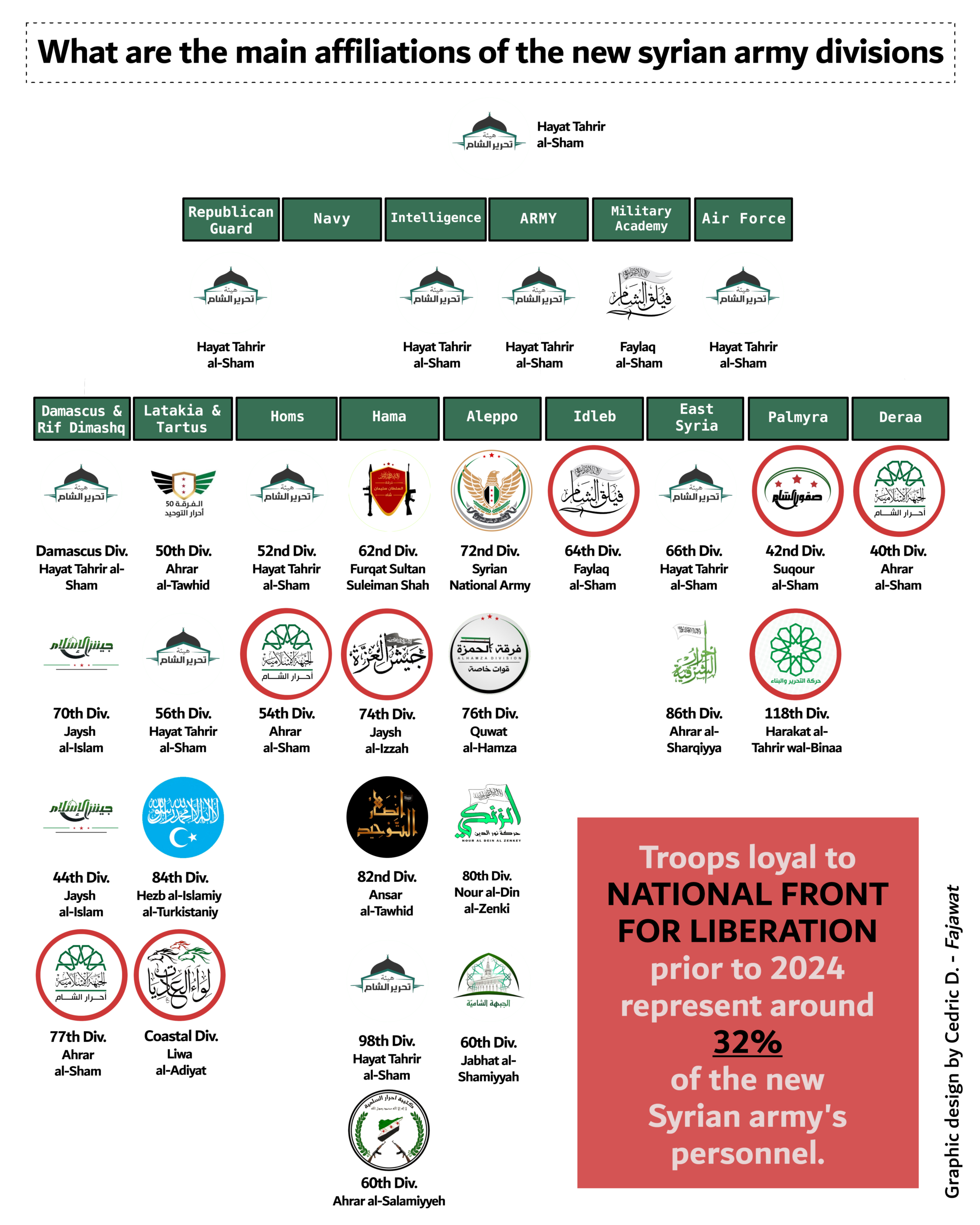
One might wonder about this surprising leniency on the part of the American and Syrian authorities, which led to the release without prosecution of dozens of Islamist leaders at the dawn of the Syrian uprising, on the pretext that their intelligence services were unable to identify them or pin any serious crime on them. Apart from Al-Jolani, those lucky ones include his mentor Abu Ali al-Anbari and Abu Bakr al-Baghdadi himself, as well as Abu Hassan al-Hashimi al-Qurayshi, Abu Ibrahim al-Hashimi al-Qurayshi, Zahran Alloush, Ahmed Isa al-Sheikh, Abu Khaled al-Suri, Abu Musab al-Suri, Hassan Abboud, Abu Jaber al-Sheikh, Abu Yahia al-Hamwi, Amer al-Absi Abu Atheer, Abu Muhannad al-Suwaydani, and Abu Ayman al-Iraqi. It is important to name them because, in the year following their release, they all became leaders of the most radical Salafist groups involved in the Syrian civil war, but also the fiercest competitors within the regional jihadist network. Let us add—and this is what will be of particular interest to us later on—that they are also the main architects of the fragmentation of the Syrian rebel forces, which was achieved through the radical purge of its most secularist and progressive components. At the head of this counter-revolutionary movement were Al-Jolani's Al-Nusra Front, Hassan Abboud's Ahrar al-Sham, Zahran Alloush's Jaysh al-Islam, Ahmed Isa al-Sheikh’s Suqour al-Sham and all the groups affiliated with Abu Bakr al-Baghdadi's Islamic State.

The empowerment of Jabhat al-Nusra

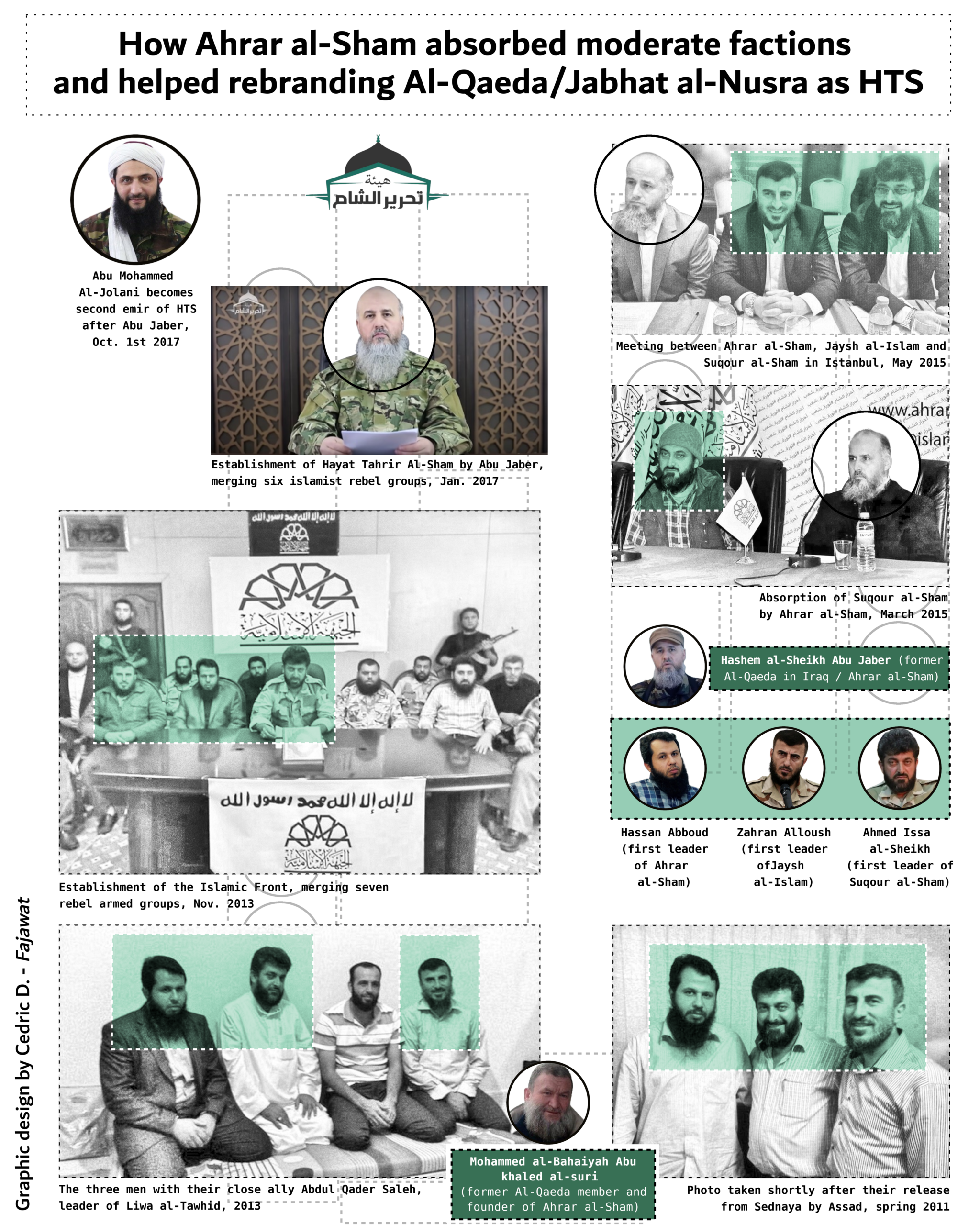
Just a few months after establishing Jabhat al-Nusra, Al-Jolani was already beginning to break away from his parent organization, prompting Al-Baghdadi to send his former mentor Al-Anbari to keep an eye on things. Al-Anbari exchanged several letters with the emir of Mosul to share his observations, and in one of them, his description of Al-Jolani is damning: "He is a sneaky person with two faces. He loves himself and does not care about the religion of his soldiers. He is willing to sacrifice their blood just so he is mentioned in the media. He flies with joy like a child when his name is mentioned on TV channels." In 2013, the split between the Al-Nusra Front and Islamic State was complete, while Al-Jolani maintained a tactical cooperation with the seven main Syrian Salafist organizations grouped within the Islamic Front (Ahrar al-Sham, Suqour al-Sham, Jaysh al-Islam, Liwa al-Tawhid, Liwa al-Haqq, Ansar al-Sham, and the Kurdish Islamic Front), despite their differences over the relationship to be maintained with Turkey. It was this last point of disagreement that led part of the leadership of Ahrar al-Sham, at the time Jabhat al-Nusra's main rival, to defect and align itself with Jabhat al-Nusra between 2014 and 2015. This was particularly the case for Abu Jaber al-Sheikh, whom we will discuss further below. At the same time, Al-Jolani thoroughly crushed the driving forces of the Syrian revolution, starting with the Syrian Revolutionary Front, the Hazm Movement, and the 13th Division of the Free Syrian Army, gradually strengthening his hegemonic position within the armed opposition to the Assad regime.

Foreign intervention, localization, and rebranding

The year 2015 marked a turning point. The Islamic State expanded rapidly on the fertile ground of the combined counterrevolutionary actions of the Assad regime and of Jabhat al-Nusra, which enabled it to seize the province of Idlib and the Palestinian camp of Yarmouk on the outskirts of the capital that same year. This second victory was also the result of a temporary tactical alliance with the Islamic State, the strategic implications of which remain unclear to this day, unless we consider that it was mainly a matter of removing the Free Syrian Army and the Islamic Front (already in decline) from the front line with the regime's forces. It should also be noted that prior to the Islamic State's takeover of the camp, Jabhat al-Nusra had prepared the ground by methodically assassinating nearly fifteen Palestinian community leaders and civil society activists. But the pivotal event that year was the Russian military intervention in the fall, which would allow Assad to recapture Aleppo and push Al-Jolani to adopt a whole new strategy to keep Idlib in the face of the rapidly deteriorating situation. It should be noted that at the time, one of the main threats to Jabhat al-Nusra was the potential cooperation between the United States and Russia to eradicate it, as would soon show the memorandum of understanding the two powers signed on October 20, 2015, in the name of fighting ISIS. It was therefore necessary to prove one's credentials in order to benefit from the support of states allied to the United States, in particular by rallying rebel groups that had hitherto been reluctant to associate themselves with an organization affiliated with Al-Qaeda and therefore with international jihad. Thus, Jabhat al-Nusra reconciled with Ahrar al-Sham to seize control of Idlib, forming an alliance backed by Saudi Arabia, Qatar, and Turkey, before officially dissociating from Al-Qaeda and rebranding itself as Jabhat Fatah al-Sham on July 28, 2016. The change was to be accompanied by a merger with Ahrar al-Sham, but Al-Jolani's proposal to this effect was rejected.  Everything comes in its own time.

It was from this moment, coinciding with the launch of the Astana talks initiated by Russia and the Turkish Euphrates Shield offensive (August 2016–March 2017) leading to the occupation of northern Syria by a coalition of rebel forces under Turkish leadership, that Al-Jolani began to claim allegiance to the Syrian revolution and to offer guarantees of “deradicalization” allowing him to navigate between the various foreign powers involved in the civil war through their numerous proxies. The opposition in exile, embodied by the Syrian National Coalition and the Syrian Interim Government (SIG), was funded by the United States to the tune of tens of millions of dollars and would give rise a few months later to the Syrian National Army (SNA), an alliance of 28 factions, 21 of which were supported and armed by the United States via a joint operations room based in Azaz and controlled by Turkey. Although the historical rivals of Jabhat al-Nusra, aka Jabhat Fatah al-Sham, were now included in the Turkish-American project, Al-Qaeda's controversial heir did not yet seem quite ready to embody the “Syrian revolution” as defined and specified by the Coalition. The split with Al-Qaeda was still too recent to be credible in the eyes of most Syrian rebels, especially given that it was carried out with the approval of several prominent Al-Qaeda figures, namely Ahmed Hassan Abu al-Khayr, Abu Muhammad al-Maqdisi, and Abu Qatada al-Falastini. Some sources claim that even Ayman al-Zawahiri himself endorsed this tactical choice.

The hand of Ankara, the elbow of Astana, and the shoulder of Washington

In any case, Al-Jolani methodically placed his pawns on the chessboard, with the aim of becoming the hegemonic leader of a Syrian rebellion in which he had to neutralize both the most uncontrollable elements on his right flank, namely the takfirists without lasting allegiance, and the more moderate factions on his left flank. While the former tended to cluster around Jabhat al-Nusra / Jabhat Fatah al-Sham, the latter had gradually moved closer to Ahrar al-Sham, whose leader Abu Jaber al-Sheikh had just created Jaysh al-Ahrar in December 2016 by incorporating sixteen local factions not yet affiliated with Jabhat Fatah al-Sham. All that remained was to merge the two, which was almost entirely accomplished just one month later with the creation on January 28, 2017, of Hayat Tahrir al-Sham (HTS), whose command was entrusted to this same Abu Jaber al-Sheikh. This appointment of a supposed adversary to lead his own troops, as well as the merge of Ahrar al-Sham into a short-lived entity that lasted merely a month (Jaysh al-Ahrar), strongly suggests that Al-Jolani had reached a prior agreement with Al-Sheikh. The question that remains unanswered is: how long had this been brewing? What is certain is that the reluctant ones of Ahrar al-Sham were subsequently rendered powerless during the summer, when HTS imposed its armed sections in all the localities where the group was still established and its remnants were forced to cede the border crossings with Turkey that had been under their control until then, including that of Bab al-Hawa, which for years served as a crossing point for Salafist fighters coming from Europe with Turkish backing. Finally, in the fall of 2017, more than 30 Salafist hardliners more or less officially affiliated with HTS were assassinated, or arrested by HTS, while Al-Sheikh ceded his position to Al-Jolani and took over as head of the Shura Council, the advisory body that traditionally surrounds the caliph. Al-Sheikh was known for being a supporter of “popular jihad” a form of Islamist populism that prioritizes the support of the people over the establishment of a caliphate (Islamic State). It should be noted that Al-Jolani subsequently established the Syrian Salvation Government to supplant the Syrian Interim Government supported by his competitors (and until then by the United States), before completing the crushing of the latter between 2018 and 2019. By early 2019, the HTS government controlled the entire province and was therefore able to begin playing politics. It finally seemed ready to rule with the approval of the Coalition.

Even though the United States and Turkey may have disagreed on strategy, particularly regarding the management of northeastern Syria and the attitude to adopt towards ISIS and the YPG/SDF, they nevertheless constitute the two cornerstones of the International Coalition in Syria and, as such, must be considered allies on the Syrian issue. When the Coalition ended its intervention in 2019 and the United States withdrew its support for the SDF, Turkey certainly had more freedom to act, but its actions continued to be negotiated with Washington. After promoting—intentionally or unintentionally, only the future will tell for sure when the archives are declassified—the emergence of a multitude of Salafist groups contributing to the fragmentation of the Syrian rebellion between 2011 and 2015, the Coalition was now steering its gradual deradicalization. This development appears to be the culmination of Turkey's takeover of HTS. Throughout the twelve meetings with Russia and Iran in Astana and Sochi between 2015 and 2021, Turkey actively worked to expand its influence and military presence in Syria, by invading the entire area northwest of Aleppo between 2016 and 2018, then by establishing de-escalation zones and a buffer zone in Idlib. The Turkish military presence in Idlib—legitimized by the defense of its 12 observation posts, which were gradually surrounded by regime forces between December 2019 and February 2020—was therefore quickly “imposed” on Al-Jolani.

Turkish forces deployed at this fateful moment to form a protective belt around the rebel forces, which were still insufficiently unified and therefore too vulnerable to offensives by the regime and the Russians. The name of the Turkish operation, “Spring Shield,” is very significant in this regard, and marks a major turning point that allowed the Idlib pocket to hold out and HTS to definitively establish its dominance over the region. This Turkish patronage, accompanied by funding for major reconstruction and development projects and the establishment of civil institutions, enabled the beylerbey Al-Jolani to calmly organize the administrative takeover of the province, thereby setting up a rudimentary state apparatus and gaining access to the threshold of power in the spring of 2023. In May of that year, he therefore publicly announced his intention to retake Aleppo, describing the city as the gateway to Damascus.

The red carpet to Damascus

On December 8, 2024, a broad alliance of rebel groups led by HTS seized power by force of arms and placed its leader at its head. This is what is known as a coup d'état. The day before, the final act of the Astana talks took place in Doha, Qatar, in the presence of five Arab countries and those presented as the three great enemies: Turkey, Russia, and Iran. Unsurprisingly, they agreed on a cessation of hostilities, coinciding with a halt to Russian bombing, as well as a total withdrawal of Hezbollah and Iranian Revolutionary Guard Corps fighters, but also of all the regime's armed forces, which, as we know, have massively thrown down their uniforms before heading back home. During the night, the Assad clan flew out along with the regime's chief negotiator in Astana, Bashar Jaafari, while sunni Prime Minister Muhammad Ghazi al-Jalali obtained a guarantee of amnesty. Before 4:30 a.m. on December 8, when the last flight departing from Damascus airport disappeared from radar just before reaching the Russian air base in Hmeimim (Tartus), more than fifty regime officers had vanished. In the evening, the Kremlin announced that Assad had taken refuge in Moscow with his family and that the matter had been settled. Thus, an escorted exit route was discreetly negotiated between the parties to the conflict with Russian mediation, like when HTS and Islamic State fighters were evacuated from Yarmouk by bus by the regime in spring 2018. Same actors, same methods.

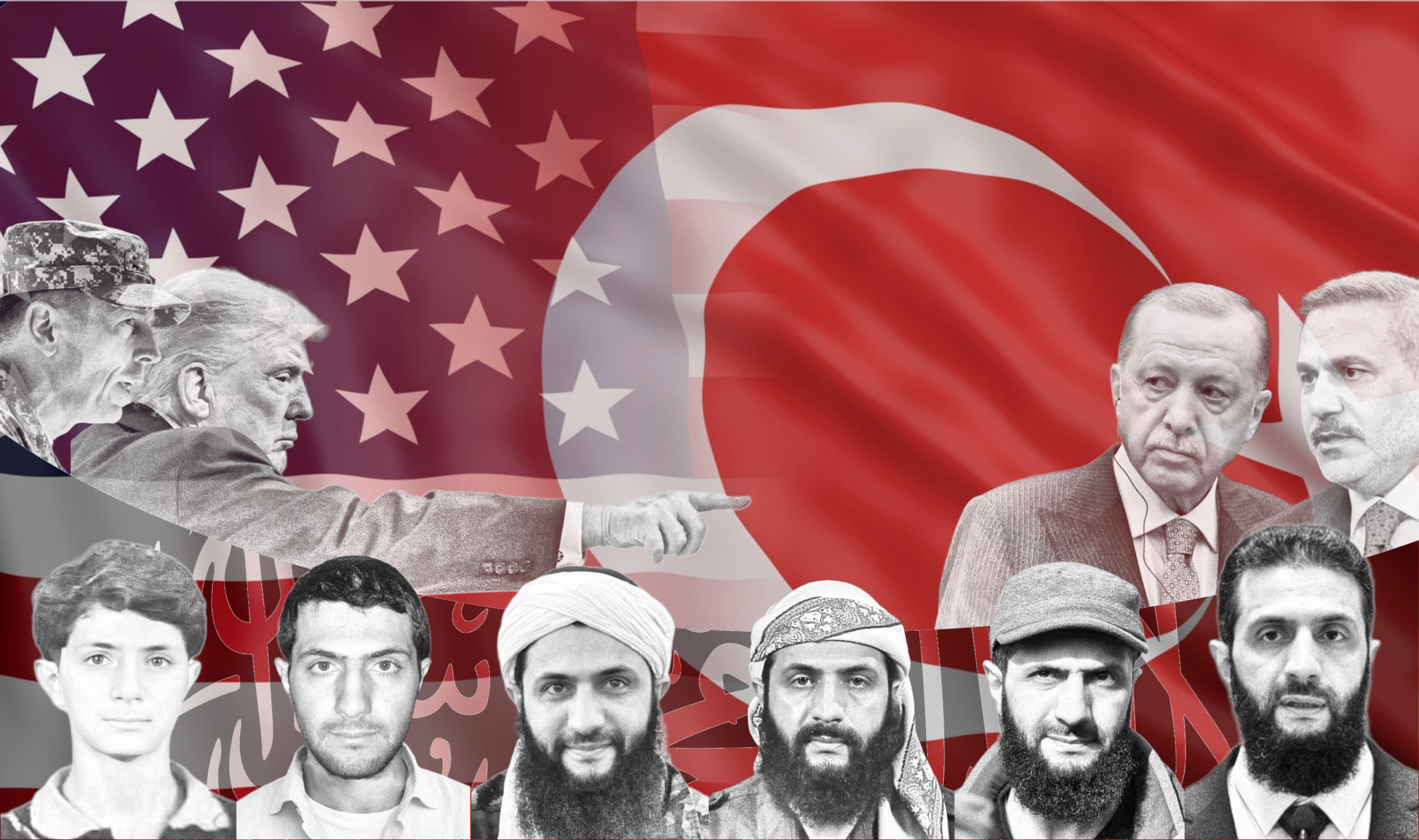
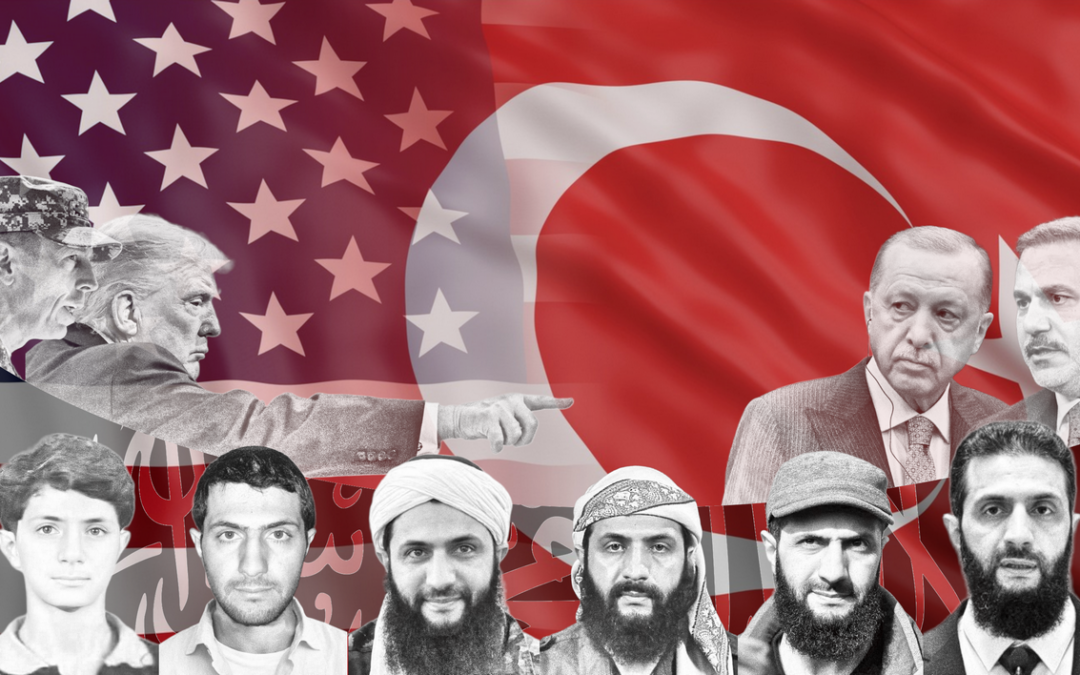
Four days later, the head of Turkish intelligence (MIT) İbrahim Kalın was the first foreign delegate to visit Damascus where he prayed at the Umayyad Mosque and met Al-Jolani, followed ten days later by his predecessor (2010-2023) and current Turkish Minister of Foreign Affairs Hakan Fidan. Al-Jolani and his patron were shown together drinking tea on the terraces of Mount Qasioun, which had been off-limits to the Syrian people since the 2011 uprising. The message could not have been clearer: if HTS's path to Damascus was not blood-stained, it was because a red carpet had been rolled out beforehand by Erdogan's agents with the consent of the other imperialist powers, including Iran. This is what Donald Trump would call a “good deal.” Indeed, the US president was very transparent about it during his first press conference since his reelection, on December 16, 2024: "Turkey's the one behind it. He's [Erdogan] a very smart guy, they've wanted it for thousands of years, and he got it, and those people that went in are controlled by Turkey, and that's OK, it's another way to fight [...] Nobody knows what the final outcome is gonna be in the region. Nobody knows who will rule in the end. I believe it is Turkey. Turkey is very smart, he is a very smart guy and he’s very tough. Turkey did an unfriendly takeover without a lot of lives being lost.”

All these undisputed facts lend credence to the claim that Al-Jolani and his companions are long-standing partners of Turkish intelligence, even though there is no evidence to suggest that this link predates the creation of Jabhat Fatah al-Sham in 2015. The only existing source is the exiled Turkish journalist Abdullah Bozkurt, who claims that Anas Khattab has been linked to MIT since the beginning of the civil war. It is noteworthy that this journalist has been the target of several threats, attacks, and legal proceedings by the Turkish state for this reason, which has also pressured the Swedish government to shut down his research center Nordic Monitor, to no avail. With the necessary hindsight and without giving in to conspiracy theories, we are still entitled to consider that Al-Nusra and what it spawned after it are in fact the fruitful result of the Coalition's strategies in the region. This seems to have been confirmed by the former Commander-in-Chief of US forces in Iraq and then Director of the CIA, David Petraeus, when he warmly praised Al-Jolani's career with these words on September 22, 2025: "Your vision is powerful and clear. Your demeanor is very impressive as well ...We obviously hope for your success, Inshallah, because at the end of the day, your success is our success.” This surreal scene took place at the Concordia Annual Summit, a conservative forum that has been held annually since 2011 with the aim of “Building Partnerships Against Extremism” (sic). In a carefully orchestrated staging in which Petraeus interviewed Al-Jolani, the latter was cordially invited to deploy his “post-jihadist” seduction game on the eve of his historic speech at the United Nations. The enthusiasm of a bridgehead of Western imperialism for the bloody achievements of a Salafist warlord on the list of “specially designated global terrorists” may seem surprising, and the lack of resonance that his statement had in the international press is up to par with the leniency of the international community in the face of Donald Trump's destructive madness. But that is undoubtedly another matter. To understand the unexpected nature of his praise, it should be noted that David Petraeus is known for having been the architect of the counterinsurgency strategies implemented in Mosul in the first year of the war. His fieldwork led him to revive the teachings of David Galula, a French army officer and torturer in Algeria who, in 1962, wrote the seminal work on psychological warfare, ‘Counterinsurgency: Theory and Practice’. Petraeus even wrote the preface to its 2008 French reissue, after publishing his own ‘Counterinsurgency Field Manual’ (FM 3-24) and even as the scandal of the abuse inflicted by the US Army on prisoners at Abu Ghraib had just placed the practices of the US Psychological Operations Teams (PsyOps) on the same level as the atrocities committed by their enemies, each thus becoming the other's terrorist. What we must remember is that Petraeus is the man who “unwittingly” arrested the bomber Al-Jolani in Mosul, before offering him a stay in the jihadist breeding ground of Camp Bucca.

“Ahmad Al-Jolani,” or the success of counterinsurgency

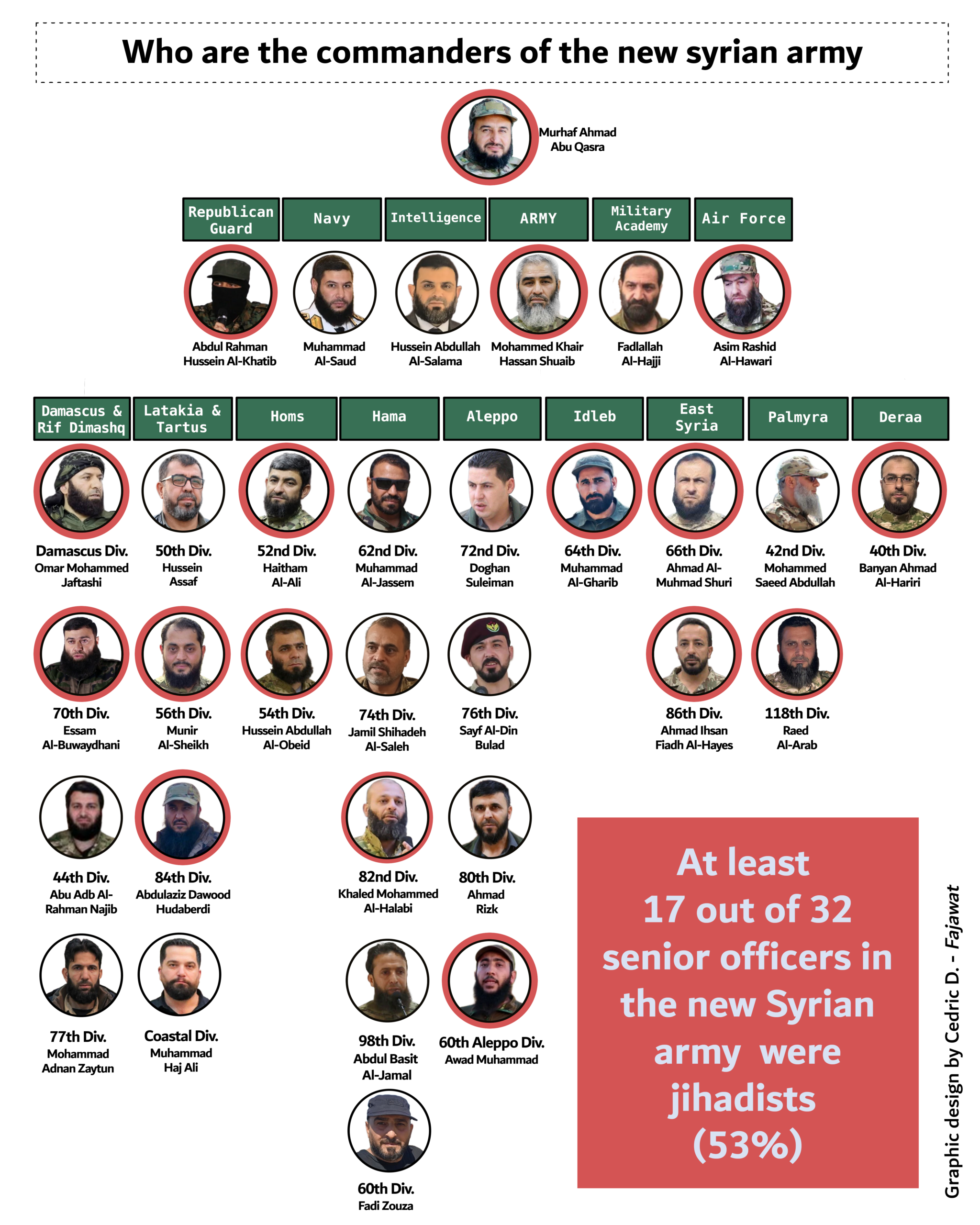
But what success is Petraeus talking about? To answer this question, we need to look at how Al-Jolani has been portrayed by experts and journalists since he took power. Driven by a kind of collective fascination with his character, many analysts seem to agree that the new “interim president” has become “deradicalized”—a term borrowed from the jargon of counterterrorism—over the past decade, and that this process has been the result of a gradual realization of the futility of his previous actions. Reading their comments, it is easy to be convinced that Al-Jolani, the jihadist turned statesman, is a kind of self-made man, a success story promoted in particular by the states that seem to have sponsored him since 2013. But more than just personal self-examination, we are led to believe that this individual process was accompanied as well by a collective realization on the part of his early companions, notably Anas Hasan Khattab (nom de guerre: Abu Ahmad Hudoud), Asaad al-Shaibani (Abu Ammar al-Shami or Zaid al-Attar) and Abd al-Rahim Attoun (Abu Abdallah al-Shami).

Once “most wanted terrorists,” they all would have transformed themselves into skilled strategists and can now be considered pragmatic leaders, their day-to-day management activities in Idlib having suddenly enlightened them to the need to demonstrate Sunni national populism rather than dogmatic Salafist intransigence. Experts cite the writings of renowned Islamologist Olivier Roy on political Islam to explain to us—and no doubt to reassure themselves and the rest of the world who was already comparing Syria to Afghanistan—that radical Islam is doomed to moderation when it finds itself in a position of having to run a state. The media were also quick to ask the rhetorical question, “Has Ahmad Al-Sharaa ceased to be a jihadist?”, even though no one seems to know anything about the man’s biography.

It should be noted that Al-Jolani's true identity was only revealed in the mainstream press after December 5, 2024, following the publication on the HTS Telegram channel of a message congratulating the people of Hama on their liberation and signed with his name, which was picked up by Reuters and the Saudi channel Al-Arabiya. Prior to that, only one TV interview given in February 2021 to journalist Martin Smith for the American PBS program Frontline had publicly mentioned his real identity. The previous TV interview, given eight years earlier to Al-Jazeera journalist Tayseer Allouni, had revealed neither his identity nor his face. It came at just the right moment, as the Islamic State—in rapid ascendance—was attracting hundreds of defectors from Jabhat al-Nusra, forcing Al-Jolani to find new strings to his bow. Like Bin Laden before him, the warlord was able to count on the Qatari channel—and its sympathetic journalist—to offer him a platform. Appearing from behind, he spoke of his rejection of the Geneva talks initiated by the United Nations, arguing that no one had “authorized its participants to represent the people” (sic), and sent a signal to Saudi Arabia to reevaluate its investment in the Syrian conflict.

Between the two interviews, Al-Jolani finally revealed his face during the announcement of the creation of Jabhat Fatah al-Sham on July 28, 2016, in which he appeared alongside ideologue Abd al-Rahim Attoun and Ahmad Salama Mabruk (Abu Faraj al-Masri), one of Al-Qaeda's most aggressive leaders and very close to Ayman al-Zawahiri and his brother Mohammed al-Zawahiri. It should be noted that, as a key figure in Al-Qaeda, Abu Faraj al-Masri's tactical expertise was undoubtedly crucial in the context of such a major reorganization of Jabhat al-Nusra, and his presence symbolized Jabhat Fatah al-Sham's continuing links with the wider Al-Qaeda network, even as the group sought to give assurances of moderation by distancing itself from the official structure of its parent organization. This undeniably reveals a highly controlled communication plan, accompanying a long-term reactionary or counter-revolutionary strategy, in which each public appearance consists of gaining support and backing by offering assurances of good faith to the international community without losing the support of followers and fighters. But these appeals are primarily aimed at states, not other components of the Syrian rebellion. This, at least, is how we should understand Abu Muhammad al-Jolani's fleeting appearances at key moments in the evolution of the political project he was part of, his gradual emergence from the shadows corresponding to the gradual normalization of his organization and its official recognition, followed by the confirmation of his candidacy to succeed Bashar al-Assad. And this project had already begun in December 2013, just eight months after his break with Al-Qaeda in Iraq, aka the Islamic State. Surprisingly quick timing.

If a jihadist is not dead, it means he can still be useful

Abu Faraj al-Masri, after playing his role as Al-Qaeda's guarantor during the creation of Jabhat Fatah al-Sham, was killed by a US drone strike three months later, on October 3, 2016, in the heart of the Turkistani Salafist stronghold of Jisr al-Shughour (Idlib). This very timely death echoes the assassinations of more than a dozen leaders representing the radical wing of HTS in the fall of 2017 and the more sensational assassination of one of Al-Jolani's six first companions, Abu Maria Al-Qahtani, on April 4, 2024. These Al-Nusra veterans, all in conflict with Al-Jolani due to the gradual transformation of their movement under the influence of the major imperialist powers—notably Turkey—were in fact swept away one by one in the whirlwind of highly targeted and precise drone strikes and bombings that effectively rid Al-Jolani of all potential obstacles to his hegemonic conquest of power. The question that should have been legitimately asked at the time was: Why did Al-Jolani survive two decades of counterinsurgency and counterterrorism—two terms that often mean the same thing—carried out jointly by the NATO coalition and the RSII coalition?

Above all, why has the unanimous and almost obsessive focus on ISIS been the subject of so little critical analysis and suspicion on the part of experts and journalists of all stripes, while Jabhat al-Nusra and its ‘turkistani’ mercenaries were gaining significant leverage without being seriously targeted? All parties to the conflict, including the Assad regime and its Iranian ally, have yet legitimized their violence by claiming to be fighting Islamist terrorism, even though they have either financed or exploited Salafist groups to turn the chaos in Syria to their advantage, often in highly fluctuating ways and on a very local scale. If the Syrian civil war is so complex, even impossible to understand, it is because no binary analysis is valid, and any attempt to identify clear alliances or converging interests between two sides on a national or regional scale is doomed to failure. Thus, two parties to the conflict such as Russia and the United States have been able to find points of agreement in sharing the sky above the desert to bomb ISIS or in protecting the border to Jordan and Israel from Iranian militias, while fighting each other through their proxies in the north, even though Russia was US-designated evil Bashar al-Assad's main supporter. At the same time, Russia intensively bombed Turkey's proxies while conducting joint patrols with the Turkish army along the M4 highway between Saraqib and Jisr al-Shughour. Finally, following the same opportunistic logic which is far removed from any ethical or partisan considerations, the Gulf States, Turkey, Jordan, and the United States have cooperated in the four-year Timber Sycamore program aimed at arming and training more than 50 Syrian rebel groups—including the most extremist ones as well as factions fighting each other—while keeping many of their leaders on terrorism watch lists. It should be noted that this program, endorsed by Barack Obama following active lobbying by King Abdullah II of Jordan and Benjamin Netanyahu, was initiated in 2012 by above mentioned CIA Director David Petraeus. While it is true that the weapons supplied easily fell into the hands of Jabhat al-Nusra, as Trump himself admitted in July 2017, it remains difficult to assert that the group or its successors received direct support, although it was claimed by the Kurdish media outlet ANF News in January 2018 based on the confessions of two Turkish MIT agents captured by Kurdish forces a year earlier.

Why, then, was the undisputed leader of Jabhat al-Nusra, who led Al-Qaeda's offshoot for thirteen long years while all of Al-Zawahiri and Al-Baghdadi's lieutenants were assassinated one after the other by surgical strikes carried out in the heart of rebel areas, spared? Why has this mysterious jihadist, with a $10 million bounty on his head, been consistently—but covertly—supported by US allies for at least ten years? Why, finally, is this uncompromising warlord, who has thoroughly wiped out all the rebel groups most in tune with the values of the Syrian revolution, suddenly being presented as the hero of that revolution, while being supported by the most reactionary and sectarian segments of Syrian society? The answer seems fairly obvious: Abu Muhammad al-Jolani is much more of an object than a subject. He is not the master of his own destiny, as his supporters would like him to be. He is merely what Ezzat Baghdadi—an independent diplomat and director of the KMT Center—calls “the man of the hour,” “neither savior nor author of a comprehensive program, but a mediator between chaos and the minimum acceptable.” The latter wrote on his Facebook page: "Al-Jolani's project does not sell a comprehensive political program, does not promise a modern state, and does not demand full sovereign recognition. What he proposes—and what is asked of him—is simpler and more pragmatic: reducing risks. Reducing the risk of security explosions, limiting the export of violence beyond borders, controlling the multiplicity of factions, and offering a single point of contact instead of a multitude of chaotic addresses. In a failed world, this is an attractive offer. […] In such a climate, the “political solution” is no longer a prerequisite for any negotiation, but simply not collapsing becomes the criterion for success. This is the real translation of a phrase we have heard repeatedly from diplomats in closed-door meetings: “Stability takes precedence over democracy.” And Al-Sharaa is in line with this requirement, as he does not open any difficult issues: no transitional justice, no restructuring of the state, no promises of major investments. He presents himself as a temporary political operator, capable of keeping the crisis below the critical threshold. This is not a project, it is a calculated postponement. […] Selling risk reduction is not a solution. But it becomes acceptable when the ability to finance solutions collapses. This is where the moral and political paradox lies: what seems rational in the short term accumulates higher costs in the long term. Because crisis management prolongs its duration, exhausts political time, and delays the reconstruction of a unifying legitimacy. That is why describing Al-Sharaa as “the man of the hour” does not mean conferring historical legitimacy on him, but rather placing him back in his functional role: the product of a global moment that buys time instead of a future and prefers to manage risks rather than confront them. Ahmed al-Sharaa is not the solution for Syria, but a sign of a world that is learning to coexist with crises rather than end them. His existence is linked to the persistence of the current phase, and his end will come as soon as a less costly and more sustainable alternative appears. Al-Jolani is ultimately no more than a racehorse”.

Conclusion

The question of whether Abu Muhammad al-Jolani has ceased to be a jihadist and whether he has been “deradicalized” distracts us from the issue that should concern us all more after half a century of dictatorship: was he democratically elected by the Syrian people, and how does he differ from Bashar al-Assad in this regard? As Ezzat Baghdadi so aptly puts it, it is not a question of Syrians continuing to manage a crisis that has lasted for decades, but of finally achieving what they aspired to when they took to the streets in 2011: social justice and democracy. In other words, a political solution, which means that no peace can be satisfactory unless it is accompanied by a robust transitional justice process. Therefore, a “Trump-style peace” that only allows foreign powers to plunder the country's resources and militarize the territory without ensuring security and equality for all Syrians before the law is not even a temporary solution; it is a guarantee of a new catastrophe in the very short term, of which the massacres on the coast and in Suwayda were only a harbinger. If Al-Jolani is a model of success for world leaders, it is because he resembles them: he is an opportunist who exploits the people's aspirations to serve the interests of his sponsors, as well as his own and those of his clan. After all, his father's cousin, Farouk al-Sharaa, was Bashar al-Assad's vice president, so the status quo he represented required that a member of the family take over and, if it makes him happy, appoint his own brother as secretary to the presidency. In conclusion, one can wonder whether the self-proclaimed president was ever truly a jihadist, or if he was nothing more than just another social climber in the great pantheon of tyrants. In any case, until Ahmad al-Sharaa is democratically elected by a majority of Syrians, including all Syrian communities, it is appropriate to continue referring to him by his nom de guerre: Abu Muhammad al-Jolani.

Is Ahmed Al-Sharaa mocking the Syrians?

Is Ahmed Al-Sharaa mocking the Syrians?

Cedric Domenjoud

by Cedric Domenjoud | May 14, 2025

The fall of the Assad regime on December 8, 2024 was an undeniable liberation for millions of Syrians, who suddenly and unexpectedly emerged from fifty years of totalitarian barbarism that had transformed Syria into a field of ruins doubling as a concentration camp archipelago, since which several hundred thousand civilians have disappeared or been forced into exile. However, six months after this historic overthrow, all signs suggest that beyond the coup, the promise of a better future is rapidly fading.

Liberation, not revolution

As early as December 9, Ahmed al-Sharaa proclaimed himself leader of the new Syria, categorically rejecting all forms of power-sharing, decentralization and federalism, while taking care never to use the term democracy, before declaring in an interview with Syria TV on December 15 - just one week after the fall of Assad - that it was now “crucial to abandon the revolutionary mentality”. It is legitimate to ask: When was Al-Sharaa ever revolutionary?

On December 29, Al-Sharaa asserted that no elections could be held for another four years, which is understandable given the deplorable situation of Syrian civil society, but not at all reassuring coming from a person who rejects the very concept of democracy, whatever its form. At the same time, he announced the forthcoming adoption of a new constitution at a hypothetical National Dialogue Conference, which would bring the transition period to a close. At this stage, the most optimistic were still waiting to “see what happens”.

On January 29, Al-Sharaa was appointed President of the Syrian Arab Republic by the Syrian General Command (embodied by himself) at a “Victory Conference”. The Syrian constitution and all the institutions inherited from the Baath Party and the Assad dictatorship were subsequently abolished. No one will regret them.

On February 12, Al-Sharaa set up a 7-member preparatory committee[1] to organize the National Dialogue Conference, which took 10 days to prepare and opened on February 24. It brought together 600 people - many of whom had been invited less than two days earlier by SMS - and excluded any representation from the Syrian Northeast Autonomous Administration and the Syrian Democratic Forces. The discussions lasted just one day, and objectively achieved nothing, apart from a superficial reaffirmation of the needs already formulated by everyone: transitional justice, respect for public and political freedoms, the role of civil society organizations in rebuilding the country, constitutional and institutional reform, respect for national sovereignty and the State monopoly on arms. To this was added a symbolic declaration condemning the Israeli incursion.

On March 2, Al-Sharaa set up a 5-member committee[2] to draft a proposed constitution, which was drawn up in 10 days and adopted on March 13 for a 5-year transitional period. The new constitution stipulates that the president must be of Muslim faith and makes Islamic jurisprudence a pillar of constitutional law, while pledging to “protect minorities”, as Bashar al-Assad had also pledged. Four days later, several hundred Alawite civilians were massacred on the coast.

On March 29, Al-Sharaa dissolved the provisional government led by Prime Minister Mohammed al-Bashir, replacing it with a Transitional Government and appointing 23 ministers[3], nine of them from HTS. With civil society insisting on respect for diversity and women's rights, Al-Sharaa appointed the only woman in the government, also a Christian, to the post of Minister of Social Affairs. If he'd wanted to be cynical, he couldn't have done a better job. In addition, all ministers are now appointed directly by the President, while the position of Prime Minister has been abolished. It should be pointed out that a presidential regime without a prime minister is not very different from a monarchy.

In less than three months, Ahmed al-Sharaa has subtly and without opposition established himself as head of state, implementing a presidential regime that can best be described as autocratic.

Political transition in the shadow of the Astana agreements

Since 1970, Syria has followed in the footsteps of its Russian sponsor. If we are familiar with the Russian system of power and analyze the Syrian system under Assad, we discover the same modes of predation, plunder and clan-based corruption, the same cynical contempt of the loyalist elites for the majority of the people, the same policy of abandonment and voluntary impoverishment of the country, but also and finally the same collective cult of the leader, Even if he clearly lacks charisma. Ironically, Assad came to power at the same time as Putin, becoming both his copy and his disciple. Since the start of the popular revolution in 2011, Assad has acted exactly as Putin does or would do in his own country in the event of an insurrection, by denying the very existence of the revolt and causing half the country's population to die, disappear or flee, rather than engaging in any semblance of reform that might win back a modicum of popular support. Obstinacy and criminal denial are what Assad and Putin have most in common. The only real difference between them is that Putin has not yet experienced a full-scale popular uprising, and has therefore not had the opportunity to deploy his totalitarian know-how to the full.

In reality, nothing could be worse than the Assad regime, and the only valid comparison would be with the Stalinist dictatorship. The model remains Russian, always. Consequently, the shadow of Russia will not cease to hang over the lives of Syrians overnight. What's more, it's legitimate to think that Assad's downfall could only have been achieved with Putin's cooperation or consent. Before crying conspiracy, let's recall a few facts we all know.

Russia has no friends, only clients, vassals and debtors. Syria has lived on Russia's and then Iran's credit for several decades, and their interventionism in the Syrian civil war was motivated by the need to repay the debts contracted by the Assad clan. Like the United States, Turkey and the Gulf petro-monarchies, each has placed its pawns on the Syrian chessboard, modifying alliances and geostrategic priorities according to circumstances and their fluctuating interests. Against their will, or even without their knowledge, Syrian communities and factions have become the proxies of a game that has quickly overtaken them. And any attempt to detect a logic based on polarized alliances, axes or camps with clear demarcations is bound to be misguided or mistaken. There are no friendships or solidarities between states, only opportunities and maneuvers.

From the outset of the popular uprising in 2011, Iran and Hezbollah were the first to intervene to protect the Syrian regime and keep control of the routes between Iraq and Lebanon, while developing their military-commercial hold in Syria. The USA, Saudi Arabia, Qatar and Turkey, with logistical support from Jordan, Great Britain and Israel, intervened in parallel, supplying arms to nearly fifty groups linked to the Free Syrian Army and the Syrian opposition embodied by the Syrian Interim Government in exile (in Turkey), including Islamist groups linked to the al-Nosra Front and united from 2015 under the umbrella of the Army of Conquest. Qatar and Turkey are thus among the main creditors of the al-Nosra Front (2012-2017), then Jabhat Fatah al-Sham (2016-2017) and Hayat Tahrir al-Sham (2017-2025).

With the Russian intervention, the capture of Kobane and the Paris attacks by the Islamic State in 2015, the strategies of both sides have evolved. The Paris attacks, following on from Assad's release of Islamist prisoners in 2011, largely contributed to the international community turning its gaze away from the regime's barbarity to focus on the jihadist scarecrow. Each has thus justified its intervention in Syria by the fight against the Islamic State: the United States gradually withdrew its support for Salafist groups to redirect it in favor of the Kurdish YPG/YPJ, then the FDS, with a focus on the fight against the Islamic State, while Russia sent its Wagner mercenaries to recruit Syrians into the “ISIS hunters” battalion before sending them to secure the regime's oil farms or serve as cannon fodder in Libya (which Turkey also did). But in reality, the Islamic State was struck with one hand and fed with the other by Turkey, Russia and the Assad regime alike, which never ceased to dispose of jihadist cells as it suited them, moving them from right to left to commit atrocities to divert attention from their own crimes and intrigues, destabilizing certain areas or populations that bothered them, or to legitimize the use of force where they lacked sufficiently valid reasons. The jihadist is a practical tool.

And contrary to popular belief, Russia, the United States and its allies (Jordan, Israel and Turkey) have not clashed militarily on Syrian soil[4]. On the contrary, in 2016 and 2017, the US, Russia and Turkey reached an agreement to set up joint air operations aimed at striking Islamic State and al-Nosra Front[5] [6]positions. Following on from this, Russia signed agreements with the USA, Israel and Jordan in 2017[7] [8] to keep the Islamists (Hezbollah and Islamic State) out of the Golan Heights and the Jordanian border, which led to the recapture of Deraa by the Syrian regime and Russia in 2018, culminating in the elimination of the Islamic State pocket in the Yarmouk basin and the surrender of the Deraa rebels as well as their integration into the normalization processes with Assad. It should be noted that all the agreements signed by Russia were signed with the consent of Bashar al-Assad[9]. Without going into further detail, it is quite clear that in the Syrian context there has never been any real duality between the “axis of evil” and the “axis of resistance”.

As early as 2015, two influential figures close to the Syrian and Russian regimes, Randa Kassis and Fabien Baussart, had begun suggesting the implementation of a peace process for Syria at a conference in Astana, Kazakhstan. After two years of fruitless talks in Geneva under the aegis of the UN, Astana finally established itself in 2017 as a negotiating space between Russia, Turkey, Iran, the Assad regime and a dozen Syrian rebel factions, led by Jaysh al-Islam, with the UN relegated to observer status. Russia and Turkey clearly showed their leadership in the discussions, with Russia even proposing a draft constitution for the future “Republic of Syria”, introducing a decentralized, federalist and secular system that would abolish Islamic jurisprudence as the source of law.  Turkey, the Arab League, the pro-Turkish opposition and Al-Assad were categorically opposed to any form of federalism. To better understand the content and outcome of these talks in the light of recent events, it may be useful to recall that Russia had proposed Assad's resignation back in 2012, but that this proposal had been refused by the USA, Great Britain and France on the pretext that Assad was “about to be overthrown” (sic). It seems that Turkey has taken the lead over Russia in these negotiations between 2019 and 2023, before designing in its corner the modalities of the political transition in Syria. Russia has been stymied by Bashar Al-Assad's obstinacy in believing himself invincible and obstructing any proposals for constitutional reform, particularly since his return to the international stage at the Arab League summit in Jeddah in June 2023.

On the eve of the regime's fall, Russia, Turkey and Iran met in Doha in the presence of 5 members of the Arab League (Egypt, Saudi Arabia, Iraq, Jordan and Qatar) to declare the end of hostilities. In the wake of this, the Russian air force suddenly halted its strikes after nine years of incessant bombing, and Russian troops peacefully withdrew to their bases in Hmeimim and Tartus, where they remain to this day in application of the Doha agreements. Under these agreements, Russia gave Assad, his clan and his allies guarantees of security and amnesty in exchange for the general withdrawal of his army, while Iran negotiated the protection of Shi'ite holy sites. On the evening of December 7-8, Assad's inner circle packed their bags, before being efficiently evacuated by plane from Syria to Russia and the Gulf States, including Bashar Jaafari, the main negotiator of the Astana agreements and Syria's ambassador to Russia[10]. All without Israel shooting down their aircraft in flight, obviously.

As early as December 29, 2024, Al-Sharaa declared that Syria shared deep strategic interests with Russia, evacuating out of hand its manifest complicity with the Assad regime and the latter's responsibility for the massacre of thousands of civilians since 2015[11].

At the end of January 2025, a Russian delegation led by Foreign Minister Mikhail Bogdanov and Russian Special Envoy to Syria Alexander Lavrentyev came to Damascus to set the framework and criteria for further bilateral relations. Al-Sharaa then laid down its conditions, demanding financial compensation for the crimes committed and the extradition of Assad to Syria, knowing full well that Russia would never agree.

At the beginning of March, just as the massacres on the coast had driven hundreds of Alawite civilians to take refuge on the Hmeimim base, Russia hypocritically offered its help to stabilize the situation in Syria. The following month saw the beginnings of a new military cooperation with Turkey and Russia, with Al-Sharaa admitting that the bulk of Syria's military equipment was supplied by Russia, that Syria remained dependent on numerous contracts with Russia in the food and energy sectors, and that its veto power at the United Nations posed a serious threat to the prospect of lifting the sanctions that were heavily affecting the country.

What we can conclude from all this data is that the destiny of the Syrians will remain intimately linked to the desiderata of Erdogan and Putin. We could call this constraint the “Curse of Astana”.

What about foreign jihadists?

First, a few biographical and contextual facts.

Ahmed al-Sharaa was born in 1982 in the same place as Osama bin Laden - Riyadh, Saudi Arabia - and lived in Syria between 1989 and 2003. Before the start of the American invasion of Iraq, he went to Baghdad, where he joined the Iraqi branch of Al-Qaeda, which its leader Abu Musab al-Zarqawi had just founded after pledging allegiance to Bin Laden. Arrested in 2006, he then spent five years in American prisons. Released after bin Laden's elimination on May 2, 2011, his successor Ayman al-Zawahiri sent al-Sharaa to Syria in August to establish the Syrian branch of al-Qaeda, Jabhat al-Nusra, in collaboration with the Islamic State in Iraq then led by Abu Bakr al-Baghdadi. As fate would have it, at exactly the same time, Bashar al-Assad amnestied and released hundreds of Islamists from Sednaya prison, including a number of notorious militants[12] who simultaneously set up, within a quarter of their release, the main Salafist groups responsible for the fragmentation and subsequent Islamization of the Free Syrian Army (FSA): Liwa al-Islam, Suqour al-Sham and Ahrar al-Sham.

In the world of Islamist armed groups, armed confrontations, wars of power, alliances of circumstance and recompositions have followed one another unceasingly, culminating in large-scale mergers in 2017 within the Syrian National Army (Jaysh al-Watani as-Suri) and the Levant Liberation Organization (Hayat Tahrir al-Sham, HTS), under the aegis of Turkey. These recompositions coincide with international negotiations within the framework of the Astana process mentioned above. This was the moment when a number of Islamist factions, faced with a stalemate in their trench warfare with the Assad regime, were prompted to change their strategy and adopt a nationalist and revolutionary rhetoric, while cleaning up on their most radical wings. Al-Sharaa's associate and accomplice since 2011, Anas Hassan Khattab, held the position of HTS intelligence officer[13], a position he retains in the Syrian government. In this position he was responsible for eliminating HTS rivals in the Idleb pocket, notably Hurras al-Din and DAESH cells, an operation he carried out in collaboration with Turkish and US intelligence services.

Their jihadist approach was then gradually abandoned in favor of a political and technocratic management of the areas under their control, embodied in particular by the new Syrian Salvation Government. Clearly, Turkey and Russia exerted a major influence on the evolution of the Syrian rebellion at this time, even though the two main factions forming HTS did not participate in the Astana negotiations[14]. Nevertheless, no one is deceived by the role played by the two imperialists in this cynical game of chess.

At that time, Ahmed al-Sharaa was still Abu Mohammad al-Joulani, and whatever his populist strategy of “Syrianization” to become a credible interlocutor on the international stage, everyone knows very well that he could never have kept control of the situation without keeping at his side the jihadist dogs of war that have always formed the core of his troops. And among them, the hundreds of international jihadi hitmen whom he would need to thank should he win the final battle to topple Al-Assad.

This is precisely what happened after the fall of the regime. In late December 2024, Al-Sharaa appointed several Syrian and foreign jihadists[15] and war criminals from its inner circle to positions of authority in the new army, referring to the forthcoming dissolution of the Hayat Tahrir al-Sham group as a precondition for lifting sanctions against the HTS leadership and Syria. A month later, 18 armed factions declared that they were disbanding to join the new national army, although no official list of the factions concerned was made public.

In concrete terms, hundreds of criminals benefited from a general amnesty and the normalization of jihad. A month later, the transitional government announced that it was considering granting citizenship to foreign anti-Assad fighters who had lived in Syria for several years, a decision that would not prevent the lifting of sanctions against Syria, even though this appeared to be a central demand on the part of the United States.

Rewarding its mercenaries seems more important than finally alleviating the suffering of Syrians: normalizing international jihad or Syrian revolution, Al-Sharaa seems to have chosen. We can also read in the background that the new strongman of Damascus may not have a complete choice, and that after years of trying to purify his ranks of the most extremists following the wise advice of his Turkish godfather, nobody knows better than he does that the only way to continue reigning supreme over a furious horde is to keep it close to you and share pieces of the feast with it. Nor is he unaware that many jihadists want him dead, especially now that he's shaking hands with all their sworn enemies.

To illustrate this nepotism, the provisional government announced a few days earlier that it had begun the process of revoking the citizenship of almost 740,000 foreign pro-Assad fighters, including Iranians, Iraqis, Afghans, Pakistanis and Lebanese. Where there's a will, there's a way. Rather than guaranteeing justice for all crimes committed against Syrians, Al-Sharaa's decision confirms that all foreign mercenaries are not treated equally. Hence, his own can continue to persecute infidels and heretics in peace.

Sectarianism and tribalism: the twin scourges of Syria

When Turkey whispered in Al-Sharaa's ear that federalist demands must not be given free rein, it was a clear message not only to the armed Kurdish factions, but also to all other armed and political forces drawn from minorities. Everyone immediately thought of the Alawites and the Druze. The former have no armed factions attached to communal demands, apart from the remnants of the regime who are still hiding here and there, but who neither represent nor protect their community. The latter, on the contrary, benefit from powerful community self-defense structures embodied by more than twenty factions committed to protecting the integrity, interests and cultural identity of their community, while enjoying solid solidarity networks among Druze communities abroad, particularly in occupied Palestine, Lebanon and among the diaspora in the rest of the world.

For the new authority in Damascus, the three communities represent a considerable balance of power and diplomatic stakes, and even a threat to the hegemonic, centralized and mono-confessional state project defended by Al-Sharaa and its main international sponsors: Turkey, Qatar and Saudi Arabia. On the other hand, Russia, the United States and Israel are on the lookout to exploit the three communities' demands for autonomy or decentralization, while Europe and the UN are eternally applying the same paternalistic schemes that would have us believe that minorities need protectors - and therefore a protectorate - even though a majority of the populations we're talking about don't wish to be chaperoned or protected by foreign powers. But whatever the true opinion of the various populations, the sectarianism that the Assad regime has promoted for several decades continues to prevail over any egalitarian or democratic consideration. Conspiracy theories, binary analyses and even analyses clearly based on sectarian or xenophobic biases combine with the aggressive propaganda of the various imperialisms to produce a constant media noise in which it is impossible to see clearly and keep a cool head. In contrast to 2011, when instant communication was still relatively undeveloped, social networks are now joining the traditional media in conveying and giving resonance to the most implausible rumors, which are nonetheless credible enough to incite anyone to violence and denial of the crimes committed. This is how, when the regime fell, the paranoid fantasies of the West about the massacre of minorities came true in part, like self-fulfilling prophecies, but less suddenly than predicted.

Before continuing, it is absolutely essential to distinguish between the scenario of the Syrian Coast massacres in early March and the violent confrontations targeting the Druze community in early May. In the former case, it was the remnants of the deposed regime, united in groups called the “Coastal Shield Brigade”, the “Military Council for the Liberation of Syria” and the “Syrian Popular Resistance”[16], who initiated the confrontation with the central authority in Damascus. Several sources suggest that these groups, made up of war criminals and torturers who remained loyal to Assad, were supported by Russia and/or Iran in an attempt to foment a takeover of power on the coast, or even beyond. In any case, these few hundred remnants launched a coordinated offensive against checkpoints, government buildings and hospitals, seizing entire districts in the towns of Jableh, Baniyas and Qardaha and indiscriminately attacking civilians and the Security forces who had arrived to put an end to the insurgency. In the bosom of General Security and in response to its call for volunteers on Telegram[17], thousands of radical fighters more or less affiliated to Salafist groups, themselves more or less affiliated to the Syrian National Army and Hayat Tahrir al-Sham, rushed to the coast with the intention of punishing loyalists as well as the entire Alawite civilian community from which they hail. Among these, there are still groups that have not disbanded, and are even hostile to Al-Sharaa, but regard General Security as one of the armed wings of the Sunni community seeking revenge. The loyalist insurrection and the ensuing ethno-confessional cleansing resulted in the massacre of between 823 and 1659 civilians and the death of around 260 fighters on each side[18], with both sides participating in the massacre of civilians.

In the second case, it all started with the broadcasting of a false recording insulting the Prophet Mohammed and attributed to a Druze clerick, Marwan Kiwan. From a polemic on social networks, the situation quickly evolved into a sectarian and xenophobic riot at Homs University, initiated by petro-engineering student Abbas Al-Khaswani, who had taken part in the bloody offensive against the Alawite community the previous month. This student was filmed delivering a hate speech against the Druze, Alawites and Kurds, followed by a mob of students circulating around the university grounds, randomly attacking seemingly non-Muslim students. The transitional government initially thanked the rioters for their religious zeal in defense of the Prophet, before timidly denying the authenticity of the audio recording. In the 48 hours that followed, armed groups stormed the predominantly Druze (and Christian) towns of Jaramana, Sahnaya and Ashrafiyet-Sahnaya, although it is not clear who these groups were composed of. However, a number of corroborating sources point the finger at networks of Bedouins and Islamist fighters from Deir Ez-Zor, Dera'a and Ghouta. In response, Druze factions in Suwayda mobilized and a convoy set off on the road to Damascus to support local factions in Sahnaya. The convoy was then ambushed, resulting in the death of more than forty Druze fighters, before a further ten villages in the Suwayda region were attacked for three days by groups from Dera'a and the region's Bedouin tribes. General Security finally deployed its forces all around the governorate to prevent further groups from entering from Dera'a, but this stranglehold on the region was accompanied by pressure on Druze leaders to agree to the disarmament of factions and the entry of General Security forces into Suwayda, which was refused. In exchange, an agreement was reached on the activation of the police and General Security in the governorate, on the sole condition that all its members be from the region. When General Security withdrew from the only village it had occupied, residents found their homes and holy places burnt and looted. Two days after the end of hostilities, dozens of Suwayda students left their universities in Damascus and Homs, while the road to Damascus remains threatened by armed groups who have fired on vehicles and placed a checkpoint under their control, while General Security seemed powerless or complicit. At the same time, the transitional government has surprisingly appointed three Bedouin tribal leaders from Deir Ez-Zor to head the intelligence, anti-corruption and supreme council of Syrian tribes and clans[19]. It's legitimate to wonder whether this is voluntary gratification or the result of blackmail and pressure tactics exerted by the powerful Bedouin tribes of the Al-Uqaydat confederation to reclaim a slice of the cake.

What these events say about Syria today is that you can't remain President of Syria without, on the one hand, exacerbating intra-community prejudices and tensions in order to retain control over the regions, and, on the other, being endorsed by the country's most reactionary forces and their allies abroad. It also demonstrates that Syrian society has not yet healed, nor is it likely to do so in the near future, from the diseases of sectarianism and the clanism that goes with it. After decades of intellectual regression and depoliticization accomplished with the whip of the Ba'ath's national socialism, Syria has gradually returned to its pre-existing tribal and feudal reflexes. In this fertile breeding ground, the Islamic model - which rejects secularism, democracy and popular representation - once again gives free reign to the heads of large families (sheikhs), warlords and other Emirs, whose ability to impose a balance of power will determine their proximity to this power and their legitimacy in sharing its usufruct. Al-Sharaa's own seizure of power demonstrated that all it takes to be legitimate is to be the strongest. And whoever can demonstrate military strength as well as loyalty will be duly thanked. This is what the leaders of the armed groups who fought for the fall of the regime have obtained, and who have agreed to dissolve their groups within the national army. It's also what the Al-Uqaydat confederation may have just obtained, after responding to the call to teach the “heretics” of Suwayda a lesson, while agreeing to withdraw once the government had obtained an initial compromise from the Druze leaders.

The virile, archaic adventure of crossing the desert to subjugate unsubmissive neighbors in order to demonstrate allegiance to the sultan and his pashas reflects a return to the feudal model that preceded the French colonial mandate. What distinguishes it, and gives the current situation an all the more terrifying dimension, is the persistence of the racist and genocidal dehumanization practices introduced by the Western colonialists, adapted to the local context by the jihadists[20] since the 1980s and brought to a climax by the Assad dictatorship. Perhaps the most notable expression of these new modes of virilist terror is the filming of Alawite men barking while Druze men have their moustaches shaved, before taking them away in shackles to an unknown destination. In truth, there is nothing to distinguish this racist practice from that of Israeli soldiers against Palestinian Arabs, which reinforces the idea that it is indeed an import from the West. Thus, a significant part of the younger generation of Sunni Muslims who did not participate in the 2011 revolution but grew up during the civil war seem to be following a similar path of fascization to that of Bashar's shabiha[21], notably by flooding news feeds and social networks with sectarian publications and comments advocating revenge and murder in the name of defending their allegedly threatened ethno-confessional identity. The paranoid logic of believing that everyone around you wants to destroy you naturally induces a reflex of withdrawal into oneself and around the charismatic leader who is supposed to guarantee your protection. So it's not surprising to see Al-Sharaa presented by Sunni Muslims - especially the younger ones - as the providential hero of a revolution carried out exclusively by and for their community, while other communities are denied their participation in the revolution against Assad. The Revolution of all Syrians appears to have been hijacked by apologetic and mystical discourses presenting HTS's seizure of power as a divine achievement, likened to the return of the Umayyads for some, or the Ottomans for others.  It's the Ummah rewarded. We shouldn't be surprised, therefore, that Al-Sharaa celebrated its victory at the Umayyad Mosque, and that old takfirist Imams such as Sheikh Adnan al-Arur - who is known for systematically peppering his sermons with interfaith hatred - are invited back to Syria after years of exile and welcomed there as masterminds of a Sunni revolution that would have prevailed over “45 years of minority rule[22]”. Meanwhile, in the shadows, a majority of moderate, progressive and pacifist Sunni Muslim Syrians - including the federalist Kurds - are once again essentialized by the extremism of a minority that agitates in the spotlight, and holds power by force of arms.

The ultra-confessional interpretation of social and political relations by fundamentalist clerics, to which members of the government and their supporters continue to belong, leads to dangerous simplifications that result in the Assad family being absolved of responsibility for its dictatorship by an entire community, the Alawites, or even all the minorities associated with them: Shi'ites, Druze, Ismailis or even the Murshidis[23], of whom hardly anyone ever hears, but of whom a dozen members have been executed since December by “unidentified individuals” in Latakia, Hama and Homs.  Similarly, several hundred civilians, including children and women, have been murdered since the fall of the regime, particularly in the Homs countryside where some villages have seen several of their residents executed on the same day by armed groups intervening as part of or alongside the “security operations” carried out by General Security[24]. So it's not a revolution that has been taking place in Syria since December 2024, but the revenge of 50 – 60% of Syrians against everyone else. As a result, we can better understand the new authority's reluctance to implement the transitional justice mechanisms needed to complete the revolution: not only is this not a priority, since it would highlight the persecution of all communities without exception, but also because it would lead to many of the new authority's representatives themselves being incriminated and prosecuted for their crimes [25].

No transitional justice, no peace

The demand for justice was pounded out by the collectives of families of the disappeared from the very first hours after the fall of the regime, when the world was pretending to discover for the first time the extent of the horror it had represented. Syrian society, which has suffered violence without being in a position to inflict it, is unanimous: no social peace or regime that respects Syrians can exist without transitional justice. If Syrian communities are to heal from half a century of dictatorship and live together once again, the representatives of the new government have no choice but to arrest as quickly as possible all the dignitaries of the regime and all those who actively participated in the disappearance, torture and murder of tens of thousands of Syrians. Obviously, when we refer to justice, we're not speaking of summary executions, show trials, closed-door hearings and public killings that reproduce the traumas generated by Takfirist barbarism, but of transparent justice that respects the fundamental principles of the right to defense and the dignity of the accused. Avenging blood and humiliation with blood and humiliation is not what Syrian society needs. On the contrary, in order to regenerate itself and emerge from the cycle of violence, it needs to demonstrate fairness and integrity, but also severity, towards those who have shown nothing but sadism and cruelty towards it. The objective must remain resilience, not the mere primary satisfaction of revenge instincts.

It is also clear that the systematic prosecution of all members of the deposed regime's army and militias is not possible and would be an extremely dangerous undertaking, leading to large-scale purges and endless settling of scores. A very instructive interview with the Director of the Syrian National Network for Human Rights, Fadel Abdul Ghani, published by the Syrian media Enab Baladi[26], describes the transitional justice process that could potentially be implemented in Syria. In it, Abdul Ghani distinguishes between a judicial component and a civil component, the latter taking the form of “Truth and Reconciliation” commissions. He estimates the number of perpetrators of war crimes and crimes against humanity linked to the former regime at 16,200, 90% of whom would be military personnel, and considers that only first- and second-rank army officers could be concerned by criminal proceedings, while third- to sixth-rank officers would be included in the program of reconciliation commissions. Non-military officials, including businessmen, would not be exempt from prosecution.

It is currently impossible to know whether this coherent framework has been accepted and implemented by the new authorities. Beyond the brief communication from the Ministry of the Interior on its Telegram feed at the time of their arrest, there is no transparent mechanism for determining the fate of those under investigation. No special court has been mentioned, nor any judicial deadline. For the past four months, the self-proclaimed government has shown a deplorable lack of commitment to this issue, and the impunity enjoyed by some of the former regime's high-ranking criminals is helping to erode Syrians' confidence. The diplomatic evacuation of the Assad clan to Russia and the United Arab Emirates was already a first betrayal of the Syrians and the Revolution. The appointment of a whole series of takfirists and war criminals to positions of responsibility, while promising foreign takfirists access to citizenship, was a second.

Beyond these highly flawed decisions taken in the name of short-term stability, the new authority has also arrested a number of notorious criminals from the former regime, only to release them due to “lack of evidence”, “ regularizing” their situation or even granting them outright amnesty. The best example is undoubtedly that of the Commander-in-Chief of the National Defense Forces (Quwat ad-Difa'a al-Watani), Fadi Ahmad aka “Fadi Saqr”, who is directly responsible for numerous massacres, the best known of which is that of Tadamon in April 2013, or that of Talal Shafik Makhlouf, Commander-in-Chief of the Republican Guard and Director of the Office of the Commander-in-Chief of the Army and Armed Forces, responsible for the murders of numerous demonstrators during the peaceful protests in Douma, Harasta, Nawa and Dera'a in 2011. To these can be added the cases of Mohammad Ghazi al-Jalali, former Minister of Communications and then Prime Minister, and Mohammad al-Shaar, former Minister of Interior[27], as well as a number of other high-ranking figures in the repressive apparatus of the Assad regime, who have since benefited from so-called “regularization” measures in exchange for their collaboration. Thus, on February 7, 2025, the residents of Tadamon reacted angrily to Fadi Saqr's visit to the scene of his own crimes in the company of General Security officials, with the stated aim of “coming clean” by denouncing his former accomplices[28].  Two months later, the authorities were conspicuous by their absence from the commemoration of the April 16 massacre, while no security perimeter or forensic investigation of any significance has been set up on the block of buildings that served for several years as the National Defense's “execution zone”, and where mass graves still undoubtedly exist. On the contrary, Fadi Saqr was appointed to head a reconciliation commission sent to the Syrian coast following the massacres of early March, a position from which he negotiated the release of former Assad regime officers arrested on that occasion. To say the least, empathy and consideration for the trauma of victims and survivors are not hallmarks of the new authorities. More recently, other notorious servants of the ousted regime have continued to make public appearances and use their privileged social position, even ostentatiously appearing alongside representatives of the new authorities[29].

Finally, and perhaps most disturbingly, the new authorities ostensibly disregarded the file on prisoners and the disappeared[30], leaving families without support or answers[31], while neglecting for many weeks to protect the archives of over 800 security services and places of detention, before finally deciding to partially restrict public access[32]. The al-Marjeh square in Damascus, where relatives of the disappeared used to meet in the weeks following the fall of the regime to support each other and gather information, was suddenly cleared of hundreds of photos of the disappeared in January as part of a vast clean-up campaign initiated by the Civil Defense and entitled “Damascus, we're back”, while a collective called ‘The Hands of Mercy’ caused a scandal by covering the inscriptions left by inmates on the walls of a prison with paintings in praise of the revolution, with the prior approval of the authorities. The indifference and negligence of the latter, or even their eagerness to wipe the slate clean, is not reassuring, even if the most optimistic find good reason to persuade themselves that it's normal and natural for things to take time, that the authorities are doing their best or that the processes underway offer encouraging signs. With five months to go since the fall of the regime, this persistence in relativism and lack of critical judgment regarding the carelessness, but also the nature and liabilities of most of the representatives of the new state apparatus, has become almost naïve and reckless. As for the relatives of victims and missing persons, they continue to be animated by the same hope that has enabled them to survive all these years. Nothing is really being done, in action or in words, to enable them to find peace.

Syria, a deprived society in the grip of Islamist neo-conservatism

The disastrous state in which Assad has left the country testifies not only to the incredible resistance and resilience of the Syrian people, but also to the inestimable capacity of human beings to survive in the most abominable circumstances. When we look at the Syrian economy, we realize just how devastated the country is and how much its infrastructure has been destroyed. And when we say destroyed, the word is inadequate: Syria is a hollowed-out, rusting wreck whose skeleton was already beginning to be eaten away before the fall of the regime. The regime's soldiers were selling furniture and looted goods to feed themselves, and when the end came, they didn't even wait for the enemy to approach before abandoning their weapons and uniforms, while the population was already rushing into all public buildings to loot absolutely everything they could. What's most astonishing about the Syria afterwards is the absolutist nature of the looting: it's not just the furniture that's been taken away, but also the cables, pipes, doors, windows, tiles and bricks that have been ripped out, and now also the metal beams, bricks and breeze-blocks that make up the very structure of the buildings. Let's not even mention vehicles (including tanks) and trees, which have been methodically removed or chopped up, transforming the entire public domain into a wild wasteland. And if you look closely at the cities and districts razed to the ground by the bombs, you'll see that every single building in ruins has been absolutely stripped of every single small object, as if every single one of the thousands of apartments demolished in this way had been conscientiously purged of everything it contained. This was carried out by the regime's own agents and soldiers, as certain districts were off-limits until the fall of Assad. Between Damascus and the governorate of Suwayda, the looters went so far as to knock down high-voltage pylons, cutting them up and severing the power cables that supply thousands of homes with electricity. Everywhere, it's hallali[33] and the smallest piece of the beast has a value.

Looting is one of the main afflictions plaguing the new Syria. The phenomenon existed before the fall of the regime and cannot be blamed on the new authorities, although it has only increased and absolutely nothing seems to have been done to put a stop to it or to protect the infrastructure. The only progress that could put an end to this self-sabotage by the Syrian population itself is the restoration of a stable economy, or at least a perceptible improvement in it. Yet it seems that the Syrian Central Bank has decided to apply a risky method, restricting liquidity[34] while refusing to intervene on the exchange rate[35] and curb illegal speculation on the Syrian pound, resulting in intense exchange rate volatility and considerable money losses for Syrians, in a country where 90% of the inhabitants continue to live below the poverty line.  The main beneficiaries are speculators, while neither local investment and production nor exports have increased. The government does not print new currency, nor does it intervene to limit currency exchange to official exchange offices, with hundreds of small traders resorting to this activity to make a profit. Meanwhile, markets have begun to be flooded with low-priced products from Turkey and elsewhere, threatening the already fragile local production[36], while Syrians' incomes have not seen any significant rise and the unemployment rate exceeds 25%. The new government seems to be relying exclusively on foreign investment. The current situation therefore foreshadows the capitalist predation to come, and with it another form of widespread looting, which will benefit speculators rather than the mass of Syrians. The pattern is well known: just look at the situation in Lebanon and Greece.

From this opportunistic perspective, international diplomacy did not wait two weeks to resume its normal course, as capitalist predators from the Arabian Peninsula and Europe were the first to flock to the presidential palace in Damascus with a view to restoring economic relations with Syria as quickly as possible and making the greatest possible profit from the new regional situation. On December 23, 2024, Qatar was the first foreign state after Turqui[37] to send a delegation to Syria to meet the new Syrian authorities, while Al-Sharaa made his first foreign visit on February 2, 2025, with a much-publicized trip to Saudi Arabia, during which he visited Mecca and introduced his partner Latifa al-Droubi to the world, before flying directly to Turkey[38].  Beyond the show, these visits testify to the desire to place Saudi Arabia and Qatar at the forefront of Syrian foreign policy. The two states plan to take back control of the energy sector by reviving electricity production fuelled almost exclusively by fossil fuels from the Gulf. That's going to burn lots of gas[39]. Both began by delivering tons of humanitarian aid to Syria the day after their first official meetings, and also pledged to pay Syria's $15 million debt to the World Bank, which foreshadows major investments: nothing is free. Germany and France were then the first European states to show up at the ex-jihadist's door on January 3, 2025[40], followed by Italy on the following January 10, the three countries having been the main beneficiaries of Syrian oil exports[41] on the eve of the 2011 revolution.  They were also the first to implement the suspension of asylum procedures for Syrians the day after the fall of the regime, and to advocate the lifting of sanctions against Syria, while France was the first European country to welcome Al-Sharaa on May 7, 2025, despite his continued blacklisting as a terrorist suspect. For Macron, the state of exception is a mode of government, and signing juicy contracts is worth turning a blind eye to the suffering of the Syrian people. All that al-Sharaa has been asked to do is to make a few symbolic statements in favor of the protection of human rights and justice. But like the Universal Declaration of Human Rights, a declaration is not binding and remains a mere promise whose primary aim is to buy social peace, and to deceive the most credulous liberals. Syria's economic partners will never bother to make the restoration of trade relations conditional on the strict implementation, under international supervision, of a democratic system representative of Syria's diversity, and of transitional justice excluding the death penalty and inhuman and degrading treatment. Instead, as mentioned earlier, we'll just demand an oral commitment from Al-Sharaa to “protect minorities” and “neutralize the Islamic State”, as has already been the case for a decade with Bashar al-Assad. No big deal.

In the capitalist system, it's all about deals and compromises. The conclusions of the commission of inquiry into the massacres on the Syrian coast can wait a few more months, until the sanctions against Syria are lifted and al-Sharaa can quietly retract its promises once international trade is restored. We are currently witnessing a historic transition towards a fusion of economic liberalism and societal conservatism, such as occurred in the United States under George Bush and his son George W. Bush, but in its Islamic version already in power in Saudi Arabia. So we shouldn't be surprised if Syria's fate depends on the relationship between Ahmed al-Sharaa, Donald Trump and Mohammed Ben Salman. Our article is timely, as all three are scheduled to meet in Saudi Arabia in a few days' time…

Sharia is capitalism-compatible, and so is Ahmed al-Sharaa.

NOTES:

[1]  Maher Alloush (1976, Homs), writer and researcher specializing in political, social and economic issues, as well as Transitional Justice, Hassan al-Daghim (1976, Idleb), graduate in Islamic studies and comparative jurisprudence, Mohammed Mustat (1985, Aleppo), graduate in electronic engineering, political science and Islamic studies, Youssef al-Hijar, Mustafa al-Moussa, pharmacist and member of HTS, Hind Kabawat (1974, India), Master's degree in Law and International Relations and Houda Atassi, civil engineer with degrees in Architecture and Information Technology.

[2] Abdul Hamid al-Awak, PhD in Constitutional Law; Yasser al-Huwaish, recently appointed Dean of the Faculty of Law at Damascus University; Ismail al-Khalfan, PhD in International Law; Mohammad Reda Jalkhi, PhD in International Law; Bahia Mardini, the only female journalist with a PhD in Law.

[3] Anas Khattab (1987, Rif Dimashq), Minister of Interior; Murhaf Abu Qasra (1984, Hama), Minister of Defense; Asaad al-Shaibani (1987, Al-Hasakeh), Minister of Foreign Affairs and Expatriates; Mazhar al-Wais (1980, Deir Ez-Zor), Minister of Justice; Mohammed Abu al-Khair Shukri (1961, Damascus), Minister of Awqaf; Marwan al-Halabi (1964, Quneitra), Minister of Higher Education; Hind Kabawat (1974, India), the only woman, Minister of Social Affairs and Labor; Mohammed al-Bashir (1984, Idleb), Minister of Energy; Mohammed Yisr Barnieh, Minister of Finance; Mohammad Nidal al-Shaar (1956, Aleppo), Minister of Economy and Industry; Musaab Nazzal al-Ali (1985, Deir Ez-Zor), Minister of Health; Mohammed Anjrani (1992, Aleppo), Minister of Local Administration and Environment; Raed al-Saleh (1983, Idleb), Minister of Emergency and Disaster Management; Abdul Salam Haykal (1978, Damascus), Minister of Communications and Information Technology; Amjad Badr (1969, As-Suwayda), Minister of Agriculture and Land Reform; Mohammed Abdul Rahman Turko (1979, Afrin), Minister of Education; Mustafa Abdul Razzaq (1989), Minister of Public Works and Housing; Mohammed Yassin Saleh (1985), Minister of Culture; Mohammed Sameh Hamedh (1976, Idleb), Minister of Youth and Sports; Mazen al-Salhani (1979, Damascus), Minister of Tourism; Mohammad Skaf (1990), Minister of Administrative Development; Yaarub Bader (1959, Latakia), Minister of Transport; Hamza al-Mustafa, Minister of Information.

[4] Except by proxies.

[5] https://www.independent.co.uk/news/world/middle-east/deal-for-joint-military-action-with-us-in-syria-could-elevate-russia-as-well-as-defeat-isis-a7237256.html

[6] https://www.middleeasteye.net/fr/news/russia-and-turkey-agree-deal-coordinate-strikes-syria-1427197601

[7] https://arabcenterdc.org/resource/jordan-and-the-us-russia-deal-in-southern-syria/

[8] https://www.dohainstitute.org/en/PoliticalStudies/Pages/Israel-Reacts-to-US-Russian-De-Escalation-Agreement-in-Syria.aspx

[9] See the history of Ahmad Al-Awda's 8th Brigade - https://middleeastdirections.eu/new-publication-med-the-eighth-brigade-striving-for-supremacy-in-southern-syria-al-jabassini/

[10] He is currently still in charge.

[11] Between 4356 and 6456 civilians killed according to airwars.org; 8763 civilians killed according to the Syrian Observatory for Human Rights.

[12] Zahran Alloush (founder of Liwa al-Islam in September 2011, which became Jaysh al-Islam in 2013); Ahmad Issa al-Sheikh (founder of Suqour al-Sham in September 2011); Abu Khalid al-Suri and Hassan Aboud (founders of Ahrar al-Sham December in 2011).

[13] Anas Hassan Khattab is also said to be a liaison officer for the Turkish intelligence service (MIT). He is believed to be operating under the control of MIT officer Kemal Eskintan, known to jihadists under the pseudonym Abu Furqan, himself under the orders of Hakan Fidan, then Ibrahim Kalin, heads of Turkish intelligence from 2010 to 2023 and since 2023. After 15 years of close collaboration, Ibrahim Kalin and Hakan Fidan were the first foreign officials to visit Damascus after the fall of the Assad regime. The former was seen praying with Al-Sharaa at the Umayyad Mosque on December 12, 2024, while the latter celebrated Turkey's victory with Al-Sharaa on the heights of Qassiun on December 22, 2024.

[14] Opposition leaders present in Astana include Mohammed Alloush (Jaysh al-Islam - Army of Islam), Fares Al-Bayoush (Jaysh Idleb al-Harr - Free Army of Idleb), Nasser al-Hariri (Syrian National Coalition of Opposition Forces and the Syrian Revolution), Abu Osama Joulani (Southern Front, made up of 58 rebel factions). Eleven other groups are taking part in the negotiations.

[15] Abdul Rahman Hussein al-Khatib a.k.a. " Abu Hussein al-Urduni " (Jordanian, General de brigade) ; Omar Mohammed Jaftashi a.k.a. " Mukhtar al-Turki " (Turc, General de brigade) ; Abd al-Aziz Daud Khudaberdi a.k.a. " Abu Mohammed al-Turkistani " ou " Zahid " (Chinese ouïghur, General de brigade) ; Abdel Samriz Jashari  a.k.a. " Abu Qatada al-Albani " (Albanais, colonel) ; Alaa Muhammad Abdul Baqi (Egyptian, colonel) ; Moulan Tarson Abdul Samad (Tadjik, colonel) ; Ibn Ahmad al-Hariri (Jordanian, colonel) ; Abdulsalam Yasin Ahmad (Chinois Ouïghur, colonel) ...

[16] The leaders of these groups are, respectively, former Assad Republican Guard commander Moqdad Fteha, former head of the Syrian Arab Army's 4th Armored Division Ghiath Dalla and Mundir W.

[17] Realizing the scale of voluntary participation in the offensive - and no doubt the genocidal chaos that ensued from the very first hours of clashes - the Authorities subsequently announced that this support was no longer necessary.

[18] Figures vary according to the two main sources: Syrian Observatory for Human Rights (SOHR) and Syrian Network for Human Rights (SNHR).

[19] Hussein al-Salama as head of intelligence, replacing Anas Khattab, Amer Names al-'Ali as chairman of the Central Control and Inspection Authority (anti-corruption) and Sheikh Rami Shahir al-Saleh al-Dosh as head of the Supreme Council of Tribes and Clans. All three hail from the town of Al-Shuhayl in the governorate of Deir Ez Zor, which has a population of less than 15,000.

[20] Which are nothing other than an Arab-Muslim version of European fascism.

[21] The chabiha are the regime's supporters, henchmen and mercenaries, most of whom have been integrated into the National Defense Forces and other paramilitary groups.

[22] In the words of Syria's new Foreign Minister Asaad al-Shaibani during his speech at the 9th Donors for Syria Conference in Brussels on March 17, 2025.

[23] The Murshidis are a recent religion founded in 1923 in the Latakia region by Salman al-Murshid. This religion derives from Alawism, and its members exist only in Syria, where they are estimated to number between 300,000 and 500,000.

[24] See our mapping of incidents listed by the Syrian Observatory for Human Rights on the home page of our website: https://interstices-fajawat.org/fr/accueil/

[25] As is already the case for the Jaysh al-Islam faction, whose members Majdi Nema aka Islam Alloush and Essam Al-Buwaydani aka Abu Hammam were arrested and prosecuted in international legal proceedings before being granted diplomatic immunity.

[26] https://english.enabbaladi.net/archives/2025/02/transitional-justice-in-syria-steps-to-diffuse-tension/

[27]  https://english.enabbaladi.net/archives/2025/02/former-syrian-interior-minister-mohammad-al-shaar-surrenders-to-authorities/

[28] In the wake of this controversial visit, General Security quietly arrested the commander of the local branch of the National Defense Forces, Ghadeer Salem, then - with more media noise - three of his subordinates, Mundhir Al-Jaza'iri, Somar Mohammed Al-Mahmoud and Imad Mohammed Al-Mahmoud.

[29] These include : Farhan al-Marsumi, chief of a Bedouin tribe in Deir Ez Zor, actively involved in drug trafficking to Iraq in collaboration with Maher al-Assad's 4th Division and Iranian militias; Agnès Mariam de la Croix, Mother Superior of the Carmelite monastery of “Saint-Jacques le Mutilé” in Homs, an accomplice and active propagandist for the Assad regime; Dr. Tammam Al Yousef, cardiac surgeon and brother of Brigadier General Ali Mu'iz al-Din Youssef al-Khatib, head of the Idleb air force intelligence service, suspected of corruption and embezzlement in cooperation with the Assad regime; Safwan Khair Beyk aka “Safwan Shafiq Jaafar”, mafia boss from Jableh and leader of the National Defense Forces, linked to the Assad family through Bashar al-Assad's cousins, Mundhir al-Assad and Ayman Jaber - Source: Zaman al-Wasl - https://www.zamanalwsl.net/

[30] The number of missing is estimated between 96,000 and 158,000, including enforced disappearances attributed to the Assad regime, the Islamic State, the Syrian Democratic Forces, armed opposition factions, the Syrian National Army and Hayat Tahrir al-Sham.

[31] It was only through public appearances and rallies in the three months following the fall of the regime that the families of the disappeared represented by The Syria Campaign obtained an appointment with Al-Sharaa in February 2025 - https://diary.thesyriacampaign.org/my-father-is-still-missing-join-wafas-struggle-to-uncover-the-truth-about-syrias-disappeared/

[32] As early as December 20, 2024, the Association of Detainees and Missing Persons in Sednaya Prison (ADMSP), Amnesty International, Human Rights Watch and the Independent International Commission of Inquiry set up by the UN Human Rights Council urged the transitional government to take steps to protect the archives and evidence of mass atrocities - https://reliefweb.int/report/syrian-arab-republic/syria-preserve-evidence-mass-atrocities-enar

[33] The hallali is the decisive moment in hunting when the impatient or excited herd of hounds rushes to the exhausted prey to put an end to the hunt.

[34] Withdrawals from ATMs have been frozen, while a large number of civil servants are no longer receiving their salaries.

[35] The exchange rate fluctuated between 10,000 and 12,000 pounds per dollar during the first four months of 2025, compared to a rate of 14,750 pounds before the fall of the regime, 15,000 the day after and an exceptional drop to 8,000 at the beginning of February - ttps://www.sp-today.com/en/currency/us_dollar/city/damascus

[36] https://english.enabbaladi.net/archives/2025/02/turkish-goods-undermine-local-products-in-syria

[37] The Turkish embassy in Damascus reopened on December 14 after a 12-year interruption in diplomatic relations, and its foreign minister, Hakan Fidan, officially visited Al-Sharaa on December 22, on the eve of Qatar's visit.

[38] Syria's relationship with Turkey must be distinguished from its relationship with Qatar and Saudi Arabia. While the former is characterized more by a form of military and strategic dependence, implying a form of colonial extension and Turkish security hold over Syria, the latter is primarily economic.

[39] The Deir Ali power plant is expected to generate 400 megawatts daily by burning natural gas supplied by Qatar via Jordan.

[40] Ahmad al-Sharaa remains on the international terrorism list with his war name of “Abu Mohammed al-Jawlani”, but the promise of a $10 million reward for his capture has been revoked by the USA.

[41] The main importers of Syrian crude oil in 2010 were Germany (32%), Italy (31%), France (11%), the Netherlands (9%), Austria (7%), Spain (5%) and Turkey (5%).

The Druze of Lebanon and Syria, a long history of insubordination

The Druze of Lebanon and Syria, a long history of insubordination

Cedric Domenjoud

by Cedric Domenjoud | Feb 5, 2025

With the Assad regime having just fallen and the issue of disarming the Druze and Kurdish communities making headlines, it is worth recalling the highly political history of the Druze community in Syria and Lebanon. Here are a few key points.

The Druze are a religious community attached to a heterodox creed of Ismaili Shi'ite Islam, which originated in Egypt under the leadership of Imam Hamza ibn Ali ibn Ahmad in the early 11th century. The Druze faith takes its name from the preacher Muhammad ad-Darazi, although some of his followers do not recognize Ad-Darazi and he was disowned by Hamza ibn Ali before being executed on the orders of the caliph Al-Hakim bi-amr Allah. The Druze prefer to define themselves as “Muwahideen” (Unitarians) or “Banu Ma'ruf” (Children of Maarouf), although the origin of this term remains uncertain.

The Druze religion, like Sufism, takes a philosophical and syncretic approach to faith, recognizing neither the rigid precepts nor the prophets of Islam. Although this belief spread to Cairo under the Fatimid caliphate of al-Hakim, who was deified by the Druze, it was soon persecuted by the rest of the Muslim community after al-Hakim's death in 1021, and so the Druze were exiled to Bilad el-Cham (present-day Syria, Lebanon, Jordan and Palestine), particularly to Mount Lebanon and the Hauran. But it was around the beginning of the 19th century that the Druze community in Hauran gained strength, after a large part of the community had been expelled from Mount Lebanon by the Ottoman authorities. The Hauran mountain was then named jebel al-Druze.

The main Druze families and clans in the 19th century

Today, Suwayda governorate is home to the majority of the world's Druze community, some 700,000 people. The Lebanese Druze are the second largest community, numbering 250,000. In Syria, several Druze settlements also exist in Jebel al-Summaq (Idlib, 25,000 people), Jebel al-Sheikh and al-Juwlan (Quneitra, 30,000 people) and Jaramana (Damascus suburbs, 50,000 people). Finally, outside Syria and Lebanon, the largest Druze communities are to be found in occupied Palestine (Galilee and Mount Karmel, 130,000), Venezuela (100,000), Jordan (20,000), North America (30,000), Colombia (3,000) and Australia (3,000).

The Druze community is structured along traditional clan lines, with large families exerting a dominant influence. Until the mid-18th century, Hauran (or Jabal Druze) was dominated by the Hamdan family, whose hegemony was challenged in the 1850s by Al-Atrash family. The conflict between the two families and their respective allies between 1856 and 1870 was finally settled by the intervention of the Ottoman authorities, who divided the region into four sub-districts, the largest of which was that of Al-Atrash family, comprising 18 villages out of the 62 in Hauran at the time.

Zuqan al-Atrash

Rebellion against Turkish-Ottoman authority...


In 1878, the semi-autonomy acquired by the Hauran was called into question by Ottoman military intervention, which sought to put an end to the conflicts between the Druze and their neighbors in the plain (now Daraa). The Ottoman authorities imposed a new form of governance under the leadership of Ibrahim al-Atrash, and the payment of taxes to the Druze community, particularly to peasants. Between 1887 and 1910, a series of conflicts ensued, first between the region's peasants and Al-Atrash family, then between Ibrahim's brothers - Shibli and Yahia - and the Ottoman authorities. In 1909, the revolt against the Ottomans led by their nephew Zuqan al-Atrash failed at the battle of Al-Kefr, and he was executed the following year. His son Sultan took over at the time of the great Arab revolt of 1918...

During the 1914-1918 war, Ottoman rule left Jabal Druze relatively undisturbed. Sultan al-Atrash forged links with the pan-Arab movements involved in the great Arab revolt of the Hijaz (Saudi Arabia) and raised the Arab flag on the fortress of Salkhad, south of the Suwayda region, and on his house in Al-Qurayya. He sent a reinforcement of 1,000 fighters to Aqaba in 1917, then joined the revolt himself with 300 fighters at Bosra, before seizing Damascus on September 29, 1918. Sultan became a general in Emir Faisal's army and Syria gained independence. This was short-lived, however, as Syria was occupied by the French in July 1920. Jabal Druze became one of the five states of the new French colony.

Sultan al-Atrash

Sultan al-Atrash

...then against French colonialism


Sultan al-Atrash first clashed with the French in 1922, when his host, Lebanese Shi'ite rebel leader Adham Khanjar, was arrested at his home in his absence. Sultan demanded his release, then attacked a French convoy believed to be carrying the prisoner. In retaliation for the attack, the French demolished his house and ordered his arrest, but Sultan took refuge in Jordan, from where he led raids against the French forces. Temporarily pardoned and allowed to return home, he led the Syrian revolt of 1925-1927, declaring revolution against the French occupiers. Initially victorious, the Great Syrian Revolt was finally defeated by the French army and Sultan was sentenced to death. He took refuge in Transjordan, before being pardoned again and invited to sign the Syrian Independence Treaty in 1937. He received a hero's welcome in Syria, a reputation he retains to this day. When the treaty failed to secure Syria's independence in May 1945, the Syrians once again revolted against the French occupiers, who sent in the army and killed around a thousand Syrians. In Hauran, the French army was defeated by the Druze under the command of Sultan al-Atrash, before the British intervention that put a definitive end to the French mandate on April 17, 1946.

Editor's note: the commitment of the Al-Atrash family must be seen in the context of Arab conservatism and nationalism, which did not challenge traditional clan, patriarchal and authoritarian structures. However, their constant opposition since the 19th century to foreign imperialism and the abusive authority of central powers made them precursors in the anti-colonial struggles of the second third of the 20th century. Their struggle can also be seen as carrying within it the seeds of community struggles for autonomy and self-defence, which will be discussed in Suwayda in the recent period (years 2010-2020). Sultan al-Atrash is also known for his stance in favor of multiculturalism and secularism.

الدين لله، والوطن للجميع

Religion is for God, Homeland is for everyone

Resistance to Israeli colonialism


When the British transferred their domination of Palestine to Zionist settlers in Europe and America, and the latter began ethnically cleansing the Palestinians from December 18, 1947, Sultan al-Atrash called for the formation of the Arab Liberation Army of Palestine. Under the command of future Syrian president Adib Shishakli, this army entered Palestine from Syria on January 8, 1948, as part of the First Arab-Israeli War.

Kamal Jumblatt

Only a year apart, on May 1, 1949, Druze intellectual and political leader Kamal Jumblatt founded the Progressive Socialist Party, then he called for the first convention of Arab Socialist Parties in May 1951 and began to establish links with the Palestinian Left Resistance, embodied by the Fedayeen movement. Jumblatt then turned the PSP into an armed movement integrated into the Lebanese National Movement, a coalition of 12 left-wing parties and movements founded in 1969 to support the Palestine Liberation Organization, itself created five years earlier and then led by Yasser Arafat. Jumblatt is the leader of the Lebanese National Movement (LNM).

The entire period between 1952 and 1975 was characterized by growing sectarian tensions between secular left-wing movements - anti-imperialist and pro-Palestinian - and the pro-Western Christian Maronite elites, who dominated the Lebanese political landscape at the time. From 1970 onwards, these tensions were heightened by the significant increase in the number of Palestinian fighters in Lebanon, following their expulsion from Jordan, and leading to a considerable increase in the influence of Palestinian movements in the country. These tensions culminated in the massacres of Palestinian civilians by Christian Phalangists (Kataeb) at Ain el-Rummaneh on April 13, 1975 (30 dead) and at Karantina (between 1,000 and 1,500 dead), followed by the massacre of Christian civilians at Damour (150 to 580 dead) in January 1976.

Syrian President Hafez al-Assad - whose Ba'ath party had until then supported the Palestinian left and its allies - took up the cause of the Christian Falangists and proposed an agreement involving the reduction of Palestinian influence in Lebanon. The PLO refused, and in March 1976, Kamal Jumblatt went to Damascus to express his disagreement to Hafez al-Assad. The following month, the LNM and the PLO took control of 80% of Lebanon, but in June the Syrian army intervened in Lebanon. During the summer, the Christian militias who had been besieging the Palestinian camp of Tell al-Zaatar since the beginning of the year, massacred between 2,000 and 3,000 civilians with Syrian military support. At the end of a six-month confrontation with the PLO and the LNM, a temporary ceasefire was signed, establishing the long-term occupation of Lebanon by the Syrian army and leading to the gradual - then definitive ten years later (1987) - annihilation of the Palestinian Resistance in Lebanon.

On March 16, 1977, Kamal Jumblatt was assassinated by gunmen hired by Hafez al-Assad's brother, Rifaat. Many left-wing personalities attended his funeral, and Yasser Arafat delivered a powerful eulogy for his ally and friend.

Excerpt from the film “Greetings to Kamal Jumblatt”, Maroun Bagdadi, 1977, 57 mm

Editor's note: We are not here to idealize Kamal Jumblatt's character, and we believe that leaders should never be heroes. However, we do not believe that Kamal Jumblatt is guilty of any crimes, nor that he has propagated feelings of hatred based on the ethnic or religious affiliation of his opponents, contrary to what has been conveyed by certain media affiliated to the Lebanese right. Nevertheless, it must be recognized that any armed movement has at one time or another been associated with or directly involved in the commission of crimes or acts of vengeance. This was notably the case with the Palestinian armed factions, and therefore their allies, as in Damour in January 1976. It's also important to admit when a leader betrays the interests of his community, as in the case of Kamal Jumblatt's son, Walid Jumblatt. His political choices following his father's death and up to the present day are relatively dubious, and he does not seem to us to be worthy of his father's political legacy.

Armed resistance to authoritarian centralism in Damascus


When the 2011 revolt against Bashar al-Assad broke out, Syria's Druze joined the rest of the Syrian population in demonstrating in the streets of Suwayda and Jaramana, the Druze community district of Damascus.

And when the armed struggle took over from the peaceful demonstrations, Druze officer Khaldun Zein Ad-Din defected from the regime's army on October 31, 2011. He publically declared his allegiance to the Free Syrian Army and created the "Sultan Basha al-Atrash" batallion, made up of 120 Druze fighters.

Khaldun Zein Ad-Din

Fadlallah Zein Ad-Din

Amira Abu Bahsas

He was joined by his brother Fadlallah Zein Ad-Din in July 2012. Denounced by informers, they are besieged and Khaldun is killed with 16 other of their companions in Tall al-Maseeh on January 13, 2013. His brother announced his death in a statement ten days later. The Progressive Socialist Party of Lebanon organized a ceremony in their honor, and he became the symbol of the revolutionary and opposition movement in Suwayda. On March 21, 2013, his wife Amira Abu Bahsas publicly declared that she too would join her late husband's battalion, becoming the first woman from Suwayda to join the Free Syrian Army.

During anti-regime demonstrations in Suwayda between 2023 and 2025, Khaldun Zein Ad-Din's portrait is displayed in Dignity Square, where his parents Sami and Siham actively participated in the protests.

Another form of resistance to Assad's dictatorship emerged in 2013 in Suwayda, following the forced recruitment of several dozen young men from the region. An influential sheikh in the community, Waheed al-Balous, refused to accept the community's participation in the war against other Syrians and opposed forced recruitment. He founded the Men of Dignity Movement (“Rijal al-Karami”), which gained in popularity over the years and prevented the conscription of between 30,000 and 50,000 young men from Suwayda.

دم السوري على السوري حرام

A Syrian must not shed the blood of another Syrian

In 2015, Balous openly denounced the dictatorship, leading to his assassination in a double bomb attack on September 4, 2015. On the evening of his death, riots broke out in the region and the statue of Hafez al-Assad that had stood in Dignity Square was removed. It was never replaced. His brother Raafat, wounded in the attack, temporarily replaced him before giving up his position. Waheed al-Balous's sons, Laith and Fahd, created a splinter group from Rijal al-Karami, the Sheikhs of Dignity (Sheikh al-Karami), which they intended to be politically more radical than their father's movement. Despite frequent disagreements, the two movements continued to carry out joint actions, even as Rijal al-Karami drew closer to another major faction, the Forces of the Mountain (Quwwat al-Jabal). In December 2024, they joined the Southern Room for Military Operations, which also included other Druze factions and took part in the liberation of Damascus.

Waheed al-Balous

Raafat al-Balous

Laith al-Balous

Fahd al-Balous

Editor's note: While here too we must refrain from idealizing one faction or another, we nevertheless consider that Rijal al-Karami and associated groups have, in recent years, embodied the Druze community's imperative for self-defense and self-determination. Whether in the face of attempts by the regime's army to impose itself by force or coercion, in the face of Islamist aggression or in the face of the predation of the gangs that have proliferated in the region, these factions have succeeded in protecting the civilian population and the general interest without committing exactions or abuses of power. Their leaders have generally answered the call of threatened communities and taken a clear stand against any outside force threatening community security. They also acted as protectors of popular demonstrations and revolts, before spontaneously joining the offensive against the regime in December 2024.

Suwayda at the heart of the revolutionary path from 2011 to 2025


Beyond the few emblematic examples of armed resistance to the authoritarian centralism of Damascus, civil society in Suwayda has never ceased to take a critical or hostile stance towards central power and the Assad dictatorship. Contrary to unfounded rumors that regularly portray the Druze as loyal to the regime, numerous examples demonstrate that the community has always succeeded in reconciling its tradition of resistance with a refusal to take sides in a conflict that very early on became confessionalized - with a very large Islamic religious component within the Free Syrian Army as early as 2012 - and which would have resulted in its annihilation.

Few remember that the people of Suwayda were involved in the 2011 uprising right from the start. As mentioned in our first article, the Suwayda Lawyers' Guild organized one of the first public demonstrations in March 2011, and as elsewhere in Syria, the Jabal Druze took to the streets in the weeks that followed. To give just a few strong and symbolic examples, let's recall that one of the main songs of the revolution is “Ya Heif!” (يا حيف - “What a Shame!”), composed and sung by Druze singer Samih Choukheir (Listen by clicking here).

At the beginning of this text, we also mentioned the influence of the Al-Atrash family in the region. Sultan al-Astrash's daughter, Muntaha al-Atrash, took an early stand against Ba'athist tyranny. In 1991, she publicly tore up a photo of Hafez al-Assad to denounce his involvement with the Coalition in the Iraq war. Saved from prison by her father's reputation, she joined the Sawaseya Human Rights Organization, becoming its spokeswoman in 2010. At the start of the revolution, she visited rebel areas and publicly called on the Syrian people to join the revolution, before receiving death threats serious enough to convince her to stop appearing in public.

Samih Choukheir

Her daughter Naila al-Atrash, a university drama teacher with close ties to the Syrian Communist Party, was regularly threatened by the regime for her activities, which were deemed subversive. Dismissed in 2001, placed under house arrest in 2008, she took part in the beginning of the 2011 revolt by organizing support groups for people displaced and affected by the conflict, before leaving Syria in 2012. To this day, Naila remains an active supporter of the liberation of Syrians.

Finally, since the assassination of Waheed al-Balous in September 2015, the resistance and revolt against the Assad regime has continued to take shape. It has taken the form of an armed resistance embodied by several popular militias, as mentioned above, but has also largely developed in civil society, with the multiplication of demonstrations and actions that have increased in intensity and regularity since 2020, also as a consequence of the explosion in prices and the cost of living.

To reread in detail the unfolding of these revolts, read our first article published in October 2023: “In Southern Syria, the uprising of Dignity has begun”.

Muntaha al-Atrash

Naila al-Atrash

Hikmat al-Hajari

Hamoud al-Henawi

Youssef Jarboua

It is also necessary to know more about the structure of Druze society to understand that the population is not necessarily subservient to the decisions of a political or spiritual leadership. In Suwayda, religious leadership is embodied by three sheikhs, the “Aql Sheikhs”: Hamoud Al-Henawi, Hikmat Al-Hajari and Youssef Jarboua. The political positions of these three sheikhs are neither identical nor immutable, and their relationship with the Assad regime has varied according to periods and events.

Following the assassination of Waheed al-Balous and the attack on Suwayda by the Islamic State in 2018, the dissensions between the three sheikhs became even more aggravated. Initially neutral or relatively loyal to the Assad regime, they began to become more critical, particularly sheikh Hikmat al-Hajari, who took a clearer stance against the regime and gradually established himself as the charismatic leader of the community.

Editor's note: The positions taken by the spiritual leadership are not binding on the Druze community, which is predominantly secular and does not follow its commandments as may be the case for other religious communities that accept that religion dictates social and political life. Regularly, Druze sheikhs have publicly declared that they support and follow the community's choices. More recently, Hikmat al-Hajjari's cautious yet firm stance on Ahmed al-Sharaa's transitional government, and in particular on the disarmament of factions, has been much criticized by many people, often ignorant of or hostile to the ways of the Druze community, or even hostile to the Druze in general, out of nationalism or religious zeal. Within the community, his positions are also criticized by supporters of factional disarmament, who see it as the main cause of violence within society and seem to trust (a little too much) in the new Islamist central power not to (re)become a threat to the Druze minority...

The Druze, Israel and the Islamists


This last chapter is essential in view of recent events concerning the Druze communities in Syria and Palestine, and the controversies and rumors that have accompanied them. The two most persistent misconceptions concern the Druze's supposed loyalty to the Assad regime on the one hand, and their supposed sympathy for Israel on the other. If we have invalidated the first theory in the preceding chapters, it seems to us that we need to add some more recent information than that concerning Kamal Jumblatt's time to invalidate the second as well.

It should first be pointed out that the Druze communities of Palestine (Mount Carmel and Galilee) were integrated by the Israeli colony in 1948, in the wake of the ethnic cleansing of the Palestinians (Nakba). As such, the Palestinian Druze have Israeli citizenship and are subject to compulsory military conscription. Many of them have now accepted this assimilation to the point of supporting the Zionist project and its genocidal policy towards other Palestinians. Their spiritual leader Muafak Tarif is a perfect example of integrationism, cultivating a friendly relationship with the colonial administration and its representatives. He is also quite close to Benyamin Netanyahu.

Muafak Tarif et Benyamin Netanyahu

Location of Druze communities in the Levant

The other Druze community colonized by Israel is that of the Golan Heights, occupied during the Six-Day War in 1967 and officially annexed in 1981. Of the 130,000 Syrians living in the Golan before the invasion, only 25,000 Druze now live on the plateau, in five communes: Majdal Shams, Buq'ata, Mas'ade, Ein Kenya and al-Gager. However, the Druze of the Golan have never accepted assimilation, and almost 80% of them still refuse to take Israeli citizenship.

Israeli leaders persist in trying to win the sympathy of the Golan Druze and never miss an opportunity to claim that they support Zionism, but reality contradicts the propaganda. When, on July 27, 2024, Hezbollah fired a rocket at a soccer field in Majdal Shams, killing 12 children from the community, the opportunistic visits of Benyamin Netanyahu and Bezamel Smotrich to the site and to the funeral were refused by the residents, who booed and branded them murderers.

Finally, when in December 2024 the Israeli army crossed the 1967 border and invaded the Druze villages of Mount Hermon (Jabal al-Sheikh), Zionist as well as anti-Zionist (and campist) propaganda shared the same false information claiming that the residents of Hadar village were in favor of their annexation by Israel. This rumor was initiated by Nidal Hamade, a pro-Hezbollah Lebanese propagandist exiled in France, who posted on his X account a decontextualized video showing a Druze man declaring that he wanted Hadar annexed.

Yet on the same day, representatives of Hadar's Druze community published a video containing a statement affirming their refusal to be occupied by Israel and denying the false accusations against the Druze.

Unfortunately, rumors often spread more widely than their denials...

For both sides, perpetuating this lie is useful: where Israel has an interest in legitimizing the occupation of Syria's Arab lands by claiming that its inhabitants want it, the pro-Iranian camp has a clear advantage in keeping alive the myth that Syria's minorities needed Assad and Hezbollah to protect them from Islamists, otherwise they would turn to Israel. This binarity of analysis feeds on the same campist and feudal logic of thought: “If you don't place yourself under my protection, then you deserve to be oppressed by my enemy”. And for both sides, the Islamist scarecrow is used to justify the subjugation of civilian populations, insecurity and fear of barbarism (terror) being the colonial powers' main resources for legitimizing their violations of the conventions and laws of war.

Assad, for his part, has never ceased to present himself as the protector of minorities, using Islamists as pawns to, on the one hand, disrupt the popular revolt against his regime, and, on the other, inflict terror among minorities when and where he needed to in support of his prophecy: “It's either me, or chaos”.

Hadar residents' statement, December 13, 2024, Al-Araby TV

In the weeks leading up to the Islamic State's bloody attack on Suwayda in July 2018 (258 dead and 36 hostages), Assad ostentatiously withdrew all his troops from the region. Then, after the attack, when the population criticized him for not having intervened immediately to block the road to the Islamic State, he responded that it was the fault of the Druze who refused to send their young men into the army. But worst of all, the Islamic State fighters had been transported by bus from Yarmouk (a Palestinian camp on the outskirts of Damascus) to the Suwayda desert a month before the attack as part of a surrender agreement. And, as if that weren't enough, in November of the same year, a new agreement was signed with the Islamic State resistance pocket in the Yarmouk basin (on the border with Jordan and the Israeli-occupied Golan Heights) for a new humanitarian evacuation to the desert in exchange for the release of the Druze hostages taken by the Islamic State after their attack on Suwayda. It should be noted that these two agreements between the regime and the EI were organized under the patronage of the Russians, who had at the same time made a commitment to Israel to keep any threat from Islamists, including Hezbollah, away from its border.

We discuss the attack on Suwayda by the Islamic State in more detail in our first article published in October 2023: "In Southern Syria, the uprising of Dignity has begun"

And to conclude: As Islamists have often been the useful idiots of imperialism on all sides, it should come as no surprise that the Druze of Suwayda are in no hurry to hand over their weapons to the new power in Damascus, since Ahmad al-Sharaa has been the representative of the two Islamist movements, DAESH and Jabhat Al-Nosra, which have violently attacked the Druze over the past decade. And that certainly doesn't make them Israel's allies, whatever supporters of Iran and Israel may think.

About the author: Cédric Domenjoud is an independent researcher and activist based in Europe. His research areas focus on exile, political violence, colonialism, and community self-defense, particularly in Western Europe, the former USSR, and the Levant. He is investigating the survival and self-defense of Syrian communities and developing a documentary film about Suwayda, as part of the Fajawat Initiative.
It’s not complicated: A note to help you understand Syria

It’s not complicated: A note to help you understand Syria

Cedric Domenjoud

Jan 12, 2025

In the age of social media and information for all and by all, it's more than ever necessary to build up a reliable list of resources on the subjects you want to analyze and understand. Particularly when it comes to international geopolitics.

This note was prepared by "Interstices-Fajawat". As an initiative connected to Syrian society, we have put together this note to share our sources of information on Syria. We do not claim that these sources are all impartial or neutral, as we believe that neutrality is often synonymous with blindness or complicity. We ourselves have our own bias regarding our beliefs in revolution and internationalism from below.

Wherever possible, we have indicated the biases and partialities we have identified. We have chosen to retain in the list resources whose analysis we do not share, because they are nonetheless well-informed and transmit first-hand information, which just needs to be taken with great care.

TO READ AND FOLLOW US :

📌 𝕏 (ex-Twitter) - https://x.com/IntersticesFaj

WEBSITES

At the top of the list, the first two categories contain most of the sources whose opinions we share, and which we recommend.

News and Analysis Websites :


Personnal Blogs (opinions & academic research) :


Syrian-led Advocacy & Media NGO Websites :


Local or specialized information websites :


General news websites :


ESSENTIAL FACT CHECKING WEBSITE 

Verify Syria (AR & EN) - based in Turkey, Syrian-led NGO 

https://verify-sy.com/

SOCIAL MEDIA ACCOUNTS (ex-Twitter/X & Instagram)

⚠️ Some of these accounts can share sometimes BIASED or ACRITICAL (sectarian, pro-Sharaa/HTS, pro-SDF/PYD, western...) content ⚠️

Local JOURNALISTS  / ANALYSTS / ACTIVISTS :

Matar Ismaeel - @RevoreporterSy
Joseph Daher - @JosephDaher19
Robin Yassin-Kassab - @qunfuz2
Hassan Ridha - @sayed_ridha
Leila Al-Shami - @LeilaShami
Rim Turkmani - @Rim_Turkmani
Mohammad Hassan - @mohammed_nomad
Firas Kontar - @fkontar78
Rami Jarrah - @RamiJarrah
Mazen Hassoun - @HassounMazen
Nedal Al-Amari - @nedalalamari
Ibrahim al-Assil - @IbrahimAlAssil
Qalaat Al Mudiq - @QalaatAlMudiq
Aymenn J Al-Tamimi - @ajaltamimi
Hassan I. Hassan - @hxhassan
Jenan Moussa - @jenanmoussa
Hussam Hammoud - @HussamHamoud
Abd alhade alani - @abdalhadealani
Rami Safadi - @RamiSafadi93
Vlogging Syria - @timtams83
Suhaib Zaino - @suhaib_zaino
Qusay Noor - @QUSAY_NOOR_
"Osama" - @OsamaSHL
"Karim" - @Idlibie
Tawfiq Ghailani - @SyriaNewsMan
Ivan Hassib - @Ivan_Hassib
Karim Franceschi - @karimfranceschi
Evin Cudi - @FreedomKurds
ScharoMaroof - @ScharoMaroof

FOREIGN JOURNALISTS/ANALYSTS :

Cédric Labrousse - @CdricLabrousse
Thomas Van Linge - @ThomasVLinge
Charles Lister - @Charles_Lister
Wladimir van Wilgenburg - @vvanwilgenburg
CJ Werleman - @cjwerleman
C4H10FO2P - @markito0171

MEDIA & SYRIAN NGOs :

ACT for the Disappeared - @actforthedisappearedlb
Action For Sama - @actionforsama
Al Swaida Al Thawra - @alswaidaalthawrah
Aljumhuriya - @aljumhuriya_net
Association Of Detainees & The Missing in Sednaya Prison - @sednayamissing
Based Syria - @based_syria
Caesar Families Association - @caesarfamilies
Daraj Media English - @darajmediaenglish
Dawlaty - @dawlatysy
Don't Suffocate the Truth - @donotsuffocatetruth
Eye On Syria - @eyeonsyriaeng
Families For Freedom - @families4freedomsyria
Free Syria's Disapeared - @freesyriasdisappeared
From the Periphery Media - @fromtheperipherymedia
Half of Syria - @halfofsyria
Horan Free League - @horanfreemedia1
Jadaliya - @jadaliyya
Jusoor for Studies - @jusooren
La Cantine Syrienne de Montreuil - @lacantinesyriennedemontreuil
Live Updates Syria - @liveupdatesfromsyria
Madaniya Network - @madaniyanetwork
Megaphone News - @megaphonenews
Middle East Eye - @middleeasteye
Middle East Institute - @middleeastinst
Middle East Matters - @middleeastmatters
Raseef 22 - @raseef22en
Release Me - @release_me0
Revoleft Syria - @revoleftsyria
Rojava Information Center - @rojavaic
Scholars for Syria - @scholars4syria
SOAS Syria Society - @soassyriasoc
Street Archives Syria - @streetarchivessyria


Syria Civil Defense - @syriacivildefence
Syria Mobilization Hub - @thesyriahub
Syria Pixel - @syria_pixel
Syria TV - @syr_television
Syrian Center for Media and Freedom of Expression - @scmsyriancenter
Syrian Emergency Task Force - @syrianetf / @ualr_setf
Syrian Eyes - @syrianeyesteam
Syrian Feminist Lobby - @syrianfeministlobby
Syrian Hub Official - @syrianhubofficial
Syrian Network for Human Rights - @snhr
Syrian Print Archive - @syrianprintarchive_
Syrian Revolution Archive - @syrian_revolution_archive
Syrian Revolution Story - @syrian.revolution.story
Syrian Road to Justice - @road2justicesy
Syrian Solidarity Campaign - @syria_solidarity_campaign
Syrian Spot - @syrianspot
Syrian Women For Democracy - @cswdsyr
Syrians for Palestine - @syrians4palestine
Syrians For Truth & Justice - @syrians_for_truth_and_justice
Ta'afi Syria - @taafi.syria
Tastakel Organization - @tastakel
The Fire These Times - @firethesetimes
The New Arab - @thenewarab
The Syria Campaign - @thesyriacampaign
The White Helmets - @the_whitehelmets
Verify Syria - @verify.sy
Vive Levantine - @vivelevantine
Wanabqa - @wanabqa
Yarmouk Camp - @yarmouk.camp

BOOKS

👷🏽‍♀️🔧 🚧 - work in progress, please help us by sharing with us books about Syria written by progressive Syrians -

DOCUMENTARIES (with our rating ⭐️⭐️⭐️)

We find it unfortunate that most of these testimonies are inaccessible to the general public and restricted to discretionary festivals where only the intellectual elites and concerned people can see them, while the Humans in question suffer and die most often in the shadows. We respect copyright, but would nevertheless like to acquire all these films, so if you know how to download or buy them, please don't hesitate to contact us:

collective@interstices-fajawat.org

1974 - EVERYDAY LIFE IN A SYRIAN VILLAGE by Omar Amiralay ⭐️⭐️⭐️


The first documentary to present an unabashed critique of the impact of the Syrian government’s agricultural and land reforms, Everyday Life in a Syrian Village delivers a powerful jab at the state’s conceit of redressing social and economic inequities.

2003 - A FLOOD IN BAATH COUNTRY by Omar Amiralay ⭐️⭐️⭐️

The movie examines the flood's devastating impact on a Syrian village. With its powerful and daring critique of Syria's political regime and the tribal politics that hold it together, the film foreshadows the wave of democracy currently sweeping the Arab world, with citizens finally rising up to demand a fundamental change in their countries' leadership.

2013 - RETURN TO HOMS by Talal Derki ⭐️⭐️⭐️

A look behind the barricades of the besieged city of Homs, where for nineteen-year-old Basset and his ragtag group of comrades, the audacious hope of revolution is crumbling like the buildings around them.

2014 - SYRIA : CHILDREN ON THE FRONTLINES by Marcel Mettelsiefen & Anthony Wonke ⭐️⭐️

The story of five young children whose lives have been changed forever by the civil war in Syria.

2014 - THE LAST ASSIGNMENT by Rashed Radwan ⭐️⭐️⭐️⭐️

On November 20, 2013, Iraqi freelance cameraman Yasser Faisal al-Jumaili crossed the Turkish border into Syria with his trusted Syrian fixer Jomah Alqasem. The Syrian war had been raging for two-and-a-half years and now saw the various rebel groups splitting one from another, mostly around ideological differences. The assignment was to access the groups and build a picture of who these men were, away from rhetoric, both on and off duty on the frontlines. For 13 days in Syria, the two reporters filmed the men behind the frontlines: fighters with the Free Syrian Army, Al-Tawhid Brigade, Al-Nusra Front, Ahrar Al-Sham, and even ISIL.

2014 - HAUNTED by Liwaa Yazji 

When the bomb comes the first thing we do is to run away, later we remember and think of everything we left behind. We did not bid farewell to our homes, memories, photos, identities and life that passed. It is about how homes haunt the life of the souls that were living in them, as much as they themselves haunt the houses.

2014 - OUR TERRIBLE COUNTRY by Mohammad Ali Atassi & Ziad Homsi ⭐️⭐️⭐️⭐️

How to make a film on violence without directly showing or reproducing it? The film Our terrible country attempts to respond to this approach by taking us on the perilous journey of Yassin Haj Saleh, a well-known Syrian intellectual and dissident, and young photographer Ziad Homsi who travel together in an arduous, dangerous route from the liberated area of Douma, Damascus to Raqqa in northern Syria, only to find themselves eventually forced to leave their home country for a temporary exile.

2014 - SILVERED WATER, SYRIA SELF PORTRAIT by Wiam Bedirxan & Ossama Mohammed ⭐️⭐️⭐️⭐️

A look at first-hand video accounts of violence in modern-day Syria as filmed by activists in the besieged city of Homs.

2014 - THE CAVE by Feras Fayyad

Deep beneath the surface in the Syrian province of Ghouta, a group of female doctors have established an underground field hospital. Under the supervision of paediatrician Dr. Amani and her staff of doctors and nurses, hope is restored for some of the thousands of children and civilian victims of the ruthless Syrian civil war.

2014 - LETTERS FROM YARMOUK by Rashid Masharawi ⭐️⭐️⭐️

Messages captured at the Yarmouk refugee camp in moments of extreme complexity; messages siding with life in the face of death; moments of love in a time of war and questions of homeland and exile.

2015 - SALAM NEIGHBOUR by Zach Ingrasci & Chris Temple

Two filmmakers fully embed themselves in a Syrian refugee camp, providing an intimate look at the world's most dire humanitarian crisis.

2015 - 7 DAYS IN SYRIA by Janine Di Giovanni & Robert Rippberger ⭐️⭐️⭐️

In the most dangerous country in the world for journalists, Newsweek Middle East editor, Janine di Giovanni, risks it all to bear witness, ensuring that the world knows about the suffering of the Syrian people.

2015 - A SYRIAN LOVE STORY by Sean McAllister ⭐️⭐️

Filmed over 5 years, A Syrian Love Story charts an incredible odyssey to political freedom. For Raghda and Amer, it is a journey of hope, dreams and despair: for the revolution, their homeland and each other.

2016 - THE WAR SHOW by Andreas Dalsgaard & Obaidah Zytoon ⭐️⭐️⭐️⭐️

A Syrian radio DJ shares her experiences in the aftermath of the 2011 Arab Spring.

2016 - HOUSES WITHOUT DOORS by Avo Kaprealian

Aleppo-Armenian filmmaker Avo Kaprealian shows the life of an Armenian family that has fled to Beirut during clashes in the New Village district of Aleppo, Syria, in 2015. Kaprealian documented the destruction in the district and the civilians who faced hardships. He managed to shoot footage from the balcony of his house [...]

2016 - BORN IN SYRIA by Hernán Zin

Since civil war started in Syria in 2011, an estimated 9 million Syrians have fled their homes, half of them children. These children have fled unimaginable horror: the indiscriminate bombings of Bachar Al Assad's government, and ISIS' raping and beheading, only to find themselves trapped in makeshift camps or closed borders. We witness the journey of these refugees to the promised land of Europe.

2016 - THE WHITE HELMETS by Orlando von Einsiedel ⭐️⭐️

As daily airstrikes pound civilian targets in Syria, a group of indomitable first responders risk their lives to rescue victims from the rubble.

2016 - TADMOR / PALMYRA by Monika Borgmann & Lokman Slim ⭐️⭐️

Amidst the popular uprising in Syria that began in 2011, a group of former Lebanese detainees of the Assad regime decides to break their long-held silence about the horrific years they spent imprisoned in Tadmor, Palmyra, one of the Syrian government's most dreaded prisons.

2017 - LAST MEN IN ALEPPO by Feras Fayyad ⭐️⭐️⭐️

Volunteers Khaled, Mahmoud, and Subhi rush toward bomb sites while others run away. They search through collapsed buildings for the living and dead. Contending with fatigue, dwindling ranks, and concerns for their families' safety, they must decide whether to stay or to flee a city in ruins.

2017 - CRIES FROM SYRIA by Evgeny Afineevsky ⭐️⭐️⭐️

An attempt to re-contextualize the European migrant crisis and ongoing hostilities in Syria, through eyewitness and participant testimony. Children and parents recount the revolution, civil war, air strikes, atrocities and ongoing humanitarian aid crises, in a portrait of recent history and the consequences of violence.

2017 - CITY OF GHOSTS by Matthew Heineman ⭐️⭐️⭐️

The anonymous activists who exposed ISIS atrocities in Raqqa. Follows their undercover operations, exile, and risks taken to reveal the ruthless realities under ISIS rule. The story of "Raqqa is Being Slaughtered Silently":

https://www.raqqa-sl.com/en/

2017 - OF FATHERS AND SONS by Talal Derki ⭐️⭐️⭐️

Talal Derki returns to his homeland where he gains the trust of a radical Islamist family, sharing their daily life for over two years. His camera focuses on Osama and his younger brother Ayman, providing an extremely rare insight into what it means to grow up in an Islamic Caliphate.

2017 - HELL ON EARTH: THE FALL OF SYRIA AND THE RISE OF ISIS by Sebastian Junger & Nick Quested

A look at the current state of Syria amidst war and chaos in 2017, featuring stories of survival and observations by political experts from around the world.

2018 - THIS IS HOME by Alexandra Shiva

The lives of four Syrian families, resettled in Baltimore and under a deadline to become self-sufficient in eight months.

2019 - FOR SAMA by Waad al-Kateab and Edward Watts ⭐️⭐️⭐️⭐️

In a time of conflict and darkness in her home in Aleppo, Syria, one young woman kept her camera rolling — while falling in love, getting married, having a baby and saying goodbye as her city crumbled. The story before "Action For Sama":

https://www.actionforsama.com/

2020 - AYOUNI by Yasmin Fedda

Noura and Machi search for answers about their loved ones - Bassel Safadi and Paolo Dall'Oglio, who are among the over 100,000 forcibly disappeared in Syria.

2021 - OUR MEMORY BELONGS TO US by Rami Farah ⭐️⭐️

Three Syrian activists are reunited on a theatre stage in Paris. 10 years after the revolution, they revisit traumas and memories of a ferocious war.

2021 - LITTLE PALESTINE: MEMORY OF A SIEGE by Abdallah Al-Khatib ⭐️⭐️⭐️⭐️

After the Syrian Revolution, Al-Assad's regime besieges the district of Yarmouk, largest Palestinian refugee camp in the world. Yarmouk is cut off. The director records the daily deprivations while celebrating the people's courage.

2022 - THE LOST SOULS OF SYRIA by Garance Le Caisne & Stéphane Malterre ⭐️⭐️

In 2013, a Syrian official flees with 27,000 photos of corpses tortured to death in the country's prisons since 2011. One year later, the photos of the Caesar Report reveal to the world the horror of the crimes of Bashar Al-Assad's regime.

2023 - UNDER THE SKY OF DAMASCUS by Talal Derki

In Damascus, a collective of young female actors comes together to research the topic. They plan to use the moving anonymous statements of countless women to create a stage play that will break taboos.

2024 - MY MEMORY IS FULL OF GHOSTS by Anas Zawahri

Like a visual elegy, My Memory Is Full of Ghosts explores a reality caught between past, present and future in Homs, Syria. Behind the self-portrait of an exsanguinated population in search of normality, emerge memories of the city, haunted by destruction, disfigurement and loss. A deeply moving film, a painful echo of the absurdity of war and the strength of human beings.