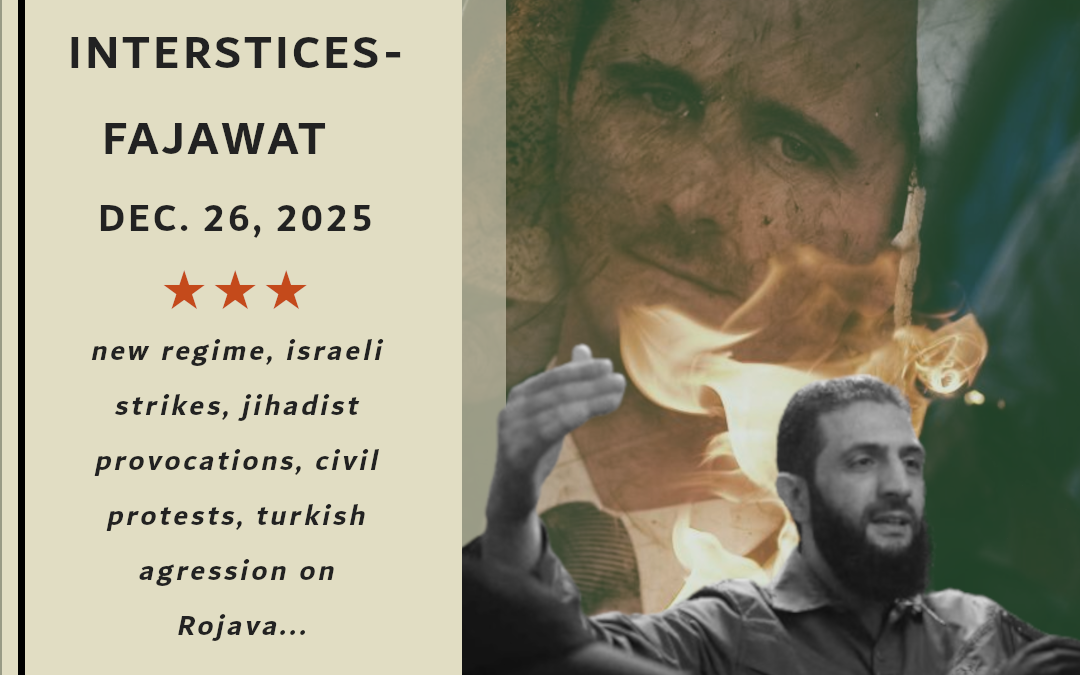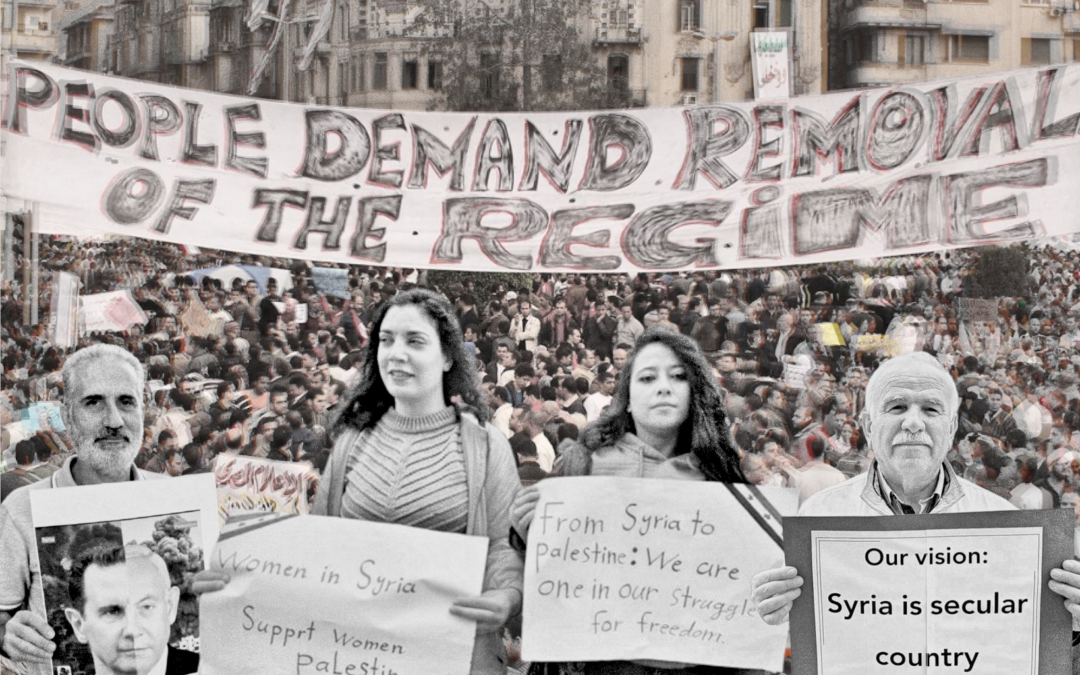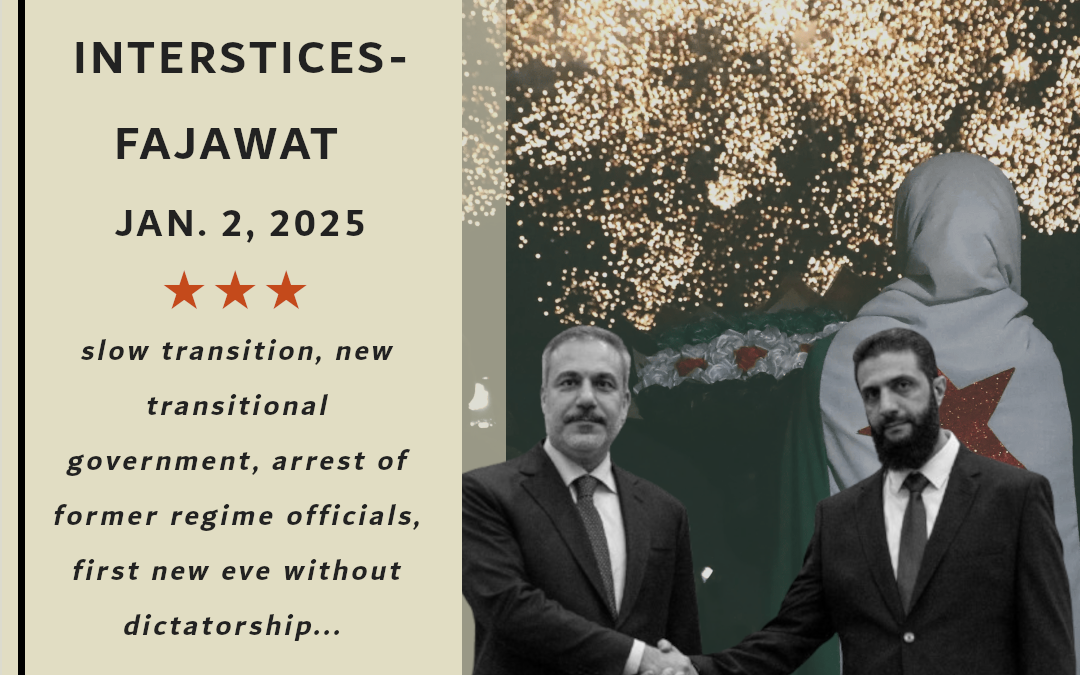
The Syrian Chronicle by Interstices-Fajawat, January, 2, 2025

The Syrian Chronicle by Interstices-Fajawat, January, 2, 2025

Fajawat Collective

by Fajawat Collective | Jan 2, 2025

CHRONICLE WRITTEN IN COLLABORATION WITH FRENCH COLLECTIVE/MEDIA “CONTRE ATTAQUE“

Our previous chronicle was published at a time when a large-scale military operation was being launched by HTS in Homs and Tartus regions to arrest a number of former officers and henchmen loyal to the deposed Assad regime. These militiamen, who had taken refuge in the predominantly Alawite coastal regions (the religious minority from which the Assad clan is descended), had in fact begun issuing threats and agitating the population against a backdrop of fake news, accusing HTS of having deliberately attacked and set fire to a sacred site for the Alawites in Aleppo. Although the holy site was indeed attacked on December 5 during the first assaults against the regime, HTS immediately condemned the action and promised to punish those responsible, which is quite different from what Assad's nostalgic supporters claim, alleging that HTS was organizing ethnic cleansing of the Alawites. In fact, this cleansing has not taken place, even though images of violence have circulated, showing militiamen from the deposed regime being mistreated when arrested. At the same time, Alawite religious and civil leaders met with HTS officials and issued statements invalidating rumors of persecution.

These sectarian tensions make us forget that the majority of Syria's Alawite population was also suffering under Assad's dictatorship, and that an attempted insurrection started from the Alawite community in August 2023 (August 10th Movement: https://en.majalla.com/node/297431/politics/alawite-protest-movement-emerging-syrias-coastal-areas ; https://syriadirect.org/where-does-latakia-stand-on-suwaydas-movement/ ), immediately put down by the regime. For the past two weeks, we've also been struggling on social networks (when we clearly have other things to do) with Western and/or pro-Assad accounts spreading disinformation and rumors about the persecution and massacre of Christians in Syria, which is simply not true. It seems that part of the world doesn't want to leave Syrians in peace and finds interest or pleasure in circulating images of atrocities, which deny our need to heal from decades of trauma. Our nightmares make their fantasies. To sort out what's true from what's not, and to deal with the rumors, we invite anyone to follow the @VeSyria / https://verify-sy.com/en account.

Still on the security front, Al-Shara'a continued to reward his lieutenants with responsibilities within the new military apparatus. A list of some 50 appointments to the new Ministry of Defense was made public, including at least seven foreign fighters, three of them Uighurs, one Turk, one Jordanian, one Egyptian and one Albanian. The Minister of Defense and the Head of Intelligence have also been appointed, all from HTS and the multiple Islamist factions that constitute it.

On the political front, the transitional authority has made progress. Last week, Ahmed Al-Shara'a (aka Al-Joulani) appointed the first woman to the government, Aisha Aldebs, as head of women's affairs. What appeared to be an encouraging sign was immediately tarnished by her first, extremely conservative statements, which for the past week have sparked strong polemics in Syrian society, as well as virulent reactions in the media. In the aftermath, Al-Shara'a seems to have wanted to adjust the balance by appointing other women to positions of responsibility: Maysaa Sabrine, as Governor of the Syrian Central Bank, Diana Elias Al-Asmar (Christian) as Director of the Damascus University Children's Hospital, and finally Mohsena Al-Maithawi (Druze), as Governor of the Suwayda region, which was a request from the Druze community. At the same time, freelance journalist Mohammed Al-Faisal was appointed spokesman for the transitional government.

Beyond this, Al-Shara'a also announced deadlines for the drafting of a new constitution and the holding of elections, stating that it would take between 3 and 4 years to guarantee the implementation of UN Resolution 2254 for a democratic transition in Syria. Given the catastrophic state of Syrian society and institutions, these timescales seem realistic, although there is still considerable concern about how the transitional government will manage public affairs over this long period. While Shara'a has rejected the federalist option and justified his choice of appointing only officials close to HTS, he has nevertheless reassured his interlocutors and detractors by promising the future dissolution of HTS within the framework of the National Conference for Dialogue due to begin on January 5. A preliminary meeting of the conference was held on December 28, but it was roundly criticized for the low participation of women (3 out of more than 100 people) and young people, as well as for the superficiality of the exchanges that took place. The way in which participants are chosen and invited remains vague. The Madaniyya network, made up of over 150 Syrian civil society organizations committed to the principles of the 2011 revolution, and which has already met with a number of foreign delegations, is waiting, for example, to be taken into consideration by the transitional government and the national conference for dialogue.

One of the blind spots in this transition is therefore still the condition of women, as well as that of the thousands of detainees and forcebley disappeared people plus their relatives, who have not been offered any concrete support or any prospect of justice or reparation. Many associations and human rights groups have begun to denounce the fact that prisons and their archives have not been put under protection over the past two weeks, and have been subject to destruction and theft. This obvious negligence raises questions about the new government's real desire to dig deep into the secrets of the deposed regime. Silence, too, on the fate of the Syrian communes occupied by Israel and Turkey, as well as that of the Druze community of Suwayda, which has enjoyed de facto autonomy for several years now and has so far neither been invited nor solicited by the new central authority in Damascus. Silence again on Russian military bases, whose total withdrawal is not mentioned, despite the fact that Russia has spent the last ten years bombing and participating in the massacre of Syrian communities. Al-Shara'a, on the other hand, has declared its desire to respect Russian strategic interests in the region, a priori on a level with those of Israel and the United States.

In conclusion, one of the main “Gordian knots” in post-Assad Syria remains the fate of the Kurdish population, and more specifically that of the autonomist Rojava project. The Syrian Democratic Forces are struggling to contain the onslaught of pro-Turkish militias on the banks of the Euphrates, and have even driven them back to the outskirts of Manbij, while the autonomous administration of north-eastern Syria has entered into negotiations with HTS, even considering demilitarization and the reunion of the SDF within the new national army. But not without serious guarantees from the new government in Damascus...
Podcast : We Will Need Time – The Final Straw Radio (USA)

Podcast : We Will Need Time – The Final Straw Radio (USA)

This podcast was made by THE FINAL STRAW RADIO, Asheville, NC, USA

https://thefinalstrawradio.libsyn.com/we-will-need-time-two-libertarian-communist-perspectives-on-events-and-possibility-in-syria 

In this episode, you’ll hear Cedric and Khuzama, two libertarian communists with connections to Syria and editor contributors to the blog interstices-fajawat.org , speaking about their observations of what’s been going on leading up to and through the ouster of Bashar Al-Assad, as well as complications among various factions on the ground and the view from the Syrian diaspora. The situation on the ground is changing fast, so check the show notes for this episode on our website for links to news sources that can be helpful in keeping up.

And if you care to hear a perspective from an anarchist combatant affiliated with Tekosina Anarsist, which works with the Autonomous Administration of North and East Syria affiliated with the SDF and Rojava Revolution, you can find our episode from December 22nd and the transcribed zine.

We Will Need Time: two libertarian communist perspectives on events and possibility in Syria

by The Final Straw Radio

The Syrian Chronicle by Interstices-Fajawat, December 26, 2024

The Syrian Chronicle by Interstices-Fajawat, December 26, 2024

Fajawat Collective

by Fajawat Collective | Dec 26, 2024

CHRONICLE WRITTEN IN COLLABORATION WITH FRENCH COLLECTIVE/MEDIA "CONTRE ATTAQUE"

Since the fall of the Assad regime, things have been moving fast.

Ahmed al-Shara'a (aka Al-Julani), leader of the rebel group Hay'at Tahrir al-Sham (HTS) has immediately appointed a transitional government formed from the pre-existing Syrian Salvation Government in Idleb since 2017. The ministers are not military, but professionals in the fields entrusted to them. They are clearly not progressives, but rather conservative Islamists. However, no constitutional changes or decisions involving major societal changes without the consultation and agreement of the Syrians have yet been taken. At the end of its transitional mandate, the interim government is supposed to make way for a national conference representing all Syrian factions and minorities, to form the new Syrian state.

Shara'a has also appointed several warlords as provincial governors, which does not reassure everyone, but not all appointments have been made and readjustments are underway. In Suwayda, a southern province where over 90% of the population is Druze, a minority that cannot be suspected of Islamist sympathies, a regional council representing all local factions has proposed the nomination of a woman as governor, a first in the country's history. In addition, a major meeting of the leaders of the various armed factions was held in Damascus to agree on the disarmament of all armed groups and the integration of their personnel into the future national army, on a voluntary basis. Shara'a announced the end of compulsory conscription.

Over the past two weeks, social networks have been pouring out conflicting reports of violence against minorities and extrajudicial executions on the Alawite-majority coast, but none of this has taken place in the areas liberated from the former regime by the HTS rebels. In Tartus and Latakia, on the contrary, Alawites welcomed the fall of the regime with the same enthusiasm as everywhere else. Nonetheless, many accounts claiming to be well-informed are spreading false information and unsourced, undated images on a daily basis to legitimize and incite inter-community tensions, despite the fact that the transitional authorities have done everything in their power to ensure that there are no reprisals or acts of violence against minorities.

Incidents took place, including the burning of a Christmas tree in Suqaylabiyah, on the outskirts of Hama, an act whose perpetrators were arrested by HTS, which undertook to repair the damage and declared Christmas an official Syrian holiday. Foreign fighters, in particular Uighurs, Chechens and Kazakhs, have been singled out and demonstrations have taken place (without incident) to demand their disarmament and expulsion from the country. These demonstrations come a week after a demonstration in the heart of Damascus in favor of secularism, which met with a wave of criticism because its main organizers were defenders of the Assad regime before its fall, but also because of the conspicuous absence of Syrian revolutionary flags. The necessary struggle for a new regime that guarantees secularism and the protection of minorities, including atheists, was thus discredited by this lamentable recuperation by personalities seeking to redeem themselves with Syrians. Moreover, the polemics surrounding this demonstration overshadowed another demonstration called in Homs by women's groups in favor of secularism and the protection of freedoms.

In terms of international politics, the daily choreography of foreign delegations coming to speak with Syria's new strongman is breathtaking. Each one seems to be keen to set conditions, demand its due or obtain guarantees, while Turkey appears to be the big winner in this regime change. Indeed, it has been quick to invest in the Syrian economy, announcing the imminent reopening of the air route between the two countries and the restoration of the railroads abandoned since 2012. There's no doubt that this renewed interest in Syria on the part of foreign states is motivated by the lure of profit, insofar as Shara'a has announced the country's reconnection with the market economy. Germany, in addition to being clearly in favor of the genocide of the Palestinians, was among the first states to suspend Syrian asylum applications and to rush to Erdogan's side to congratulate him and remind us of what a first-rate partner he has been in terms of migration management... Rapacious.

For its part, Israel continues to militarily occupy villages in the provinces of Dera'a, Quneitra and rural Damascus: at present, nearly thirty villages have been annexed, affecting almost 50,000 Syrian residents. Israeli officials are delighted to have taken possession of Mount Hermon, which accounts for 30% of Syria's water resources and 40% of those of Jordan. While Shara'a cautiously avoids criticizing Israel, the population did not wait to express its hostility towards the Israeli army, which opened fire and wounded several people before withdrawing from the village of Al-Suwaisa (Quneitra). Residents of the Druze village of Hader also publicly declared their refusal to be annexed by Israel, thereby responding to the rumors and fake news propagated by Zionists and Islamists falsely accusing the Druze of being pro-Israel.

Finally, the Kurdish question will also be decisive, depending on US decisions and the outcome of ongoing negotiations between Shara'a, the US-backed Syrian Democratic Forces (SDF) and the autonomous Rojava administration. On December 14, the truce in the Kobane and Manbij regions agreed two days earlier was immediately violated by Turkey, prompting the SDF to retaliate against the pro-Turkish militias of the Syrian National Army (SNA). Let's not forget that if the war is not over, the fault lies largely with the colonial and imperialist aspirations of Erdogan, who is neither the liberator nor the friend of the Syrians. As for the SDF, over 60% of its members are Syrian Arabs, which does not make it a Kurdish force as some claim. The simplification of power relations and the ethnocultural characteristics of the regions east of the Euphrates are partly responsible for the indifference of many Syrians to what is currently happening there, and therefore for a form of denial regarding the crimes committed by the pro-Turkish forces.

The situation therefore remains extremely uncertain, even if we are generally confident about future developments, as a number of progressive, democratic and secular popular initiatives have already been launched, demonstrating that Syrian society will not allow itself to be imposed with a new military or religious dictatorship. Whatever may happen in the coming weeks, what has been happening in Syria over the past two weeks is an unprecedented demonstration of collective resilience.

Call to all Syrian progressive forces !

Call to all Syrian progressive forces !

Fajawat Collective

Dec 12, 2024

Apart from the accomplices of the Assad regime and the civilian populations still being targeted in the North and East of Syria, all Syrians are happy with the liberation of Syria thanks to the offensive of the Syrian rebels and the support of many Syrian communities who were only waiting for a signal to participate in the liberation.

After 58 years of one of the most ferocious dictatorships, and not 13 or 24 years as suggested by the Western media, Syrians needed at least 48 hours to breathe and share their infinite happiness, their cries, their joy, but also their tears of relief and sorrow too long contained.

Many abroad have not respected this need, continuing to infantilize Syrians and scorn their democratic and secular aspirations, constantly brandishing the Islamist threat in front of our faces since the start of the rebel offensive (which we refuse to reduce to Hayat Tahrir al-Sham, because hundreds of other factions have joined the operation).

We didn't need to be told. We were among the first to suffer this threat, which has been with us for years, but we also know that jihadist criminal groups didn't just spring up. They were born out of the chaos produced by decades of colonization, armed invasion and indiscriminate bombing.

Having celebrated, Syria's progressive forces must now act fast and not relax too early. The threats of a reactionary and fundamentalist backlash are real.

That's why we want to share a few essential demands with you, to be widely disseminated within ALL Syrian communities and passed on to those who will ensure the political transition in Syria.

We must:

END THE VIOLENCE

  • Put an immediate end to all military intervention in the areas of Idleb, Aleppo, Raqqa, Deir Ez-Zor and Hasakeh and implement ceasefire agreements between rebel forces and YPG/SDF armed forces;
  • Condemn and put a definitive end to foreign bombing raids on Syrian soil;
  • Demand the liberation of Syrian territories and civilian communities held hostage by neighboring states and armed groups serving their interests, in particular Israel and Turkey in the Golan, Quneitra, West Damascus, Idleb, Aleppo, Raqqa and Hasakeh regions;
  • Disarm non-Syrian armed fighters and ask them to leave the country, return home or apply for asylum in Syria, to be considered in the light of serious investigations into the crimes committed by the armed groups to which they belonged;
  • Guarantee access to Syrian territory for humanitarian NGOs and journalists;

IMPLEMENT A RESTORATIVE JUSTICE PROCESS:

  • Protect and analyze the archives of the Assad regime's security services, then make them available for consultation by those concerned, to enable grieving and reparation for the crimes, as well as prosecution of the perpetrators;
  • Protect and allow full access to the lists of detainees and victims of the Assad regime for the families of victims searching for missing persons;
  • List those complicit in slanderous denunciations and protect their identity to prevent personal vengeance and ensure fair judicial procedures, which may involve transformative and restorative, rather than punitive, modes of justice;
  • Arrest and detain in humanitarian conditions all army, security service or armed militia personnel suspected of direct involvement in the commission of crimes against civilians and war crimes;
  • Prevent any public humiliation or execution, and initiate justice processes that respect international conventions against the death penalty;
  • Enable the establishment of alternative systems of conflict resolution and justice, allowing defendants to choose under which justice system they wish to be tried, while prohibiting the use of penalties involving corporal punishment or the death penalty;

GUARANTEE POLITICAL TRANSITION:

  • Prevent the establishment of a political regime based on religious or ethnic affiliations, to prevent a sectarian division of Syria;
  • Prevent the use of symbols of armed groups, as well as flags associated with Al-Qaeda and the Islamic State, and other Islamist groups, in the public institutions of the new political regime;
  • Organize a political transition to a confederal regime allowing egalitarian and non-segregative representation of the different ethno-religious communities of Syrian society that represent at least 1% of Syrian society: Sunni Arabs, Shiite Arabs, Christian Arabs, Druze, Alawites, Kurds and Assyrians. Ethnic communities representing less than 1% of the Syrian population must be given proportional representation in order to ensure respect for their specific identities and related rights: Turkmen, Circassians, Bedouins, Armenians, Mizrahim Jews, Yezids, Palestinians, Romanis, Aramaic/Syriacs;
  • Freeze all cooperation with a neighboring state that does not guarantee full freedom for populations belonging to at least one of the above-mentioned Syrian communities;
  • Restore full and unrestricted political and religious freedoms, as well as freedom of association, freedom of assembly, freedom of expression and freedom of the press;
  • Guarantee the freedom and protection of the rights of women and sexual minorities;

Without the implementation of all these demands, the self-determination of Syrians is not guaranteed, and the resurgence of authoritarian powers is to be feared. We must mobilize en masse to prevent history repeating itself and autocratic or reactionary ambitions compromising the democratic and secular Syrian revolution.

We must therefore loudly proclaim our solidarity with the Palestinian, Lebanese and Kurdish peoples in the face of oppression and unjustified violence. It's not a question of supporting armed groups who carry their voice, but of sending a clear message to our brother peoples and to civilians who don't deserve to suffer the repercussions of colonial wars.

We only want peace and democracy in Syria and the surrounding region.

Fajawat Initiative

2023 – In southern Syria, the uprising of Dignity has begun

2023 – In southern Syria, the uprising of Dignity has begun

Fajawat Collective

by Fajawat Collective | Oct 2, 2023

More than ten years after the uprising of 2011, the revolt has resumed in southern Syria. As in 2011, the mainstream media are not reporting much on it, as if popular uprisings in this region were only of interest if they coincided with the interests of the states that have been working to carve up the Middle East since the Sykes-Picot agreements in 1916. This time, the revolt started in Suwayda, the Druze governorate, in the middle of August and spread modestly to other towns, notably in the neighboring governorate of Dera'a. This text offers a contextualization on Syria in general and on Suwayda in particular. It has been written by people from the region who are concerned about the situation there, and who hope that a solution will finally be found for the people, which does not simply consist of choosing their oppressors. No foreign power can propose a viable and satisfactory solution for the Syrians, their land having served as a bloody playground for all the powers that have interfered in their affairs.

The Druze exception

The Druze are a religious community attached to a heterodox belief in Ismaili Shi'ite Islam, which originated in Egypt under the impetus of Imam Hamza ibn Ali ibn Ahmad and Vizir Nashtakin ad-Darazi in the early 11th century. The druze religion, like Sufism, takes a philosophical and syncretic approach to faith, recognizing neither the rigorist precepts nor the prophets of Islam. Note that the Druzes prefer to call themselves Al-Muwahhidun (Unitarians) or Bani Maaruf (People of Goodness). Despite the spread of this belief to Cairo during the Fatimid caliphate of Al-Hakim, who was venerated by the Druzes, they were swiftly subjected to persecution by the rest of the Muslim community following his demise in 1021. As a result, they were exiled to Bilad el-Cham (present-day Syria, Lebanon, Jordan, and Palestine), specifically to Mount Lebanon and Hawran. However, it was around the beginning of the 19th century that the Druze community of Hawran gained strength after a large part of the community had been expelled from Mount Lebanon by the Ottoman authorities. The Hawran then took the name of Jabel al-Druze.

Today, Suwayda governorate is home to the majority of the world's Druze community, some 700,000 people. The Lebanese Druze are the second-largest community, numbering 250,000. In Syria, several Druze settlements also exist in Jebel al-Summaq (Idlib, 25,000 people), Jebel al-Sheikh (Quneitra, 30,000 people), and Jaramana (Damascus suburbs, 50,000 people). Finally, outside Syria and Lebanon, the largest Druze communities are to be found in occupied Palestine (al-Juwlan, Galilee and Mount Karmel, 130,000), Venezuela (100,000), Jordan (20,000), North America (30,000), Colombia (3,000) and Australia (3,000).

Following numerous revolts against the Ottoman Empire until 1918, then against the French colonizers between 1925 and 1945[1], the Druze have a reputation for insubordination that describes them to this day and which has enabled them to maintain a permanent balance of power with the Assad regime, based on compromises negotiated between Druze leaders and the regime's local representatives[2]. After 2011, despite a few sheikhs expressing their support for the regime[3], many Druzes took part in the demonstrations against Bashar al-Assad, mostly supporting the position of the "Men for Dignity"[4], who refused to take part in the war and called on the community to arm itself for the sole purpose of self-defense. The sheikhs took the lead and the initiative by refusing to join the regime's army with the aim of protecting the region and its youth, but also to prevent the community from being compromised in Assad's war by taking part in the repression of other communities elsewhere. This defiance of the regime was embodied, among others, by the druze sheikhs Ahmed Salman al-Hajari and Abu Fahd Wahid al-Bal'ous, who both were killed, the first in a car "accident" in March 2012[5] and the second in a bombing that killed 23 other people in September 2015.

Other prominent druze figures got involved in the opposition: Khaldoun Zeineddine, his brother Fadlallah Zeineddine and Hafez Jad Al-Kareem Faraj, all three officers in the Syrian army, from which they defected to join the rebels. Khaldoun Zeineddine formed the Sultan Pasha al-Atrash Battalion within the Free Syrian Army (FSA)[6] [7]. Joined by a number of Druzes, the battalion, however, remained weak and isolated and faced several attacks and kidnappings by Al-Nusra rebels in Dera'a[8] before being finally wiped out and its commander killed in 2013[9]. Its remaining members fled to Jordan, from where they announced the cessation of their activities in January 2014, denouncing a lack of support for the revolution from the Suwayda Military Council and from the Druze community, as well as the hostility toward the Druze on the part of the rebel groups of Dera'a, called "Islamists" and accused of being accomplices of the Assad regime[10].

Generally speaking, the Druze have a very secularist vision of society, and their religious representatives refuse to take charge of the community's political and administrative affairs. In the conflicts that have shaken Druze and Syrian society, the sheikhs have repeatedly expressed their support and encouragement for the community's choices[11]. While the Druze community has refused to take sides in the civil war, it has nevertheless always expressed its rejection of the regime, not hesitating to confront the security forces present in the governorate to enforce their demands or free prisoners from the hands of the army[12].

Bashar and his Islamist puppets

Right from the start of the insurrection and repeatedly since, the regime has played the divide-and-rule card, urging the Shi'a and Ismaili religious minorities (to which the Druzes belong) to oppose the FSA because of the "Islamist threat" their Sunni majority component is supposed to represent. In the propagandist rhetoric of the regime and its allies, the FSA rebels are constantly equated with the Al-Nusra Front and branded as Salafists or takfiri, while the useful idiots of the Islamic State are used in a thousand ways to hinder the revolution and to go hand in hand with the regime's forces for the indiscriminate slaughtering of the Syrian population. In fact, the most radical religious component of the Syrian opposition has been deliberately favored by the regime: between June and October 2011, three months after the first anti-regime demonstrations, Bashar al-Assad released nearly 1,500 Islamist militants from prison, most of whom went on to join jihadist groups affiliated with al-Qaeda and ISIS. Thus, the main leaders of the Jabhat al-Nusra, Ahrar al-Sham and Jaish al-Islam groups, as well as the ISIS section responsible for most of the beheading of foreigners, had previously been released from the notorious Saydnaya prison[13].

Bashar al-Assad's strategy has paid off, as the outpouring of violence from ISIS jihadists has succeeded in permanently distracting the rest of the world's gaze from the atrocities committed by the Syrian army, the Shabihas[14] [15] and Iran-backed militias[16], and then from the massive bombing of civilians in the north and east of the country by the Russian air force from September 2015 onwards[17], with this military intervention itself motivated by the "fight against Islamists". Moreover, it has enabled the Kurdish People's Protection Units and Women's Protection Units (YPG/YPJ) to distance themselves from the Syrian revolution and focus their forces on the fight against the Islamists, mainly with American help. Finally, because of the terror instigated by the jihadists and out of disinterest in the fate of the Syrian people and their revolution, the "international community" (EU, USA and UN) did not bring substantial support to the FSA, leaving Qatar, Saudi Arabia and Turkey to provide logistical and military support to the FSA components most compatible with their political agenda and confessional interests, so to speak "the Islamists"[18]. The democratic, secular and socialist components of the FSA, abandoned on most sides and threatened from within by the Islamists, then had no choice but to join the sectarian groups in order to survive and continue the fight against the main executioner of the Syrian people: the regime of Bashar al-Assad[19].

In May 2018, Bashar al-Assad's regime made an agreement with ISIS for their surrender in the Damascus area[20]. Following this agreement, 800 of its fighters and their families (1,800 people) had been evacuated from the districts of Yarmouk and Tadamon (Damascus suburbs) to the desert near Palmyra and to abandoned villages northeast of Suwayda[21], with 40 trucks and cars under heavy guard by the Syrian army. Three months later, on July 25, 2018, ISIS predictably attempted to invade the Suwayda governorate from the east, guided by Bedouins who had a long-standing discord with the Druzes. At dawn, ISIS fighters thus began slaughtering the population of several druze villages on the edge of the desert[22] before taking 42 members of the community as hostages (including 16 children and 14 women[23]) and carrying out four suicide attacks in the heart of the main city of Suwayda[24]. Hundreds of Druzes from Jabal al-Druze (the region of Suwayda), joined by Druzes from Jabal al-Sheikh (located on the border with Lebanon), spontaneously took up arms and threw ISIS back into the desert, putting a stop to its campaign towards the south of the country[25] but also definitively confirming the anger and distrust of the Suwayda Druzes towards the Syrian regime, accused of using ISIS to weaken them[26].

Regime and gangs hand in hand

Although the region has escaped bombardment and military operations since 2011, the people of Suwayda, like all Syrians, have endured the consequences of the war and the regime's murderous policies: sporadic armed confrontations with gangs and militias affiliated to the regime, assassinations, kidnappings, drug trafficking[27]...

In the spring of 2022, the gang of Raji Falhout, a notorious trafficker, claimed responsibility for the kidnapping of some twenty residents of Suwayda and Dera'a[28] before his men stormed the swimming pool in Suwayda's al-Maqous district to kidnap its users, provoking an armed confrontation with the residents[29].

Following this incident, an uprising broke out on July 26 in the town of Shahba following the kidnapping of a resident, Jad al-Taweel, by Falhout's gang[30]. Residents led by the "Men for Dignity" Movement blocked the roads and arrested military intelligence agents affiliated with the local organized crime[31] before taking up arms against the Falhout gang, leaving 24 people dead on the residents' side and 12 on the gang's side. The gang's headquarters in the towns of Salim and Atil were then stormed by residents of numerous villages in the region, leading to the capture of the premises, the release of hostages, and the discovery of Captagon production equipments[32], revealing the Assad clan's complicity with organized crime, using the 4th Military Intelligence Division and Hezbollah as middlemen[33]. Over the past decade, these regime-affiliated gangs have been responsible for numerous kidnappings and assassinations, causing insecurity and violence to destabilize the region.

After the eradication of the Falhout gang and its affiliated gangs, kidnapping and car theft operations in the Suwayda region significantly decreased[34], and this victory over organized crime has proven the capacity of the Druze community to ensure its own security.

Falhout gang with the citizens they kidnapped, 2022.

Raji Falhout posing with his gang.

Raji Falhout's card as a member of the Intelligence Service Division n°2017.

People from Suwayda gathering to raid the Falhout gang

Captagon production

Endemic crisis and seeds of dissent

Over and above the direct consequences of the civil war, and then of the imperialist wars waged in Syria by the major powers (Iran, Russia, Turkey, Israel, the United States, Qatar, Saudi Arabia...)[35], Syria has been in an unprecedented economic slump for ten years. The population was initially subjected to rationing of basic resources and foodstuffs, such as water, gas, petrol, fuel oil, bread, sugar, oil, rice, tea and onions, obtained with the help of a ration card (the smart card), before abolishing this support for essential goods, leaving the population obliged to buy these commodities at market prices. The value of a Syrian pound has risen from $1 = 47 SYR in 2011 to 500 SYR in 2017, and climbed from 2,500 to 14,000 SYR by the summer of 2023, with an above average salary of 200,000 SYR ($14). In summer 2023, the food prices reached unprecedented level: 1L oil = 30000 SYR, 1L milk = 6000 SYP, 1kg flour = 4500 SYR, 1kg tomato = 4000 SYR, 1kg potatoes = 6500 SYR, 1kg onions = 3500 SYR, 1kg cucumber = 4000 SYR, one egg = 2000 SYP. This means that the majority of Syrians have spent their entire salary in less than a week. As for electricity, two years ago it was delivered to the Suwayda region as part of a daily rationing program (three hours on, three hours off), before this short window was reduced to an hour and a half on, versus six or seven hours off, not to mention the numerous power cuts occurring during this time, causing the rapid degradation of electronic devices whose purchase or fixing prices are unaffordable.

In recent years, Russian military police have regularly attempted to act as peacekeepers to ease tensions generated by the economic crisis. Its presence was confirmed in 2021 in Suwayda governorate, when a delegation of Russian officers presented themselves to the population with the intention of recruiting deputies from the population of both governorates[36]. The Russian contingent based in Bosra, located between Suwayda and Dera'a, made several attempts to distribute food aid in 2021 to Shahba and in 2022 to Dhibin, but residents firmly rejected their humanitarian intervention[37].

Between 2020 and 2023, spontaneous and short-lived demonstrations regularly took place in Suwayda, but were either not renewed or were repressed. In February and April 2022, protesters blocked the roads, stormed the governorate building, and set fire to a military vehicle before security forces opened fire on demonstrators, killing one and injuring 18[38]. Nevertheless, in December 2022, protesters managed to storm the governorate building for the second time, while their slogans and protest signs were mainly demanding a "decent life", after the allocations of gas and electricity had been reduced. Throughout the winter and spring of 2023, rallies continued under pressure from Baath Party members actions, who attempted to organize pro-regime demonstrations in order to intimidate the protesters.

Meanwhile, the Assad regime returned to the fold of the Arab League following diplomatic meetings in Cairo on May 7, 2023, and the Arab League Summit in Riyadh on May 19[39], as well as a Chinese-brokered deal to reestablish ties between Iran and Saudi Arabia in order to defuse the proxy war these two countries are waging in Syria and Yemen[40]. In exchange for this return of favor, Bashar al-Assad committed himself to tackling drug trafficking on his borders with Jordan and Iraq[41]. The day after the Cairo agreement, Jordan sent a clear message to the Syrian authorities by carrying out an air strike on the personal home of drug trafficker Marai al-Ramthan in Al-Shaab, south of the Suwayda governorate, killing him, his wife and six children, as well as an Iran-linked (handled by Hezbollah) drug facility in Kharab al-Shahem in the nearby Dera'a governorate[42].

And the fuse caught fire…

On August 5, 2023, a collective emerged in the coastal governorates of Latakia and Tartus, issuing an ultimatum to the regime by August 10[43], demanding reforms and making public a list of demands in application of UN Security Council Resolution 2254 which was adopted in Geneva in 2015. A particular feature of the movement is that it has developed in regions with a strong Alawite community, to which Bashar al-Assad belongs, notably in the towns of Tartus, Latakia, Banias and Jableh, where thousands of leaflets have been distributed[44]. In response, Bashar al-Assad raised civil employees' salaries by 100% but simultaneously announced the abolition of petrol subsidies and an increase in fuel prices, with the price of a liter of petrol rising sharply from 3,000 to 8,000 Syrian pounds, an increase of 167%, and the price of fuel from 700 to 2,000 Syrian pounds, an increase of 186%. Syrians' exorbitant transport budgets are making daily life impossible and forcing thousands of Syrians to stop going to work. Faced with the rise in resignations in the public sector, the regime has responded by tightening the conditions of resignation. Meanwhile, the regime has announced its intention to abolish subsidies on all consumer goods by 2024[45].

In the wake of these announcements, a call for a general strike was issued in southern Syria[46]. Since August 16, more than 52 communes in southern Syria have witnessed demonstrations using various types of action: strikes, vigils, blocking roads, closing government institutions, etc.

Demonstrations of support took place in the governorates of Idlib, Dera'a and Aleppo, as well as in Jaramana, the predominantly Druze district of Rural Damascus, reviving the slogans of 2011 for the fall of Assad : "Syria is ours, not Assad's", "one, one, one, the Syrian people are one" and "the people want the fall of the regime". The demonstrators also expressed their wish to see an end to the Iranian presence in Syria.

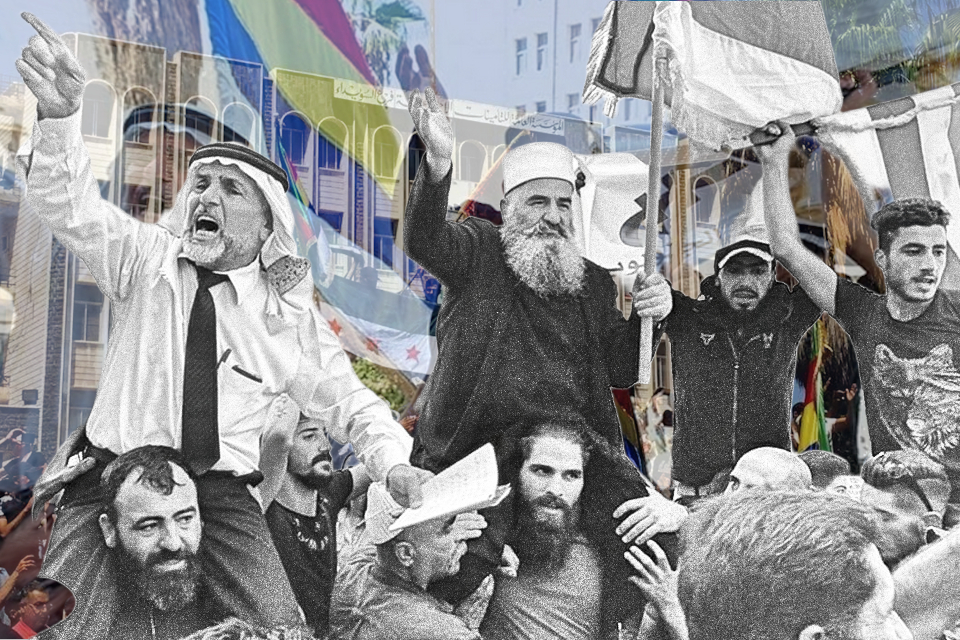
On August 25, demonstrations spreaded to Idleb, Aleppo, Azaz, Afrin and Al-Bab. In several places, demonstrators waved the Druze, Kurdish and Syrian Revolution flags together. While the regime's forces did not overreact in Suwayda governorate, they did open fire in Aleppo and Dera'a, killing at least two people. The Syrian Human Rights Network also reports the arrest of 57 people in connection with the protests, mainly in the governorate of Lattakia et Tartus[47].

Protesters show Druze, Syriaque and Kurdish flag replacing the three stars of the Syrian Revolution flag in the city of Idleb

Protesters show Syrian Revolution, Kurdish, Shia, Druze, Sunni, Christian and Syrian national flags in the city of Suwayda.

Since then demonstrations in Suwayda's central square, long since renamed "Dignity Square" (al-Karami) by the population, have been weekly, if not daily, and have grown from one Friday to the next, reaching several thousand people a month after the start of the revolt, on September 22. Baath Party offices and a number of government offices were closed by the demonstrators during the protests, while banners and portraits of Bashar al-Assad were destroyed and burned.

Meanwhile, on September 14, Bashar al-Assad's cousin, Firas al-Assad[48], published a video in which he condemned the regime and expressed his support for the demonstrators[49]. This video follows that of Majd Jadaan, Maher al-Assad's sister-in-law[50], fiercely denouncing the crimes of the Assad clan from Jordan and hailing the revolt of the people of Suwayda against the regime[51]. Interviews of actors of the revolt were also made public, such as that of the leader of the "Men of Dignity Movement" in Suwayda, Sheikh Abu Hassan Yahya Al-Hajjar[52], or the activist and lawyer Adel al-Hadi[53].

Protesters burn a military vehicle in front of the governorate building.

The governorate building with Hafez al-Assad's picture set in flames.

In the chaos of the proxy war

Despite twelve years of revolt and civil war, the Syrian regime is still in power. If it has withstood the storms, it is undoubtedly thanks to the interventions of Iran, ISIS and Russia, each of which, in their own ways, helped to make the Revolution so desired by the Syrian people impossible. To this we can add Saudi Arabia, Qatar and Turkey, who for their part have succeeded in creating division within the democratic and secular forces of the Free Syrian Army by favoring, as mentioned earlier, the most reactionary and least democratic forces of the rebellion against the regime.

The United States, for its part, which is responsible for the birth and development of Al-Qaeda and the Islamic State, both born on the still-smoldering rubble of Afghan and Iraqi societies, chose in 2011 (the year of its official withdrawal from Iraq) to no longer participate directly with its armed forces in conflicts in the Middle East. For all that, after condemning the repression of the 2011 protests and imposing sanctions against the Assad regime, the United States launched its first air strikes in Syria in September 2014[54] and, from 2015, sponsored the new Syrian Democratic Forces (SDF), made up of 25,000 Kurdish fighters from the YPG/YPJ and 5,000 Arab fighters, with the stated aim of halting the advance of the Islamic State. Initially spared, the Syrian regime finally underwent US strikes in 2017 and 2018, in retaliation for the Syrian army's use of chemical weapons against civilians in Douma (Damascus) and Khan Cheikhoun (Idlib)[55]. That same year, two-thirds of the American troops deployed on Syrian soil were brought back in agreement with Turkey, which then decided to launch an offensive in the Kurdish-controlled border zone in order to establish a "security zone" there[56]. Nevertheless, the United States maintained a strong presence in Syria; in 2021, it carried out a series of air strikes against Hezbollah and its Iraqi allies, including Hachd al-Chaabi, who were held responsible for attacks against "western interests" in Iraq[57].

Russia, which has been one of the Syrian regime's main military backers since 2015, was diverted by its invasion of Ukraine, which didn't go exactly as Putin would have liked. It had to withdraw a significant part of its contingent from Syrian territory[58] to redeploy it in eastern Ukraine, while the 250 to 450 Wagner mercenaries operating notably in the Syrian governorates of Homs and Deir ez-Zor, remaining without leadership since the Prigozhine mutiny, were reportedly ordered to report to their base in Hmeimim (Latakia governorate) and return to the authority of the Russian military command[59]. Some of those who refused were possibly sent back to Russia or redeployed to Mali. As a result of the withdrawal of Russian troops, some of the military bases under their control were transferred to the Iranian armed forces, notably the Islamic Revolutionary Guard Corps and Hezbollah. However, Russia retains its military forces in Syria and has no intention of relinquishing its share of influence in the region, particularly in the face of Iran, which remains its main competitor there.

Iran, which has been the primary supporter of the Assad regime since the reign of Bashar's father, Hafez, remains the key player in the Syrian war. Without the military support of Iranian militias, the main one being the Lebanese Hezbollah, the Assad regime would probably not have been able to hold out, not least because of Hezbollah's involvement in the trafficking of Captagon, one of the regime's main resources. After denying their presence in Syria, the Iranian regime and Hezbollah ended up openly supporting the Assad regime, calling it both a "jihad against Sunni extremists" and a "necessary intervention to protect Palestine and resist Israel". In the propaganda of Iran and Lebanese Hezbollah, unconditional support for the liberation of the Palestinian people is a mirage that works well, particularly among the Western left[60]. Where one might have expected unanimous support for the Syrian revolution from the majority of revolutionary left-wing forces, a resounding silence responded to the chants of the Syrian demonstrators. In the naive imagination of the left, Iran, Syria and the Hezbollah (and Hamas) militias constitute an indisputable bulwark against American imperialism and Israeli colonialism. In reality, Hezbollah's main concern is to maintain its quasi-hegemonic hold on Lebanese society while working frantically to keep Syria within Iran's zone of influence, on which its entire survival depends. Between 2013 and 2018, the Syrian regime's siege[61] and then violent eradication of the world's largest Palestinian Yarmouk refugee camp (suburb of Damascus)[62], which can easily be considered an operation of ethnic cleansing carried out with the complicity of Hezbollah and Palestinian movements like PFLP and Hamas[63], is enough to disqualify the latter's propaganda as to the reality of their struggle for the emancipation of the Palestinian people.

Israel, without intervening militarily on Syrian soil, has never stopped launching drone strikes on Iranian infrastructures in Syria. In fact, not a month goes by without rockets hitting Hezbollah buildings or executives, the militia being the main concern of the Israeli regime. Yet, Israel has never shown any willingness to support the democratic aspirations of the Syrian people. If we look at the situation rationally, we understand that Israel has no interest in the establishment of a democratic society in an Arab country on its borders, as any democratic progress in the region would naturally lead to Arab solidarity with the Palestinians and a threat to Israel's apartheid regime. In fact, the Assad regime and Hezbollah have largely contributed to restricting the political organization and resistance of Palestinian refugees in Lebanon and Syria[64], which is not to Israel's displeasure.

What could happen next?

Like the Syrian people as a whole in 2011, the Suwayda demonstrators can hardly win a revolution without external support or a large uprising of the Syrian population in the main other governorates.

As for the Free Syrian Army, it's hard to expect enthusiastic support for the Druze uprising, given that the aspiration of the majority of the current fighting groups remains the establishment of an Islamic caliphate that is difficult to reconcile with the democratic and secular aspirations of the Suwayda protesters. Nevertheless, in all the governorates, whether under the control of the regime or the rebels, there are still remnants of democratic movements who see the Druze insurrection as an immense source of hope. This is why those who still believe in a non-confessional, democratic society have spontaneously taken to the streets of various towns to express their solidarity with Suwayda, whether they be Sunni Muslims, Alawites, Christians, Syriacs, Arabs or Kurds.

Here again, one would expect Kurdish organizations, which have managed to maintain their autonomous status in a good quarter of the country and proclaim loud and clear that they are driven by a revolutionary, universalist and democratic project, to express more strong and unconditional support for their brothers and sisters in Suwayda. But beyond a communiqué from the women of the Syrian Democratic Council calling for Syrian women to take the political issue into their own hands, we haven't heard much from the Kurdish revolutionary movements. This suggests that, in accordance to their well-established autonomy, the Kurds don't feel much concern for what's happening south of the Euphrates, whether the fate of the rest of the Syrian people or that of the Palestinians. It's sad to see the extent to which solidarity with other struggling communities is not perceived as a sine qua non for the survival of the project for Democracy in the Middle East. Moreover, recent events in Deir ez-Zor have done little to bolster Arab confidence in the Kurdish People's Protection Units (YPG): between August 27 and September 7, the Syrian Democratic Forces, largely dominated by the YPG, clashed with local Arab factions affiliated to the Deir ez-Zor Military Council following the dismissal and arrest of an Arab senior commander of the SDF, Ahmed al-Khubail also know as Rashid Abu Khawla. Although the sanctions taken against him were justified in view of the accusations of corruption and drug trafficking made against him by the local population, the arrest fueled the anger of its supporters, who launched an assault on the SDF, resulting in the death of 90 people over the eleven days the fighting lasted[65]. The backdrop to this conflict is the reproach levelled at the Kurds by the local population, who legitimately blame them for their hegemonic control of the area, which is seen as disrespectful considering the Arab majority living there[66].

Among the Druze, there is intense debate about the procedure to be followed. A certain mistrust seems to persist with regard to the autonomist and confederalist proposal. Some people see in the autonomist claim a risk of separation from the rest of the Syrians, unable to grasp the difference between autonomy and independence, while others confuse the means with the end: when they are told about establishing democratic assemblies and struggle committees to organize the revolt in the medium term, they think they are being told about a long-term project for society, and find it hard to believe in the people's capacity for self-organization without mediators and leaders. As a result, political organization in the context of the popular uprising in al-Karami Square is still struggling to take on the form of the Egyptian Tahrir of 2010 or the Ukrainian Maïdan of 2014, when it would perhaps be sufficient to take up the recipes and positive experiences of the 2011 uprising, and in particular that of the Local Committees described by the Syrian anarchist Omar Aziz[67] and set up in many cities at the time. Unfortunately, if no grassroots’ organizing initiative is put in place, we run the risk of seeing sheikhs and heads of traditional family clans propelled as leaders, to the detriment of lesser-known individuals or collectives driven by more progressive and genuinely emancipatory ideals.

Already, Russian ambassador Anatoly Viktorov has paid a visit to the sheikh of the Druze of Galilee (Israel) Muwafaq Tarif[68], while American representatives French Hill, Joe Wilson and Brendan Boyle have called on phone the sheikh of Suwayda Hikmat Al-Hijri[69], trying to initiate negotiations with the Druze community to ensure that the outcome of the revolt would be in line with their interests in the region. Nor should we doubt that Saudi butcher Mohammed Ben Salman, who is conducting diplomatic dealings on all sides with Iran, China, Israel, the United States and France, will also come to shake up the region's future, so much does his interest in weaponry acquisition and uranium enrichment outweigh the fate of the people, whether Syrian or Palestinian. For the Saudi tyrant, it obviously doesn't matter that these peoples remain caged, as long as they are martyred in silence and don't disturb usual business. And that's not counting Bashar al-Assad's recent visit to Beijing at the invitation of Chinese despot Xi Jinping, to break out of his isolation and secure China's support for a deal to "rebuild" Syria. The very act of all these vultures is enough to generate suspicion and speculation, which cannot be beneficial to the popular movement underway. In view of the chaos that the various states have generated in Iraq and Syria over the last twenty years, we can legitimately say that only solutions implemented by the people for the people can hope to lead to a semblance of peace and democracy. For now, the people of Suwayda have categorically refused to join under any banner that has political or economic interests in Syria.

Let's hope it will last and succeed in this way!

NOTES

[1] The withdrawal of the French in 1945 was largely due to the fight for independence waged since the 1920s by Sultan Pacha al-Atrach, representing a family of Druze notables, whose feats of arms and resistance to the occupiers are still celebrated by many Syrians.

[2] The regime has no checkpoints inside Suwayda governorate, and the community refuses to send its young people to the army outside the region. Nevertheless, the governorate administration and security services remain present and informed of what is happening in the region.

[3] Among these sheikhs, the notorious ones are the sheikh Jerbo and Nayef al-Aqil from the Dir’ al-Watan faction.

[4] https://yalibnan.com/2012/03/25/anti-regime-druze-spiritual-leader-killed-in-syria/

[5] https://www.meforum.org/5554/the-assassination-of-sheikh-abu-fahad-al-balous

[6] https://foreignpolicy.com/2015/06/22/druze-syria-assad-israel-netanyahu/

[7] https://syrianobserver.com/news/34453/sedition_between_druze_and_sunni_fighters.html

[8] https://www.meforum.org/3463/syrian-druze-neutrality

[9] https://www.zamanalwsl.net/news/article/45392

[10] https://www.zamanalwsl.net/news/article/45392 (AR)

[11] https://www.youtube.com/watch?v=J8HeEzKTmbc (EN)

[12] https://suwayda24.com/?p=20610 (AR)

[13] https://s.telegraph.co.uk/graphics/projects/isis-jihad-syria-assad-islamic/ (EN)

[14] https://npasyria.com/en/53834/ (EN)

[15] https://cija-syria-paramilitaries.org/#investigating-assads-ghosts (EN)

[16] https://syriafreedomforever.wordpress.com/2017/02/26/the-rawr-report-interview-with-joseph-daher-on-hezbollah-and-the-syrian-revolution-02162017/ (EN)

[17] https://www.aljazeera.com/news/2015/9/30/russia-carries-out-first-air-strikes-in-syria

[18] The main are Ahrar al-Sham (Qatar, Turkey, Saudi Arabia), Syrian Islamic Liberation Front (Qatar, Turkey), Liwa al-Tawhid (Qatar, Turkey), Jaych al-Islam (Saudi Arabia, Qatar)

[19] https://thisishell.com/interviews/894-leila-al-shami-robin-yassin-kassab (EN)

[20] https://english.aawsat.com/home/article/1275206/isis-militants-evacuated-southern-damascus-desert (EN)

[21] Hamlets called Ashraffieh, al-Saqiya and al-Awara, less than 20 kilometers from the Khalkhalah military base and less than 10 kilometers from the first Druze settlements at the gateway to the desert, al-Qasr and Barek – https://suwayda24.com/?p=2423 (AR)

[22] Villages of Tema, Douma, Al-Kseib, Tarba, Ghaydah Hamayel, Rami, al-Shbeki, al-Sharahi, al-Mtouneh and al-Sweimreh – https://suwayda24.com/?p=4431

[23] On July 31, 2018, the regime negotiated the release of women held hostage by the jihadists, in exchange for an agreement to evacuate more than 200 of their fighters from western Deraa (Yarmouk Basin) to the Badiya region. Refusing the deal, the Islamic State demanded a ransom, before publishing the video of the execution of one of the hostages, Muhannad Touqan Abu Ammar, a 19-year-old Druze resident of al-Shbeki, on August 2, 2018 – https://www.youtube.com/watch?v=f_OhL8bJD2M (AR). Eventually, the remaining hostages were released following agreements reached with the regime in october and november 2018, while 700 to 1,000 jihadists were evacuated to Badiya under a new agreement reached with the regime on November 17 – https://suwayda24.com/?p=19606 (AR) ; https://stj-sy.org/en/946/ (EN)

[24] https://www.hrw.org/news/2018/08/25/syria-isis-holding-children-hostage (EN)

[25] The ISIS offensive affected 10 villages, 263 people were killed (30 by the suicide bombers in Suwayda) and 300 injured. In retaliation for the massacre, on August 7, 2018 local members of the pro-regime Syrian Social Nationalist Party (SSNP) hanged an elderly man they presented as a jihadist at the so-called “Arch of the Hanged” (al-Mashnaqah) in the town of Suwayda – https://suwayda24.com/?p=4711 (AR) ; https://syria.news/179bd6d3-07081812.html (AR) ; https://orient-news.net/ar/news_show/152458 (AR)

[26] The regime’s army intervened only belatedly (after the attack on the Khalkhalah military base located to the north of Suwayda governorate) to track down ISIS into the desert next to the volcanic field of as-Safa, as they were already pushed back by the Druzes’ counter-attack.

[27] Watch “Captagon: Inside Syria’s drug trafficking empire” by BBC World Service Documentaries – https://www.youtube.com/watch?v=N4DaOxf13O0 (EN)

[28] https://www.facebook.com/Suwayda24/photos/pb.100064794576009.-2207520000/2097785973734342/?type=3

[29] https://suwayda24.com/?p=19288 (AR)

[30] https://suwayda24.com/?p=19589 (AR) ; https://suwayda24.com/?p=19611 (AR)

[31] https://www.opensanctions.org/entities/NK-Do5hgZ5JS8hTfGJbyQvr6J/ (EN)

[32] https://www.facebook.com/photo/?fbid=2161930727319866&set=pb.100064794576009.-2207520000

[33] https://www.bbc.com/news/world-middle-east-66002450 (EN)

[34] https://suwayda24.com/?p=19955 (AR)

[35] Since 2011, over 600,000 people have been killed in the conflict, more than half of them civilians. Five million Syrians have left the country, while almost 8 million have been internally displaced. While Russia and Turkey intervene militarily on Syrian territory, most other powers intervene through militias or by providing financial and material aid to the various armed groups active in the conflict. Iran openly supports the Syrian regime, notably by guaranteeing the support of its militias, the main one being Hezbollah.

[36] https://npasyria.com/en/65789/ (EN)

[37] https://syrianobserver.com/news/75404/widely-condemned-russian-delegation-enters-town-in-suweida-under-pretext-of-aid.html (EN)

[38] https://suwayda24.com/?p=20325 (AR)

[39] https://www.aljazeera.com/news/2023/5/7/arab-league-agrees-to-bring-syria-back-into-its-fold (EN)

[40] https://www.usip.org/publications/2023/03/what-you-need-know-about-chinas-saudi-iran-deal (EN)

[41] https://www.aljazeera.com/news/2023/5/1/syria-agrees-to-curb-drug-trade-in-arab-ministers-meeting (EN)

[42] https://www.aljazeera.com/news/2023/5/8/sohr-attack-that-killed-drug-trafficker-in-syria-was-by-jordan (EN)

[43] https://www.newarab.com/news/who-are-syrias-new-opposition-group-10-august-movement (EN)

[44] https://en.majalla.com/node/297431/politics/alawite-protest-movement-emerging-syrias-coastal-areas (EN)

[45] https://alsifr.org/syria-protests (AR)

[46] https://suwayda24.com/?p=21730 (AR) ; https://www.aljazeera.com/news/2023/8/21/strike-protests-in-syrias-sweida-enter-second-day (EN)

[47] https://leilashami.wordpress.com/2023/08/26/revolution-reborn/ (EN)

[48] Firas’ father, Rifaat, commanded the armed forces responsible for the Hama massacre in 1982, before attempting a coup against his brother, Bashar al-Assad’s father, in 1984. Exiled to France, he finally returned to Syria in 2021 after being granted an amnesty by his nefew and found guilty by French courts of embezzling and laundering money for the Syrian regime. All his assets were seized, worth an estimated 90 million euros, including two Parisian townhouses, a stud farm, 40 apartments, 7300 square metres of office space in Lyon and a castle.

[49] https://www.youtube.com/watch?v=GmCRl-Hkn94 (AR)

[50] Maher is Bashar’s brother and General commander of the Republican Guard and the regime’s Military Intelligence. He is the regime’s second strongman, directly responsible for the Shabihas militia and the captagon traffic organized by the military intelligence services, in particular the Fourth Armored Division.

[51] https://youtu.be/IobX1vxHkDY (AR)

[52] https://suwayda24.com/?p=20610 (AR)

[53] https://hawarnews.com/en/haber/developments-in-as-suwayda-to-where-h37625.html (EN)

[54] https://obamawhitehouse.archives.gov/the-press-office/2014/09/23/statement-president-airstrikes-syria (EN)

[55] https://www.armscontrol.org/factsheets/Timeline-of-Syrian-Chemical-Weapons-Activity (EN) ; https://www.opcw.org/media-centre/news/2023/01/opcw-releases-third-report-investigation-and-identification-team (EN)

[56] https://www.kurdistan24.net/en/news/fff9400a-a0b3-4ff4-be05-e18d00a046cf (EN)

[57] https://www.reuters.com/world/middle-east/us-carries-out-air-strikes-against-iran-backed-militia-iraq-syria-2021-06-27/ (EN)

[58] By 2020, Russia had control over 75 sites in Syria, including 23 military bases, 42 points of presence and 10 observation points. While an estimated 63,000 Russian military personnel were deployed in Syria between 2015 and 2018, on the eve of the war in Ukraine this number appears to have fallen to 20,000 – https://daraj.media/108925/ (AR) ; https://www.arab-reform.net/publication/russian-forces-in-syria-and-the-building-of-a-sustainable-military-presence-i/ (EN)

[59] The main Russian military bases in Syria are located in Tartus, Hmeimim (Latakia) and since 2019 in Qamishli (Al-Hasakah).

[60] https://alsifr.org/syria-protests (AR)

[61] See the film “Little Palestine”, by Abdallah al-Khatib – https://youtu.be/GbpxMFNuYVY (AR / FR)

[62] Before 2013, the Yarmouk camp was home to over 160,000 Palestinian refugees.

[63] Hamas militants in Yarmouk initially fought the Assad regime until 2013, when Hamas timidly criticized the intervention against the Yarmouk camp, before maintaining a position of neutrality, due to its financial and military dependence on Hezbollah. Hamas also maintains its headquarters in Hezbollah’s stronghold in Dahiyeh, Lebanon.

[64] https://alsifr.org/syria-protests (AR)

[65] It was finally under US pressure that a withdrawal and ceasefire agreement was initiated by the FDS, motivated by the fear that ISIS cells, regime forces and pro-Iranian militias would take advantage of the situation to regain ground in the region.

[66] https://www.middleeasteye.net/news/syria-deir-ezzor-sdf-fights-arab-tribes-control (EN)

[67] https://www.fifthestate.org/archive/397-winter-2017/the-legacy-of-omar-aziz/ (EN) ; https://www.syria.tv/عمر-عزيز-يدخل-غيابه-العاشر

[68] https://www.aljazeera.net/politics/2023/9/21/انتفاضة-السويداء-مستمرة-اتصالات

[69] https://syrianobserver.com/news/85155/american-senator-reaches-out-to-sheikh-al-hijri-in-suweida.html (EN) ; https://www.thenationalnews.com/world/us-news/2023/09/21/us-politicians-speak-to-druze-leader-sheikh-al-hajari-as-anti-assad-protests-continue/ (EN)